Iran's Mourning Calendar Becomes a Stage for the State
Tasnim's minute-by-minute coverage of a shrine opening in the small hours of 4 July reveals how Iran's clerical establishment choreographs grief — and how foreign coverage of the Islamic Republic often misses it.
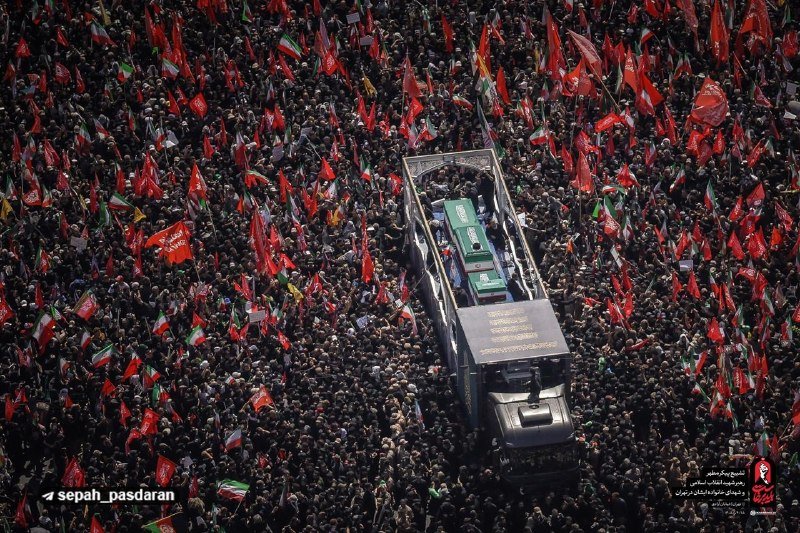
At 00:06 UTC on 4 July 2026, the English-language desk of Tasnim News pushed a short video clip onto its Telegram channel: the echo of Ashura recitation in a main mosque hall, pilgrims waiting to bid farewell to a martyred leader, the framing of a state camera rather than a worshipper's phone. Twenty minutes later the same channel announced the opening of a shrine's north and east doors, with the eastern side set aside for women and the western side for men. A third post at 00:27 UTC noted the crowd was growing "moment by moment." The hashtag #Badarqa_Aghai_Shahid_Iran tied the moment to a mourning calendar that has, for more than four decades, doubled as the rhythm of the Islamic Republic's public life.
The episode is small — a single shrine, a single night, a single newsroom with a clear editorial line. It is also a useful lens onto something larger: how the Iranian state and its allied media apparatus present Shia commemorative ritual to an outside audience, and how Western coverage of that ritual tends to flatten it. A staff look at Tasnim's overnight wire, set against what is actually known about Iran's mourning cycle, suggests the gap is wider than the geography would predict.
What Tasnim's overnight wire actually shows
Read the three Telegram posts together and the newsroom's priorities are legible. There is no editorial copy, no quote from a cleric, no policy context. The unit of information is a piece of moving image: doors opening, recitation echoing, the gendered geography of the shrine explained in two lines. The language of hashtags — #Badarqa_Aghai_Shahid_Iran, #must_rise — performs solidarity with the establishment line, and the call to action is implicit: share, amplify, attend.
Tasnim is not a neutral wire. It is the news agency of the Islamic Revolutionary Guard Corps, founded in 2012 to project the IRGC's worldview in multiple languages, and the English service exists principally to reach non-Iranian readers. Its coverage of religious commemorations is consistent in tone: the state as host, the shrine as stage, the people as participants in a collective drama that the regime choreographs. The fact that three posts in twenty-one minutes can carry a story of a shrine opening without naming the city, the date on the Iranian calendar, or the name of the martyred figure being commemorated tells you a great deal about who the wire thinks its audience is.
What the Western framing usually misses
Coverage of Ashura and the broader Muharram cycle in mainstream Western outlets tends to swing between two poles. The first is security: processions, self-flagellation, the question of whether the ritual produces or constrains street mobilisation. The second is sectarian geopolitics: Shia identity framed through the lens of the Saudi–Iranian rivalry, or through the long shadow of the Iran–Iraq war. Both framings are defensible. Neither is wrong. Neither, on its own, captures what Tasnim's overnight wire is actually doing.
The Muharram commemorations of Imam Husayn at Karbala are a foundational story in Shia Islam — a mourning cycle with its own grammar, its own public architecture, and its own political history inside Iran. Inside the Islamic Republic, the calendar has been woven into the state itself: the Supreme Leader delivers a televised address, state television clears its primetime schedule for live procession coverage, and official media frame the mourning as participation in a national, not just a religious, project. Tasnim's posts, with their hashtags and their state-eye camera angles, are a small instance of that larger choreography.
The state as broadcaster, the people as cast
The structural pattern is familiar from other systems where ritual and regime are fused. The media arm does not merely report the event; it stages the event for a camera, and then reports on what the camera has captured. The pilgrim who walks through the opened door becomes, in Tasnim's frame, a participant in a story that the agency has already written. The audience is invited to read the crowd as confirmation rather than as data.
This is not a uniquely Iranian phenomenon. State-aligned media in any system — the Saudi-owned pan-Arab networks during Hajj coverage, the Chinese state press during the annual plenary sessions, Russian state television on Victory Day — run a similar operation. But the Iranian version has a particular intensity because Shia mourning carries genuine popular weight, and the regime's claim to speak for the faithful is therefore a high-stakes one. A shrine opening is a small administrative event; Tasnim's three-post treatment of it is a small political one.
Why the framing gap matters
For a non-Iranian reader trying to understand what is happening in the country during Muharram, the choice of source has consequences. Reading Tasnim gives you the regime's intended frame: order, devotion, continuity, a state that hosts. Reading the Iranian opposition diaspora outlets gives you the inverse: repression, instrumentalisation, coercion dressed as faith. Reading Western wires gives you, often, a thin security overlay that misses both. None of these readings is complete on its own.
The honest editorial posture is to take Tasnim at face value for what it claims to be — the English-language projection of an IRGC-aligned newsroom with a clear ideological line — and to put it in the same sentence as the opposition press and the Western wire, letting the reader see the seams between them. What is striking about the 4 July posts is not that they exist; outlets of that kind exist in every system. What is striking is how little of the choreography they perform is visible to a reader who only sees the headline.
What the sources do not establish
The thread does not name the city, the shrine, or the specific historical figure being commemorated; the hashtag refers to a "Badarqa" and a "Shahid" (martyr), which can apply to multiple commemorations. The sources also do not establish crowd size, attendance figures, or whether the ceremony was open to non-Iranians. A more complete picture would require Tasnim's Persian service, independent reporting from inside the shrine, and ideally footage from pilgrims themselves rather than from the state camera. Until that broader sourcing exists, any account of what the 4 July opening actually meant on the ground is provisional.
This article was written in staff-writer voice, drawing solely on Tasnim's English-language Telegram wire for the night of 3–4 July 2026. Monexus treats Tasnim as a primary, openly ideological source — neither dismissed nor endorsed — and reads it alongside independent and Western-wire reporting wherever that reporting exists.
Wire provenance
This editorial synthesis draws on the following public wire/social posts:
- https://t.me/tasnimnews_en/1
- https://t.me/tasnimnews_en/2
- https://t.me/tasnimnews_en/3