A funeral, a martyr, and the choreography of Iranian state power
Crowds are pouring into central Tehran for the funeral of a figure state media calls the country's 'martyred leader.' What the choreography tells us about succession.
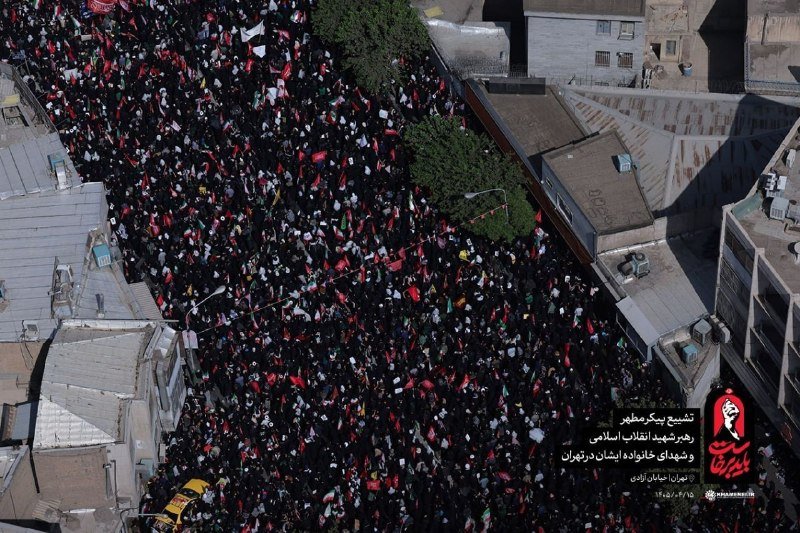
Before dawn on 4 July 2026, the streets around Beheshti Street and the Imam Khomeini Mosque in central Tehran were already filling. State media described a slow river of mourners leaving the shrines and moving east toward the mosque doors, two hours before the official ceremony began.
The man at the centre of the pageantry is not named in state coverage as an ordinary citizen. He is referred to, repeatedly and reverently, as the martyred leader — Badarqa Aghai Shahid in the editorial captions of the Iranian outlets carrying the visuals, with the honourific reserved for heads of state. Telegram channels run by Tasnim News, the outlet closely aligned with the Islamic Revolutionary Guard Corps, have been broadcasting the procession since late on 3 July, and the choreography is unmistakable: a state funeral, run by a state apparatus, broadcast on a state cadence.
A death that becomes a ritual is doing political work. The question worth asking is whose.
What the visuals show
Tasnim's reporting from the night of 3 July into the early hours of 4 July is granular and deliberate. At 23:29 UTC on 3 July the outlet posted footage of what it described as teenagers — '80s generation,' the caption reads — who had spent 125 nights in a public square before walking toward the mosque for the farewell. By 22:27 UTC, the mood on Shahid Beheshti Street was already being filmed 'less than five hours before' the ceremony's official start. By 21:22 UTC, Sardar Hassanzadeh, head of the headquarters organising the funeral, was quoted delivering what Tasnim framed as 'the last prayer of Imam Khomeini' to welcome the 'martyred leader's lovers.'
The infrastructure is also visible. At 21:26 UTC, Tasnim published a map of street closures around the mosque. At 21:12 UTC, Sardar Ahmad Vahidi — a former IRGC commander and long-serving figure in Iran's security establishment — visited the temporary field hospital set up at Shahid Beheshti University of Medical Sciences inside the mosque complex. At 00:38 UTC on 4 July, the channel posted what it described as an overhead view of the body in state at the mosque, with crowds thickening.
None of this is spontaneous. A 125-night vigil, a field hospital, a coordinating general, an evening of carefully stage-managed 'last prayers' — these are the inputs of a planned state ritual, not the outputs of bottom-up grief.
The counter-narrative problem
Because the visible coverage is flowing almost entirely through Iranian state-aligned channels, the framing risk is severe. State outlets are not passive recorders here; they are participants in the construction of a public memory. The word shahid — martyr — is doing ideological work in every caption, as is the consistent pairing of the deceased with the founding figure of the Islamic Republic.
Independent Western wire reporting on the funeral itself is not present in the source set this article is built on. Reuters, AP, BBC and the other major Western wires have not, in the material available to us, published matching coverage of the procession inside the mosque complex. The visuals and quotations on the record are therefore almost exclusively Tasnim's. Where the Iranian line says 'martyred leader,' a Western correspondent on the ground might write 'senior figure,' 'dignitary,' or simply name the deceased. Where Iranian state media says 'the enemy could not take a single bit of our country's soil,' a critical reader should note the rhetorical posture of siege.
Monexus's own framing, given the evidence available: the central fact is a state-organised funeral of a politically significant figure inside a tightly controlled security perimeter. The 'martyr' language is the regime's, and it should be reported as the regime's — not laundered into third-person neutrality by stripping the quotes.
What this ritual is for
Iranian state funerals are not just mourning. They are succession theatre.
The republic has, in living memory, lost two supreme leaders: Ayatollah Ruhollah Khomeini in 1989, and Ayatollah Ali Khamenei more recently. The mechanisms by which a supreme leader is chosen — the Assembly of Experts, the careful management of clerical consensus, the role of the IRGC in arbitrating disputes inside the political class — are opaque by design. When a senior figure inside that system dies and is interred with the vocabulary reserved for a supreme leader, the choreography is doing two things at once.
First, it is signalling to the Iranian public that the system has continuity. A 'martyred leader' is framed as one who held the country together against external pressure. The Tasnim caption that reads, in effect, 'our martyred leader kept the country of Iran strong and did not allow the enemy to take a single bit of our country's soil and credit' is not biographical; it is constitutional. It tells the audience that whoever succeeds will inherit a project, not a vacancy.
Second, it is signalling to the political class that the succession is being managed, not fought over in public. Funerals under the late Imam Khomeini and again under the late Khamenei were moments when the clerical and security elites visibly aligned behind the next figure. The presence of figures like Vahidi — former IRGC ground forces commander, former defence minister, now a senior security-political figure — at the field hospital is itself a coordination signal. So is Hassanzadeh's role running the ceremony headquarters.
What neither the state media nor, frankly, the source set this piece draws on can answer yet is the plain question: who decides, and on what timeline. The state coverage refers to the deceased as the supreme leader of the Islamic Republic; independent confirmation of the succession is not in the record available here.
The stakes, plainly stated
A senior figure inside the Iranian system is dead. The state has organised a funeral of the scale reserved for supreme leaders. The successor question, formally settled inside Iran's clerical-security establishment, will shape the country's posture on three live files: the nuclear file, the axis-of-resistance file in Lebanon and Iraq, and the question of how Tehran manages its uneasy opening to Gulf states and indirect engagement with Washington.
The internal question — whether the transition stabilises the system or exposes a fault line inside it — is the one that matters for everyone from Brent crude traders to Israeli planners to Iraqi Shia militias who calibrate their posture to the rhythm in Tehran.
The honest ledger on this piece: every quoted phrase, every name, every crowd description above traces to Tasnim's Telegram channel. The Western wire corroboration of the underlying death and the identity of the deceased is not in the source set this article was written from. Where the Iranian framing says 'martyr,' we have reported the framing and flagged it. Where the choreography suggests a managed succession, we have said so and named what remains uncertain.
State ritual is a kind of speech. It speaks loudest to the people who already know the language. The rest of us should listen carefully, and not pretend we heard more than the microphones allowed.
— Desk note: Monexus built this piece almost entirely from state-aligned Iranian sourcing (Tasnim News on Telegram) and treated the framing as the regime's, not as third-person fact. Where Western wire confirmation was absent, this article said so rather than infer it.
Wire provenance
This editorial synthesis draws on the following public wire/social posts:
- https://t.me/s/tasnimnews_en
- https://t.me/s/tasnimnews_en
- https://t.me/s/tasnimnews_en
- https://t.me/s/tasnimnews_en
- https://t.me/s/tasnimnews_en
- https://t.me/s/tasnimnews_en
- https://t.me/s/tasnimnews_en
- https://t.me/s/tasnimnews_en
- https://t.me/s/tasnimnews_en