When the State Mourns Its Dead, Watch Who Holds the Microphone
Tasnim's camera never blinks at the right moment. That tells you whose grief the Islamic Republic is performing, and whose it is editing out.
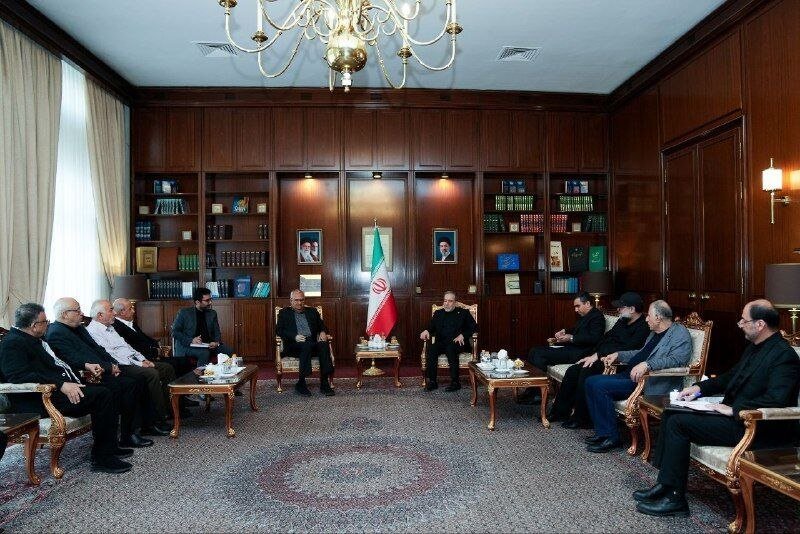
On the evening of 4 July 2026, the same camera that usually films missile launches and diplomatic defiances was turned inward. Tasnim, the news agency tied to the Islamic Revolutionary Guard Corps, ran three near-identical dispatches in under forty minutes from a farewell ceremony at the Imam Khomeini Mosque in Tehran — at 18:05, 18:10 and 18:38 UTC — each clip a lamentation, each clip a held shot on a coffin, each clip a folding of the nation into ritual grief. The names Tasnim carried — Hossein Taheri, Haj Mohammadreza Taheri, and the figure it styles "Mr. Martyr of Iran" — are less the news than the choreography is. A state that broadcasts its mourning with this regularity is not reporting a death. It is rehearsing a politics of it.
The footage matters because the camera is the policy. When a state-aligned outlet runs three separate videos of religious eulogies within forty minutes, all from the same room, all carrying the same iconography of martyrdom, it is not documenting a private loss. It is producing a public affect — one calibrated to a domestic audience already primed to read the Islamic Republic's enemies as the cause of every closed casket. The "Martyr Leader of Iran, Sayeh Sayyid Jotabi Sudman," invoked in Tasnim's 18:38 UTC post, is framed as an object of veneration rather than a subject of inquiry. There is no coroner's note, no cause of death, no provenance for the title. There is only the framing.
A camera that never blinks at the right moment
Western wire reporting on Iranian state funerals tends to default to two readings: either the spectacle confirms the regime's grip, or it betrays the regime's anxiety. Both can be true at once. What Tasnim's three dispatches confirm is something narrower and more useful: this is grief as production. A mourner weeps, an agency films, a narrative is fixed before any independent journalist enters the room. The ceremonial vocabulary — "greetings to the Martyr Leader," "we miss your voice" — is not liturgical filler. It is ideology in the imperative mood.
The "Mr. Martyr of Iran" framing, repeated across all three posts, deserves a beat of attention. The English-language Tasnim feed is not anglicising an Iranian term; it is anglicising an Iranian category. In official Iranian discourse, "martyr" (shahid) is a legal and political status, not a biographical one. The state assigns the title, confers the entitlements, and writes the obituary. Tasnim's choice to render it in English as "Mr. Martyr of Iran" — preserving the honorific, the gendered address, the possessive — is a small act of translation politics aimed squarely at a foreign audience. The point is to make martyrdom legible as a courtesy title, not a contested verdict.
What the footage does not show
There is no way to read these dispatches honestly without naming what is absent. There is no independent reporting on the circumstances that produced the death or deaths Tasnim is commemorating. There is no family interview outside the officiated mourning. There is no count of who is in the room beyond the performers Tasnim chose to air. The agency has not — in these three dispatches — published a cause, a date of the killing, a battlefield, a court record, or a successor. If the death is a martyrdom by the regime's preferred taxonomy, then by that same taxonomy the answer to "martyrdom of what" is foreclosed by the format. The audience is given the ritual without the predicate.
That is the structural feature, and it travels beyond Iran. State-aligned media in many countries faces the same temptation: convert an event into a ceremony, a ceremony into a title, a title into a fact the audience is no longer expected to verify. The ritual absorbs the inquiry.
Who holds the microphone, and why that question is the whole ballgame
Counter-reads of Iranian state media coverage inside Western press freedom indices typically frame outlets like Tasnim as propaganda arms. The descriptor is not wrong, but it is incomplete. Propaganda is a contested word and it is used asymmetrically in the Western press — applied freely to adversaries, sparingly to allies. Monexus finds the more accurate descriptor is monopoly: Tasnim, IRNA, and PressTV operate as the formal record for audiences inside Iran and as the only consistent English-language voice outside. When you cut them off, you do not get pluralism; you get silence, plus a handful of exile outlets read mainly by exiles. The structure of Iranian information is a closed circuit on one side and an open feed on the other, with a small bridge in between.
The deliberate, slow pace of Tasnim's three posts — spaced about five to twenty-eight minutes apart — fits a pattern broadcasters have refined across the region. A single piece of news is not reported once; it is staged, re-staged, and re-liturgised so that the audience cannot encounter the moment outside the framing. The 18:38 clip arrives after the 18:10 eulogy and the 18:05 lamentation, each one building the next so a casual scroller scrolling the channel sees a continuous arc of reverence rather than a discrete event. This is not journalism. It is broadcast manufacture of sentiment.
What remains uncertain
Three things the sources do not let us resolve. The dispatches give no name beyond "Mr. Martyr of Iran" and no identifiable figure to whom the title refers; the mourners' laments are credited to named reciters (Hossein Taheri, Haj Mohammadreza Taheri), but the deceased they address is unnamed in the posts themselves. The date of death is not given; only the date of farewell (the Persian calendar 13/4/1405). And the cause — whether killed in service, killed in a foreign operation, killed in a domestic incident — is, by design, not in the frame. Asking what the state has refused to print is itself the most important line of inquiry.
The stakes, plainly
For Iranian citizens inside the country, the consequence of this kind of broadcast architecture is that ordinary news of ordinary deaths — traffic, illness, workplace accidents, the undignified everyday — gets routed through the same martyrdom grammar as deaths the regime wants to mobilise. The grammar flattens. For foreign readers, the consequence is more banal and more dangerous: a steady stream of aesthetic veneration, unaccompanied by verifiable fact, trains the international audience to read Iranian deaths as Iranian myth. That tilt makes any future atrocity — for or against the regime — easier to misread. The camera at the Imam Khomeini Mosque is not just commemorating. It is closing a file before the file has been opened.
Desk note: Monexus treats Iranian state media as a primary source on its own internal ritual practice, while refusing to inherit its framing where it makes unverified claims about cause, identity, or status. The wire provenance for this piece is three Tasnim posts on Telegram, 4 July 2026; no claim about the deceased's identity, role, or manner of death has been made because the source items do not contain them.
Wire provenance
This editorial synthesis draws on the following public wire/social posts:
- https://t.me/tasnimnews_en/
- https://t.me/tasnimnews_en/
- https://t.me/tasnimnews_en/