Iran bids farewell to a slain 'martyr leader' as Tehran's streets fill before dawn
Crowds massed at Tehran's Mosalla from the early hours of 4 July 2026 for the public farewell to a figure Iranian state media calls a 'martyr leader,' killed alongside family members in an attack authorities are still attributing publicly.
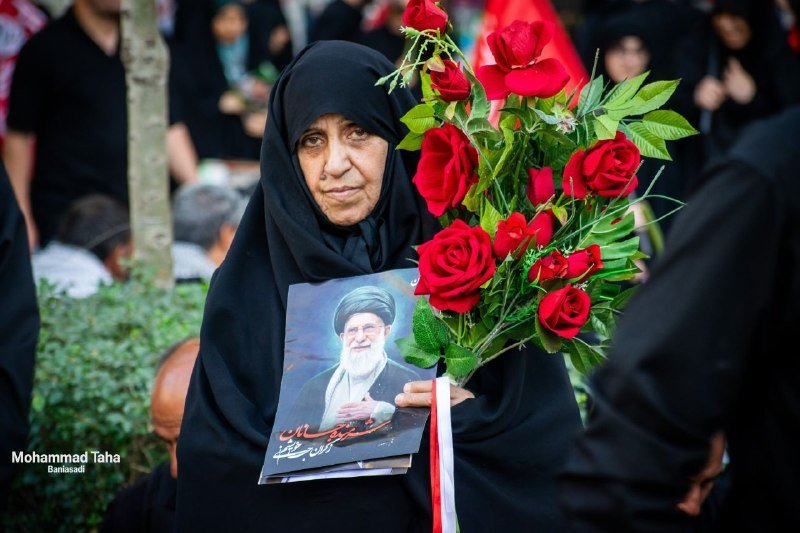
In the hours before dawn on 4 July 2026, several thousand people converged on the Mosalla — the great prayer hall complex in central Tehran — for what Iranian state media are calling a farewell to a "revolutionary martyr leader," killed alongside family members in an attack that authorities have, in the messages circulating overnight, framed as an assassination. Photographs and video published by Mehr News from roughly 02:30 UTC show the courtyard already filling; by 03:00 UTC the agency was reporting a "large" turnout; by 04:12 UTC the same outlet said the body of the slain leader and members of his family had been placed for public viewing inside the complex. The traffic around the surrounding streets had become thick enough by 03:53 UTC that the English-language service of Tasnim News used the word "magnificent" to describe the scene.
This publication finds that the ceremony is being staged as more than a funeral. It is the opening move in a domestic narrative the Iranian state intends to dominate for days: a slain insider, venerated as a martyr, mourned by a crowd the cameras will keep returning to. The scale of the turnout matters less as a measurement of public sentiment than as a measurement of state capacity — the ability to convene, to broadcast, to compress grief into a single, repeating image that Iranian outlets can put in front of domestic audiences before competing framings can take hold.
What state media is showing
Two agencies, Mehr News and Tasnim, are driving the coverage. Mehr — affiliated with the country's largest reformist newspaper of the same name but operating today in a tightly managed media environment — has issued the most consistent visual record: the body laid out, the courtyard filling, the close-up of mourners pressing toward the entrance. Tasnim, a news agency tied to the Islamic Revolutionary Guard Corps, has emphasised the size of the gathering and the geographic spread of the attendees, describing "lovers of the martyred leader" arriving from the early hours. The English-language Tasnim feed has been the most export-oriented of the two, with captions designed for an audience outside Iran.
There is one detail both outlets share and one detail both elide. They share the title — "martyr leader," "Mr. Shahid," the Persian honorific for a slain figure — and they share the choreography of the farewell, presented in near-identical sequence: empty streets in the first minutes, then a swelling crowd, then the formal placement of the body for viewing. The detail they elide is the man's name. In the items published overnight he remains "the martyred leader," a referent rather than a person, the kind of staging that Iranian state outlets use when a figure's full biography is about to be reassembled around his killing.
What the framing does
Calling a fallen political figure a shahid — a martyr — is not a rhetorical flourish in Iranian state vocabulary. It is a category with legal and political weight. It places the dead person inside a recognised lineage of sacrifice that runs from the Iran-Iraq war through the assassinated nuclear scientists and IRGC commanders of the 2010s to the Hezbollah and Iranian-axis figures killed in the regional exchanges of recent years. The state ceremony that follows the title — the public viewing, the procession, the eventual burial at a designated martyrs' site — is the same set of moves used for those predecessors.
Two consequences follow. The first is internal: the more fully the state controls the choreography of grief, the more fully it controls the meaning of the killing. The second is external: every Iranian state outlet's choice of imagery and vocabulary is also a signal to the wider regional and global news ecosystem, where the question of who benefits from the killing and who has the means to carry it out is, at this writing, openly contested. Western and Israeli outlets have not yet been able to report independently from inside Mosalla; the only large-volume footage in circulation as of 04:30 UTC is the footage state outlets chose to release.
Counter-reads and what remains uncertain
Three plausible readings of the night's coverage sit alongside the official one. The first is that the turnout is real and large, and that the state's vocabulary of martyrdom accurately captures a moment of genuine public grief. The second is that the turnout is partly mobilised — bused-in, organised, captured selectively by state cameras — and that the use of "magnificent scenes" is less an observation than a directive to other outlets about how the event should be described. The third is that the absence of a named individual in the public reporting is itself a story: either the state is protecting a family from immediate retaliation, or it is holding the name back to maximise the symbolic register of the moment before the more granular coverage begins.
The sources available overnight do not allow this publication to choose between those readings. They confirm only the visible facts: a public farewell at the Tehran Mosalla, in progress from approximately 02:30 UTC; large crowds; the body of the slain leader and family members placed for viewing; the framing of the deceased as a martyr; and the use of "Mr. Shahid" rather than a personal name. They do not specify the cause of death, the perpetrators, the size of the crowd, the identity of the family members, or any official Iranian institutional response beyond the ceremony itself.
Stakes
What is at stake in the next 48 hours is the narrative frame inside which the killing will be discussed, both inside Iran and outside. The state has chosen martyrdom as the lens. That choice will make it harder, not easier, for any domestic actor — including officials who might otherwise be willing to talk about operational failure — to question the version of events the cameras are building. Externally, the same vocabulary will harden the regional alignment around the killing: Iranian-aligned outlets in Iraq, Lebanon and Yemen already read Iranian state frames as their own, and the visual record from Tehran will move through those networks fast.
The reading this publication will be watching for is the one that arrives once the cameras leave the Mosalla. Funerals in Iran are the prelude; the policy and security consequences arrive after.
Desk note: Monexus's coverage leads with the wire imagery from Iranian state outlets as the only verifiable visual record in circulation at the time of writing, while flagging the editorial function that imagery serves. Where the framing of martyrdom is concerned, the piece reports the vocabulary Iranian outlets are using without endorsing or contesting it.