Khamenei's farewell and the inheritance question Iran's rulers cannot answer out loud
The funeral rituals in Tehran confirm a death. They do not confirm a plan. Monexus reads the optics of a regime rehearsing succession in public while refusing to name a successor.
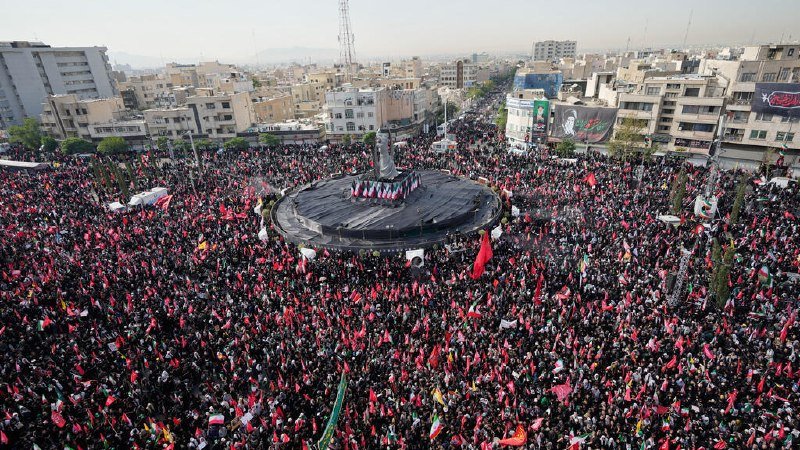
The body of Iran's Supreme Leader, Ayatollah Ali Khamenei, lay in state at Tehran's Imam Khomeini Mosque on 4 July 2026. State-aligned outlets broadcast the recitation of the Qur'an at the opening of the farewell ceremony; crowds chanted slogans of loyalty, including the pointed cry "Labik ya Seyyed Mojtaba," invoking the deceased leader's second son, Mojtaba Khamenei, by name. The choreography was unmistakable. So was what it did not contain: a public proclamation of who comes next.
Iran has lost the figure who held the system together for thirty-seven years. What it has not lost, at least not yet, is the institutional scaffolding that produced him. The order of succession in the Islamic Republic is decided, in normal times, behind closed doors by the Assembly of Experts — a body of eighty-eight clerics that in theory supervises, appoints, and in extreme cases dismisses the Supreme Leader. In practice the body has never dismissed one, and the deliberations that produced Khamenei in 1989 were among the most opaque in the republic's history. The country is now entering a moment that the constitution pretends is routine and that, in fact, it has no rehearsed script for.
The slogan is the message
The "Labik ya Seyyed Mojtaba" chants, captured by Al-Alam's Persian-language feed, are the giveaway. In Shia political vocabulary, "labik" is the pilgrim's response to a sacred summons. Directing it at a living cleric — and at one who is not the Supreme Leader and has not been formally designated as a candidate — is a political act dressed in devotional clothing. The crowd at the mosque was not merely mourning. It was auditioning.
The argument Mojtaba's allies are making is straightforward: hereditary succession would be a rupture with Khomeini's own theory of velayat-e faqih, the doctrine of clerical guardianship that underwrites the system. Khomeini's eldest son, Ahmad, was once floated and quietly dropped. A second son is a different proposition, and one that several factions inside the Islamic Republic have long favoured, including parts of the Islamic Revolutionary Guard Corps (IRGC) and the hardline paydari faction that has dominated the Majles in recent years. The slogans give that faction cover: if the people themselves are calling for Mojtaba, the Assembly of Experts can claim it is merely ratifying a popular verdict.
The counter-argument is also straightforward, and it comes from within the establishment. Senior clerics in Qom have long argued that the institution cannot survive being read as a monarchy with turbans. Mojtaba has none of the formal religious credentials of a marja, a senior source of emulation in Twelver Shia Islam, and elevating him would harden a fault line the system has spent four decades papering over: the gap between the revolutionary clergy and the seminaries. That fault line is not theoretical. It is the reason Hassan Khomeini, the founder's grandson, has spent years carefully distancing himself from factional politics while remaining a live symbolic alternative.
The empty chair the constitution cannot fill
The Islamic Republic's succession mechanism is designed to produce a consensus after the death, not a contest before it. That design is now a vulnerability. Three problems collide in real time.
First, the institution that is supposed to decide — the Assembly of Experts — last held a competitive election in 2024, and a meaningful number of seats were won by figures openly critical of Mojtaba and of the paydari hardliners. The body is not the rubber stamp it was in 1989. A contested vote inside it is now plausible in a way it was not under Khamenei's lifetime authority.
Second, the regional architecture Khamenei built is under simultaneous pressure. Hezbollah in Lebanon is weakened from the 2024-25 conflict with Israel and is rebuilding under sustained Israeli strikes. The Houthi position in Yemen has eroded; Syrian government forces lost power in Damascus in late 2024 and the new authorities in Damascus have tilted away from Tehran. The Iraqi Shia militias that were Iran's forward shield are operating in a tighter political space in Baghdad. The Supreme Leader's most consequential foreign-policy assets are not what they were two years ago. Whoever succeeds him inherits a thinner map.
Third, the economy is a domestic fact, not a foreign one, and it is grim. Inflation in rial terms, currency depreciation, water stress across the central plateau, and the long tail of sanctions have all worn down the social contract the 1979 settlement rested on. The 2022-23 protests were the largest since 1979; their memory is short inside the palace and long inside the streets. A succession that reads as a palace coup risks being the spark for a different kind of politics entirely.
What the Western wire line gets wrong
Western commentary on Iranian succession tends to slide into one of two registers. The first treats the succession as a horse race with a small field of named insiders, as if the outcome will be settled in a smoke-filled room and ratified in a Friday sermon. The second treats it as the prelude to regime collapse, with the IRGC either seizing the state or withering under sanctions, and the street sweeping the whole structure away. Both registers underestimate how much of the Islamic Republic's durability is institutional rather than personal.
The real picture is messier and slower. Khamenei did not run a personality cult; he ran a system of patronage, ideological licensing, and coercive redundancy. Each major institution — the IRGC, the Ministry of Intelligence, the judiciary, the state broadcasting apparatus, the bonyads or revolutionary foundations — has its own faction, its own foreign clients, and its own veto. A successful succession is one in which no single faction believes it has been cheated. That is a harder engineering problem than picking a name.
It is also why the funeral theatre matters. The slogans at the Imam Khomeini Mosque are not a coronation. They are a price-discovery mechanism. The crowd is being asked, in the language of mourning, whether Mojtaba's name is now politically usable. The answer being broadcast from Tehran is: yes, but carefully, and only as one option.
What to watch in the next thirty days
Three indicators will tell readers how the question is being settled. First, whether the Friday prayer leaders in Qom and Mashhad begin invoking Mojtaba by kunya (honorific title) in their sermons, or whether they conspicuously avoid it. The clerical class in those two cities is where doctrinal legitimacy is manufactured. Second, whether the IRGC's formal statement on the succession mentions "continuity" and "unity" in the same paragraph — the official code for a managed outcome — or whether it uses language that signals factional positioning. Third, whether the Assembly of Experts announces a convocation date for the selection meeting, and whether that date is weeks rather than months away; a long delay is itself a verdict, signalling that consensus has not been reached.
If those three indicators point toward a managed outcome, the system has a working succession. If one of them slips — if the seminaries publicly demur, or the IRGC publicly splits, or the Assembly cannot agree on a timetable — the funeral rituals we are watching now will be remembered as the last time the Islamic Republic looked like a single actor on its own stage.
Desk note: the wire frames this almost exclusively as a personality transition. Monexus reads it as an institutional stress test — the same event, the same calendar, a different question.
Wire provenance
This editorial synthesis draws on the following public wire/social posts:
- https://t.me/alalamfa
- https://t.me/alalamfa
- https://t.me/alalamfa
- https://t.me/Khamenei_arabi