Khamenei's farewell and the choreography of Iranian succession
Tens of thousands have converged on central Tehran as the Islamic Republic buries Ali Khamenei. The choreography on display is itself the news — and it points firmly at the son.
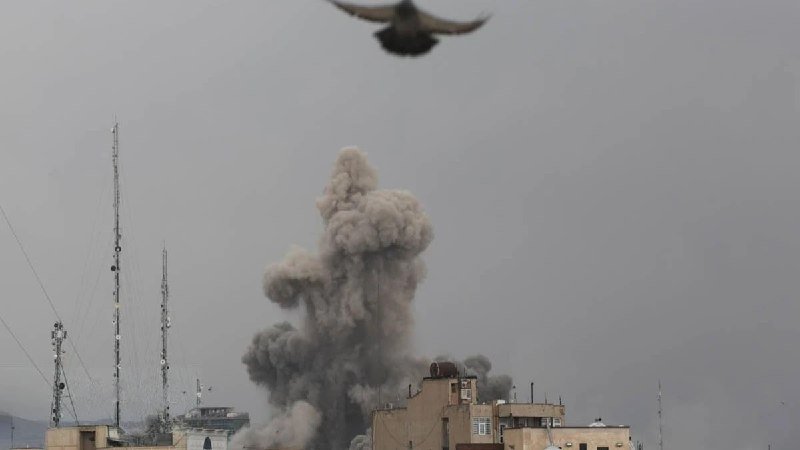
The farewell ceremony for Iran's late Supreme Leader Ali Khamenei stretched into a second day on 4 July 2026, with the venue at central Tehran's mosalla drawing an apparently high turnout under tight state choreography. The images released by Telegram channels including Clash Report and Middle East Spectator show a single, repeating motif: the name of the son.
The transition matters less for the personality at the centre than for what it tells observers about how power in the Islamic Republic now moves. The chants taped inside the mosalla — "To the Martyr of Iran, salute. In the shadow of Seyyed Mojtaba, we shall stand firm" and "We are all the avengers of the Father; obedient to the command of the Son" — are not crowd noise. They are positioning. Whoever wrote the slogans is signalling to the clerical corps, the Revolutionary Guards, and the foreign-policy establishment that Mojtaba Khamenei is the operationally settled heir before any formal conclave of the Assembly of Experts has ratified him.
What the choreography reveals
Public mourning in the Islamic Republic has long been choreographed, but the scale and the scripted vocabulary of these chants are unusual. The framing of the late leader as a "martyr" — a title normally reserved for those killed in the line of duty — is a deliberate theological lift. It places Ali Khamenei in the same register as General Qasem Soleimani, the IRGC commander killed in a US strike in January 2020. That equivalence is doing work: it tells audiences that the succession is not a managerial handover but a continuation of unfinished business, and that the martyr's unfinished business now lives in his son.
The sloganeering also pre-empts the institutional question that should, on paper, follow a Supreme Leader's death. Under Iran's 1979 constitution the Assembly of Experts — an elected body of clerics — names a new Supreme Leader. In practice, the contest is decided inside the Islamic Republic's parallel power structures: the office of the Supreme Leader itself, the IRGC's senior command, the judiciary, and the network of bonyads and state-linked foundations. The crowd at the mosalla is being used to launder an internal decision into a national verdict.
The counter-read, and why it strains
Western analysts who follow the succession question closely have tended to predict a slower, more contested process — a caretaker council, a competitive Experts' meeting, a possible role for senior clerics outside the Khamenei family. That read is not wrong about the formal procedure; it is wrong about who decides when the formal procedure matters.
The structural fact is that the Islamic Republic has, over four decades, hollowed out its own pluralist mechanisms. The 1989 constitutional amendment eliminated the post of Prime Minister and consolidated executive authority in the Supreme Leader's office; subsequent revisions to the Experts' selection process, and the long dominance of the office over the Guardian Council's appointments, have left the succession stage managed rather than deliberative. If the chants outside the mosalla read as a coronation, that is because the system has spent a generation converting its institutions into props.
A second, more cynical counter-read is that the entire display is a familiar theatrical export. Iran is experienced at scripting mourning for foreign cameras — the Soleimani funeral in January 2020 was the template. The dismissal is tempting and partly correct: image-management is part of how Tehran projects power. But it misses what is specific about 4 July 2026, which is that the audience for these chants is overwhelmingly domestic. The signals are aimed inward, at the IRGC officer corps and the clerical hierarchy in Qom, not at a Western wire desk.
The structural pattern
What this episode illustrates, more broadly, is how the Islamic Republic handles succession in an era when its deterrence posture depends on continuity. Iran's regional position rests on a tightly held decision-making loop in the Supreme Leader's office and the IRGC's Quds Force. A contested succession — the kind that produced Egypt's turmoil in 2011-12 or, in a very different register, the Soviet Union's endgame in 1991 — would expose that loop to factional capture at exactly the moment Tehran faces the Gaza endgame, ongoing exchanges with Israel, and a renewed standoff with the United States over the nuclear file.
The chosen successor has been groomed inside that loop. Mojtaba Khamenei's role has been informal but consistent: control over domestic political coordination, management of the late leader's office, and supervision of loyalist media. He is, in other words, the continuity candidate in a system whose entire regional doctrine assumes continuity. The sloganeers at the mosalla are not improvising. They are spelling out the political logic of the institution they serve.
What remains genuinely uncertain
Three things are still genuinely open. First, the constitutional question has not been closed: the Experts' formal meeting, the announcement of which has not been confirmed in the materials available to this publication, will set the legal floor for Mojtaba's authority. A rubber-stamp conclave and a contested one produce different legitimacies inside Iran and different expectations abroad. Second, the IRGC's senior command has not been heard from publicly on the question. Its silence is currently being read as acquiescence, but the guards' eventual posture will determine whether the succession is frictionless or merely managed. Third, the regional system — Hezbollah's weakened state after the 2024-25 war, the new Syrian order, the Houthi posture — will itself react to a Khamenei II, and that reaction is not knowable in advance from inside a Tehran mosalla.
The funeral imagery is therefore best read not as an answer but as the opening bid of a transition whose next moves will come from Qom, from IRGC headquarters, and from the closed rooms of the Experts — not from the chants.
This publication treats the mosalla footage as signalling, not as proof of an institutional outcome. The funeral choreography is what is verifiable; the constitutional sequence still has to run.
Wire provenance
This editorial synthesis draws on the following public wire/social posts:
- https://t.me/ClashReport
- https://t.me/Middle_East_Spectator