The farewell they orchestrated, and the question it cannot answer
Iranian state media is choreographing a single national mood around the death of Ali Khamenei. The harder question is what that performance is hiding about what comes next.
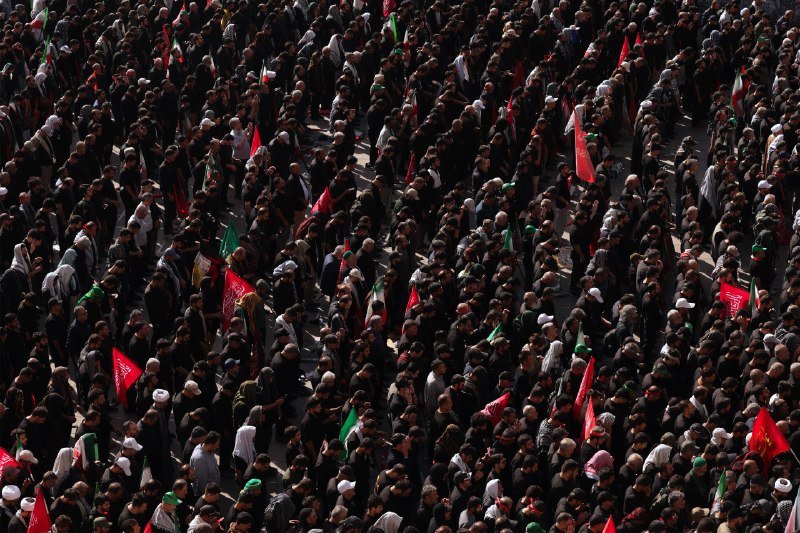
By 5:26 UTC on 4 July 2026, the podium at Imam Khomeini's mosque in Tehran was already dressed for a coronation. According to a Telegram channel affiliated with the office of Ali Khamenei himself, a single Qur'anic verse — "Say, 'I only admonish you with one thing: that you stand up for God, in pairs and singly'" (Saba, 46) — hung above the platform of a ceremony officially framed as the Iranian people's "farewell" to their Supreme Leader. The state news agency Tasnim, by 5:31 UTC, was already broadcasting the slogan "Labbayk ya Khamenei" echoing through the courtyard. By 6:24 UTC, mourners were chanting the same line under the hashtag #Badarqa_Aghai_Shahid_Iran — "to the shrine of the Mr. Martyr of Iran." By 6:34 UTC, a reciter was performing the opening verses of the Quran at the podium. By 6:57 UTC, a Bosnian woman at the ceremony was telling Tasnim that her nation's debt to Khamenei would persist "until the end of its life." By 7:17 UTC, the line "this is the last meeting" had entered the wire. None of this is accidental.
The performance is the point
What is being staged in the mosque courtyard is not a wake. It is a liturgy — a designed consensus written and produced by the same apparatus that, for thirty-seven years, has translated Khamenei's tenure into a story of divinely sanctioned guardianship. The sloganeering is curated, the foreign guests are cultivated, the verse on the wall is curated. The choreography tells the public mood rather than records it. Reading Tasnim's morning wire is not journalism in any conventional sense; it is the published libretto of a state funeral.
What the choreographers cannot say
That is the news. State-aligned media in Iran have always been assertive on such occasions, but the intensity of the staging — multilingual cameos, scripted slogans, a curated Qur'anic backdrop — is the tell. The louder the production, the louder the underlying uncertainty. A regime confident of uncontested succession does not need foreign devotees on camera to testify that the martyred leader was loved. The institutional question Tehran's political class is sitting with — and the one these ceremonies are designed to keep the public away from — is the one Iranian state media declines to ask on camera: what is the Velayat-e Faqih going to look like at 9 a.m. on the morning after, and by what procedure is the next Supreme Leader being selected?
Why the framing holds anyway
The dominant media frame inside Iran will hold because it is engineered to. Loyal outlets — Tasnim, IRNA, the Khamenei office's own Telegram channel — set the visual and verbal vocabulary. The slogans, the hashtags, the foreign guests performing grief, and the Qur'anic verse curated for the moment produce a coherent narrative: a nation in mourning, a leader sanctified, a continuity assured. Coverage inside Iran routinely defers to the language of official spokespeople. Dissent, where it exists, gets no microphones. Inside that closed media ecosystem, the frame does not need to win the argument. It only needs to be the only argument on the airwaves. Western wires covering the succession will be tempted to reproduce the sloganeering as reportage; that is a mistake. "Labbayk ya Khamenei" is a sentence in a script, not a finding about public sentiment.
What the structural frame actually is
In plain language: a theocratic system that vests supreme authority in a single cleric is facing its first handover in nearly four decades, and the institution that produces its own legitimacy is now the institution producing grief. That is the structural shape of the moment. The choreography in the mosque is the regime's attempt to launder a constitutional succession crisis through the vocabulary of martyrdom. When one faction of a ruling class can name a hashtag, deploy the reciters, and queue the foreign mourners, it is not persuading — it is performing monopoly.
Stakes — for Iran and for everyone watching
If the choreography holds, Tehran's regional posture survives intact: the network of allies built around the late Supreme Leader's patronage — the dossiers, the armed-client budgets, the theological authority — passes to a successor who can be presented as chosen by consensus. If the choreography cracks, the succession will be a contest conducted behind the same hashtags, and the contest will be visible in the very slogans that today sound unanimous. Either way, the rest of the region is watching. Iran does not have a deputy Supreme Leader, and the procedure for selecting one has historically taken the form it takes now: behind closed doors, in public costume. The costumes are expensive, and they tell you what the regime is afraid of.
What remains genuinely uncertain
The wire this morning tells us what the state wants us to know. It does not tell us who has been designated, what the Assembly of Experts will actually do, or which factions are aligned with whom. The foreign guests on camera are a clue, not a verdict. Until the regime itself names the successor and the dossier publishes in plain text, every Telegram post about "the last meeting" is a script, not a poll. Read them as such.
This article was first published under the Monexus opinion desk. The framing is editorial; the wire provenance for the claims above is laid out below.
Wire provenance
This editorial synthesis draws on the following public wire/social posts:
- https://t.me/tasnimnews_en
- https://t.me/Khamenei_arabi