Khamenei's funeral procession: the choreography of succession
Iran's new leaders are burying Ali Khamenei across five cities in Iran and Iraq — a logistical and political statement about who controls the story of his death.
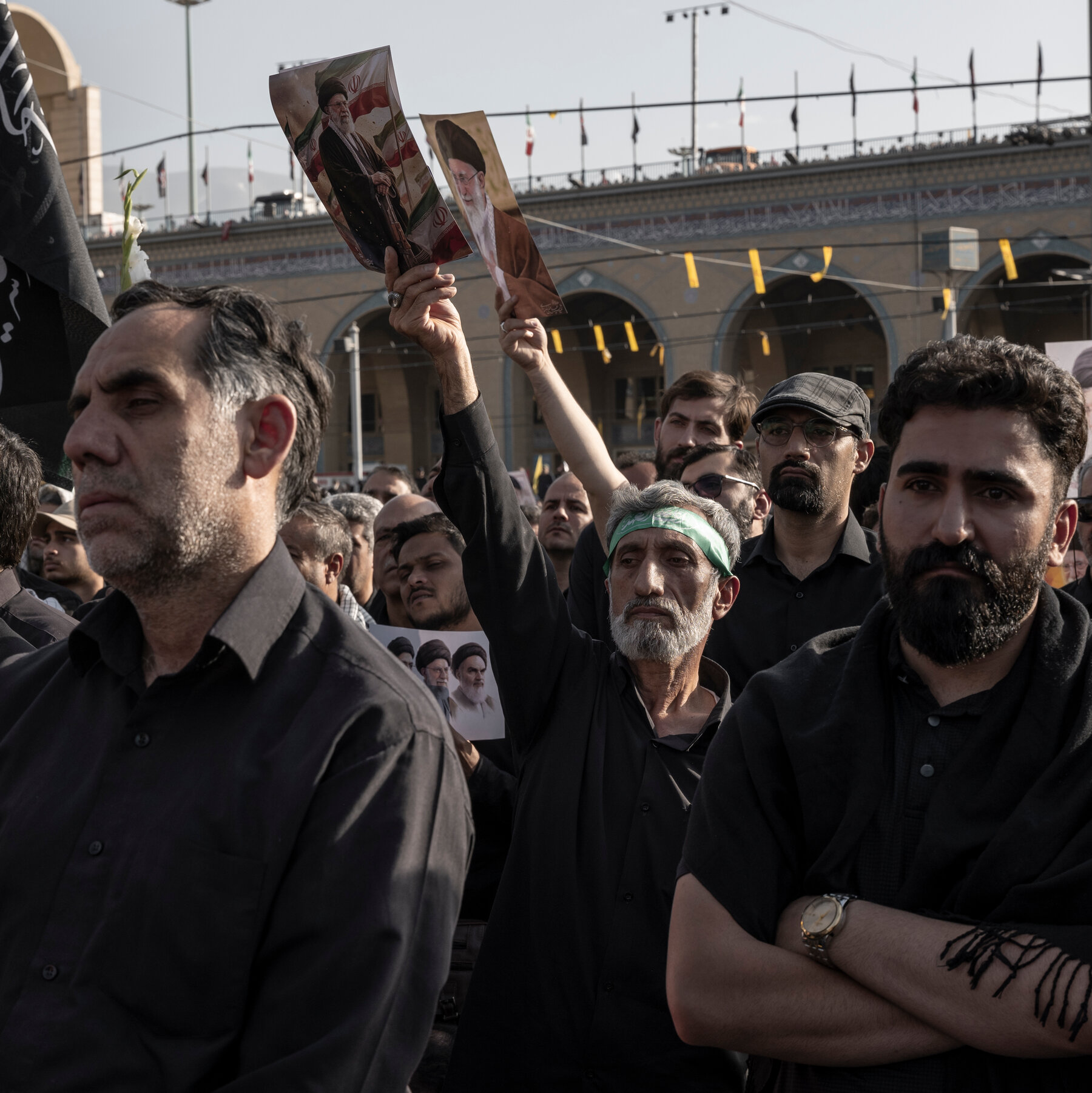
The body of Ayatollah Ali Khamenei is moving on Friday, 4 July 2026, along a five-city route through Iran and Iraq, in a funeral procession that Iran's new leadership has spent weeks choreographing. The scale is unusual — inter-state, multi-day, and built for cameras — but the more telling detail is which institutions are permitted to handle the rites, and which have been pushed to the margins of a country still at war.
What the public choreography conceals is a quiet but consequential succession. Khamenei was killed on the first day of the U.S.-Israeli war against Iran, according to reporting in The New York Times on 4 July 2026, and the men now speaking in his name are not his chosen heirs. The procession is therefore not only mourning. It is the visible half of a transfer of authority whose invisible half — courts, security organs, the bonyads, the IRGC command chain — is still being negotiated behind closed doors in Tehran and Qom.
A route that doubles as a border
A five-city itinerary that crosses into Iraq is, in this part of the world, a political document. It places Iranian clerics inside Iraqi holy cities — Najaf and Karbala are the implied destinations given the geography and the standard Shia commemorative pattern — under the protection of armed escorts and live television. The Iraqi government is consenting to be a stage. The signalling works in two directions: inward, to Iranians who need to see their dead leader honoured at the shrines; outward, to every capital watching whether Baghdad will continue to host Iranian religious traffic while Iranian territory is under bombardment.
The route also tells you who, in the new order, gets to ride. Reports from the Polymarket news wire at 15:57 UTC on 4 July 2026 list the procession as a five-city, two-country affair, with no detail yet on which officials accompany the casket in which leg. That silence is itself informative. The customary protocol — the Supreme Leader's representative in Iraq, senior clerics of the hawza, the head of the Organisation of Islamic Cooperation's Iran office — is unlikely to be intact. A wartime succession reads its seating chart out loud.
The framing fight over how he died
Western and Israeli coverage of the funeral has converged on a narrow storyline: the man who spent four decades funding regional proxies, sanctioning nuclear ambiguity, and presiding over the suppression of the 2022–23 protest wave has been removed by direct military action, and his successors are now scrambling to preserve the state he built. The funeral, in this telling, is a propaganda exercise designed to convert a violent death into a martyrdom narrative.
That reading is not wrong, but it is incomplete. Iranian state-aligned outlets have already begun the counter-frame — Khamenei as the victim of an unprovoked war, the procession as evidence of an unbowed nation, and the new leadership as the inheritors of a resistance project rather than the survivors of a decapitation strike. Both framings carry weight. The first describes the structural fact: the Supreme Leader is dead because two foreign powers decided he should be dead. The second describes the operational fact: the institutions he commanded are still largely intact, the regional network has not collapsed in the first weeks of war, and a five-city funeral is not the kind of ceremony a defunct state organises.
Who is actually in charge
The most consequential question — and the one the funeral choreography is designed to defer — is who now occupies the three posts that matter: Supreme Leader, commander of the IRGC, and head of the judiciary. Iran's constitution sets out a formal succession path through the Assembly of Experts, the Guardian Council, and a temporary council, but the constitution was written for a peacetime transfer in which the outgoing leader had years to position his replacement. Khamenei had hours.
Reports circulating in the immediate aftermath of his death, as cited in the NYT funeral coverage on 4 July 2026, suggest that operational command has consolidated around figures closely tied to the security services rather than the clerical establishment — a pattern visible in Iran's response to previous shocks, from the 1988 prison massacres to the suppression of the Mahsa Amini protests. If that reading holds, the funeral is performing unity for an audience that includes the Iranian street, the Iraqi Shia political class, Hezbollah's dwindling leadership in Beirut, and the Houthi command in Sanaa. Each audience needs a different Khamenei. The procession is the venue where all of those Khameneis are produced at once.
What the funeral does not settle
Five cities and two countries are not a verdict. They are a delay. The route will be broadcast, the grief will be visible, the martyrs' posters will be printed. None of that resolves the harder questions the war has forced on the Islamic Republic — whether the nuclear file is now reopened from a position of weakness, whether the regional axis survives its principal patron, whether a succession installed under bombardment can claim the legitimacy the previous one spent forty years accumulating. Those questions are not answered at a funeral. They are merely deferred until the cameras leave.
A Monexus desk note: The wire coverage of 4 July 2026 has so far emphasised the visual spectacle of the procession; this piece reads the route, the protocol, and the silence around the succession as the actual story.