Morocco dispatch Canada from the World Cup, and a co-host learns the cost of hosting
A 3-0 win in Houston ends Canada's tournament and sends Morocco into the last eight — the first co-host out, on a night that tested what it means to play the knockout stage at home.
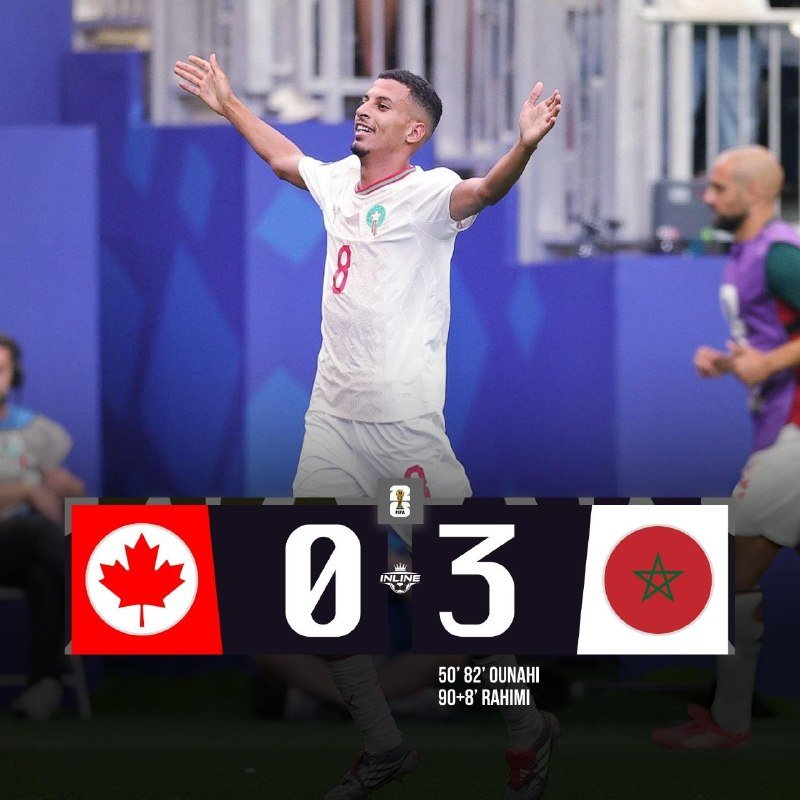
Hake-filled NRG Stadium fell quiet in the second half. By the time Azzedine Ounahi had added his second of three Moroccan goals in Houston, on 4 July 2026, the arithmetic was no longer complicated: co-host Canada were going out of their own World Cup, and they were going out thoroughly. The final was 3-0 to Morocco. Canada's tournament, the first in which Les Rouges had been anything more than a footnote, ended at the round-of-16 stage.
What the scoreline does not say — and what the next 48 hours of coverage will partly obscure — is that this was the expected result pretending to be a shock. Morocco arrived as the highest-ranked African side at the tournament and the only CAF representative to clear the group stage. Canada arrived as the more fragile of the three co-hosts: a young team playing in a confederation that had not produced a knockout-round winner since the United States in 2002. The gap on the pitch was not enormous. The gap on the scoreboard, in the end, was.
How the game turned
The first half was scoreless and, by Canada's accounting, winnable. Jesse Marsch's side had spells of possession and forced the issue without forcing a save that mattered. The match was still goalless at half-time — and that is the version of the contest that Marsch would carry into his post-match remarks. "I'd rather be us than them," the Canada head coach said, in remarks reported on 4 July at 22:10 UTC. The line reads better in the original than it does as analysis. It is the language of a manager asking his squad, and a host public, to keep faith.
The second half belonged to Morocco, and to Ounahi. The midfielder broke the deadlock early in the period, with the goal confirmed by the BBC at 19:04 UTC. Two more followed. By 20:03 UTC, Al Jazeera's breaking-news desk had the lead: "Ounahi fires Morocco into World Cup quarterfinals with 3-0 win over Canada." The tempo of the reporting — goal, then two more, then the line-item summary inside an hour — is itself a story. When a co-host loses to a non-European, non-South American side in the round of 16, the wire desks do not pause to file colour.
The co-host frame
Canada is the first of the 2026 hosts — the United States, Mexico and Canada — to be eliminated. That fact deserves more weight than it is likely to receive in the next news cycle. Hosting privileges in this tournament were sold to a domestic audience as a competitive advantage: more matches in Canadian cities, a deeper squad rotation through domestic fixtures, the assumed benefit of familiar conditions and crowd support. None of that converts into goals once the knockout round begins. Mexico and the United States will draw their own lessons from Houston before they play their next elimination game.
There is a separate, less flattering frame that the Canadian performance invites, and that some of the pre-match coverage had already begun to sketch. CBS Sports' Round-of-16 preview, filed earlier on 4 July, ran Morocco as a comfortable favourite against a Canadian side the model pegged as a long shot to advance. The 25-15 expert record on those picks is a small-sample boast; the directional call was not. When the lines and the result agree, the analytics desk does not get to claim it was brave.
What Morocco actually won
Strip the co-host story out and Morocco's run is genuinely significant. They are into a second consecutive World Cup quarter-final — they reached the same stage in Qatar 2022 — and they are the standard-bearer for an African contingent whose group-stage depth, with Ghana, Senegal, Egypt, Cameroon and Morocco all in the field, was the deepest the continent had sent to a single tournament. Australia's meeting with Egypt on 3 July, also covered on the CBS Sports betting line, was the other CAF-versus-upset-relevant fixture in this window; Egypt exited there.
That gives Morocco a particular standing going into the last eight. They are not a surprise package. They are a programme — one that learned, in 2022, what a quarter-final costs and what it teaches. Whether Walid Regragui's side can take the next step depends on a draw that has not, as of this filing, fully resolved.
The stakes, off the pitch
For Canada, the bill comes due quietly. A second successive World Cup qualification was always the realistic ceiling for this squad; the actual tournament has confirmed it. Marsch's framing — that the side competed, that the dressing room is intact, that the gap to a quarter-finalist is narrower than the scoreline — will hold up in the immediate aftermath. It will not hold up if Les Rouges fail to qualify for 2030. Hosting a tournament is a stimulus; it is not, on its own, a foundation.
For the tournament as a whole, the more interesting question is what Canada's exit does to the gate. Three co-hosts means three national storylines run by three different broadcast ecosystems. One co-host down before the quarter-finals reduces the Canadian broadcast narrative to supporting cast, and shifts more of the marketing weight south. FIFA and its commercial partners will not say so publicly. The fixture list already has.
What we do not yet know
Several things remain uncertain in the immediate aftermath. The exact composition of the Morocco goal sequence — who assisted, the minute-by-minute — will firm up over the next 24 hours as advanced-stats feeds publish. The quarter-final pairing, and therefore a measure of how seriously to take Morocco's run, is not yet set. And the wider read of Canada's tournament will partly turn on how Mexico and the United States fare in their own round-of-16 ties: a single co-host exit reads one way; a sweep reads another. The wire coverage, as of 22:10 UTC on 4 July 2026, has not yet had time to settle the question.
Desk note: Monexus led with the wire confirmation of the result — BBC Sport and Al Jazeera's breaking-news line — rather than the manager's post-match framing. The latter is a fair comment to publish; it is not, on its own, the news.