Bulletproof nuptials at MSG: a $20m spectacle that says more about the security state than the bride
Taylor Swift and Travis Kelce reportedly tied the knot inside Madison Square Garden on 3 July 2026 under what witnesses call military-grade security — a private ceremony priced north of $20m, and a useful lens on the new American spectacle.
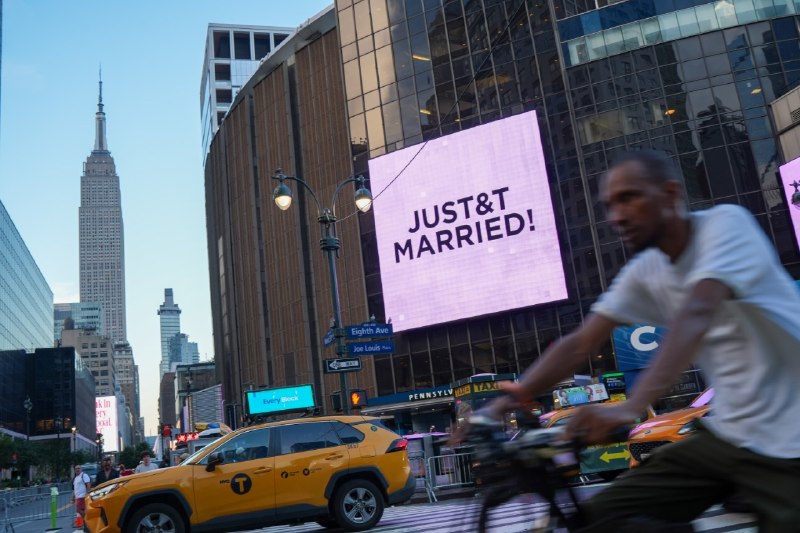
The bride and groom are Taylor Swift and Travis Kelce, the venue is Madison Square Garden, and the date is 3 July 2026. According to a 10:04 UTC report from El País on 4 July, the couple chose the world's most famous arena for a private wedding described in initial dispatches as a "secured" ceremony held inside what the coverage characterises as a bulletproof enclosure. Spanish-language coverage of the event reached global wires within hours, and prediction-market accounts on X confirmed the basic facts — marriage at MSG — by 23:55 UTC on 3 July.
The thesis this publication is willing to defend: when two of America's most surveilled celebrities marry inside a militarised perimeter, the wedding is no longer a private event. It is a small, well-lit case study in how wealth, attention, and the security industry now co-produce the rituals of public life.
What we actually know, hour by hour
The timeline is unusually clean. At 01:31 UTC on 3 July, prediction-market accounts on X reported "military-level security" being deployed around Madison Square Garden ahead of the ceremony, language that pre-set the frame for every dispatch that followed. By 20:27 UTC, a Forbes estimate circulating on the same channel put the cost of the event at "more than $20 million." At 22:14 UTC, the same feed added that the bride was "reportedly" planning to perform music at her own reception. Just over an hour later, the marriage itself was declared official. El País's morning-after write-up on 4 July supplied the venue specificity and the security framing that the market chatter had been gesturing toward all night.
That ordering matters. The security perimeter was reported first, the price tag second, the entertainment third, and the marriage last. Read in that sequence, the story is not really about the wedding. It is about the apparatus surrounding it.
The counter-narrative the wires won't write
The dominant framing treats the spectacle as a human-interest confection: two famous people, a famous building, a famous amount of money. That framing is convenient because it allows the press to publish photographs of the perimeter, the gowns, and the guest list without asking the obvious question — why does a wedding require a military-grade envelope in midtown Manhattan in the first place?
A more honest read is that the security apparatus is the point. The bulletproof framing, the perimeter, the cost — these are the legible artefacts of an attention economy in which the boundary between celebrity and state has thinned to the point of transparency. When a private ceremony requires the kind of cordon previously reserved for heads of state at the UN General Assembly, the cordon has become the ceremony.
The structural frame, in plain language
Three forces are colliding at Madison Square Garden. First, the financialisation of fame: a wedding is now a media property, and media properties require insured, securitised production. Second, the professionalisation of celebrity protection: the line between private security contractors and public law enforcement has been blurring for two decades, and events like this are where the contract becomes indistinguishable from the institution. Third, the normalisation of spectacle as a civic good — the assumption that a publicly visible, privately funded ritual somehow performs a service for the audience that watches it.
None of this is new in isolation. What is new is the willingness of mainstream coverage to treat the apparatus as scenery rather than as a story.
Stakes
If the frame is right, the implications are larger than pop culture. Every city that hosts a comparable event inherits the security footprint, the traffic closure, and the precedent. The costs — fiscal, civic, and atmospheric — are diffused across a public that had no vote on whether to hold the ceremony at all. The winners are the contractors, the venue, and the platforms that monetise the coverage. The losers are the surrounding blocks, the press freedom of photographers working outside the cordon, and the larger norm that weddings are not state occasions.
The remaining uncertainty is significant. The Spanish-language wire describes the security arrangements but does not specify which agency or contractor is responsible. The $20m Forbes figure is an estimate, not a budget, and the prediction-market chatter that popularised it carries no editorial weight on its own. Even the venue characterisation — a "secured wedding" held inside a venue that itself was described as a target-rich environment by every counter-terror bulletin of the past decade — rests on a small number of reports that have not been independently verified.
What can be said with confidence is that the timeline has been set, the perimeter has been built, and the photographs will be studied for years. The marriage itself, on the evidence available, lasted about as long as any other. Everything around it will outlast the ceremony by an order of magnitude — and that, more than the bride's dress, is the story.
How this publication framed it: where the wire treated the wedding as a closing feel-good item, Monexus treated the perimeter as the lead — and let the marriage follow.
Wire provenance
This editorial synthesis draws on the following public wire/social posts:
- https://t.me/elpais