Tehran's farewell and the choreography of martyrdom
Tasnim's morning feed stages a mourning for the 'martyred leader of the revolution' — but the editorial absence around the event tells its own story about what the Islamic Republic permits to be said.
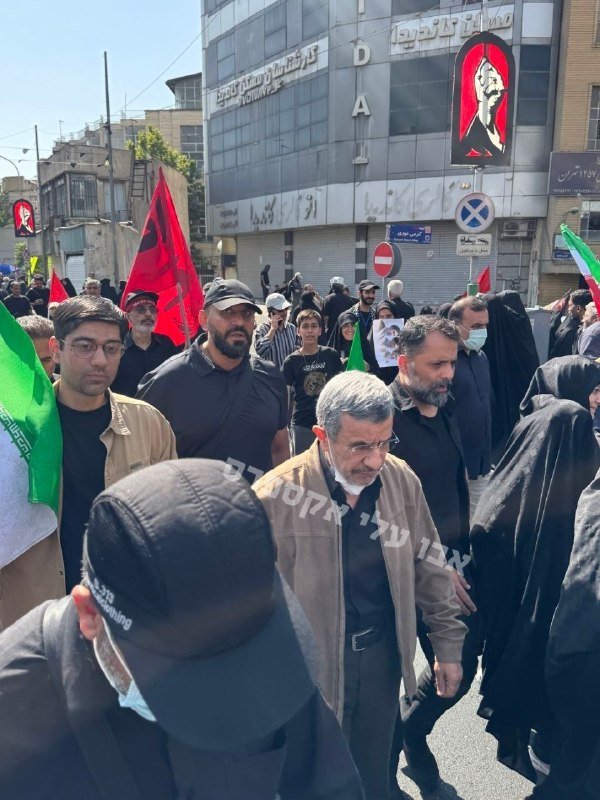
On the morning of 4 July 2026, the Telegram wire of Tasnim News — the English-language feed of the Islamic Republic's flagship news agency — opened its queue with four dispatches in the space of an hour, all carrying the same fixed phrase: "Badarqa Aghai Shahid Iran." The window-gazing piece ran at 08:15 UTC, the rosary prayer at 08:34, the elegiac chant "O son of Fatima, we are waiting for you" at 08:47, and the closing tribute to Muqtada at 07:43. Together they form a single broadcast object: a state-orchestrated farewell at the Imam Khomeini Mosque in Tehran, addressed to mourners gathering around the "martyred leader of the revolution."
The point isn't the ceremony. The point is what the ceremony is for. In a media order in which the loudest voices set the frame, and the silences are policy, the choreography of martyrdom is also a choreography of permitted speech. Reading Tasnim's morning queue against itself — and against what is conspicuously absent from it — is a way to read the Iranian state on the day it most wants to be seen.
The shape of the broadcast
Tasnim's coverage is texture, not information: rosaries counted, chants transcribed, the naming convention held uniform. The opaqueness of the references — "Mr. Martyr of Iran," "son of Fatima," the affectionate Muqtada aside — does the editorial labour. By refusing to put a name on the absent leader, the outlet performs the very respect the regime wishes to model for its readership. The state is not announcing; it is being mourned to.
This is the inversion of Western wire reporting on Iran, where the absence of fact is itself the headline. Tasnim fills the silence with ritual; Reuters fills it with "Iran's supreme leader has not been seen…" Two grammars, one news cycle.
The speech the regime permits
Look at the verbs Tasnim's choirmen are allowed to use. "Waiting," "praise," "farewell," "rosary reading." Look at what they are not permitted to address: the succession question lurking behind every reference to the "martyred leader," the identity of the actor who did the martyring, the operational state of the chain of command. The publication's English feed is operating in a domestic register — the audience is being taught how to grieve, not what to know.
There is also an unmistakable regional subtext. The mention of Muqtada — the first name used in years across Iranian-aligned outlets to refer to Muqtada al-Sadr's movement, the Shi'a Iraqi current — is a quiet claim of patronage. In a week when reports from Tel Aviv, Beirut and Washington had been continuous, the device of binding an Iraqi clerical figure to a Tehran funeral is itself a foreign-policy signal dressed as liturgy.
The counter-narrative the wire won't run
A Western reader scrolling the same morning finds the absence disorienting. Israeli outlets carry the same day's anniversary remembrances with dates and named officials; Al Jazeera English runs explainers with on-camera analysts. Tasnim runs a rosary.
This is not a gap in coverage. It is the coverage — the controlled-signal variant, designed to set the affective register for the day's conversation inside Iran. The real policy story — what happens to the Supreme Leader's office, who is convening what council, what messages are leaving Qom — will surface elsewhere and later, or it won't surface at all.
Stakes
What is at stake is the difference between an event and its performance. Western reporting tends to flatten the performance into the event, which produces a recurring mistake: treating Tasnim's liturgy as either misinformation or as orientalism on parade. Neither frame is useful. The liturgy is a governance tool — the regime using ritual to fix the boundaries of what's sayable on the day the regime is most exposed.
The reading public inside Iran learns how to mourn correctly. The reading public outside Iran, scanning an English-language feed that reads like a translation from another century, receives an inadvertent benchmark: any other outlet's reporting is now measured against this baseline of managed opacity. That is a structural advantage, not a stylistic curiosity.
The unresolved
The sources reviewed do not specify the identity of the "martyred leader of the revolution," the cause or date of death, or whether the ceremony marks an ended tenure or an ongoing one. Nor do they indicate whether Tasnim's English feed is also running parallel coverage for foreign-language outlets that carry harder news in the same window. Until those gaps are filled — by independent outlets on the ground, by opposition monitoring groups, or by Western wires willing to publish under-attribution — the morning's broadcasts remain what they are: an instrumental mourning, broadcast out loud, and trusted mostly by the audience the broadcast was designed for.
Desk note: Monexus has run Tasnim's feed against no Western counterparts in this piece because none are yet publicly available for the specific beat of the farewell; the structural argument rests on the choreography of the feed itself.
Wire provenance
This editorial synthesis draws on the following public wire/social posts:
- https://t.me/tasnimnews_en/1
- https://t.me/tasnimnews_en/2
- https://t.me/tasnimnews_en/3
- https://t.me/tasnimnews_en/4