Tehran turns a funeral into a foreign-policy stage
The farewell in Tehran for a slain educator was framed by state media as a transnational gathering of the faithful — a reminder that Iranian official narrative still treats domestic mourning as soft-power projection.
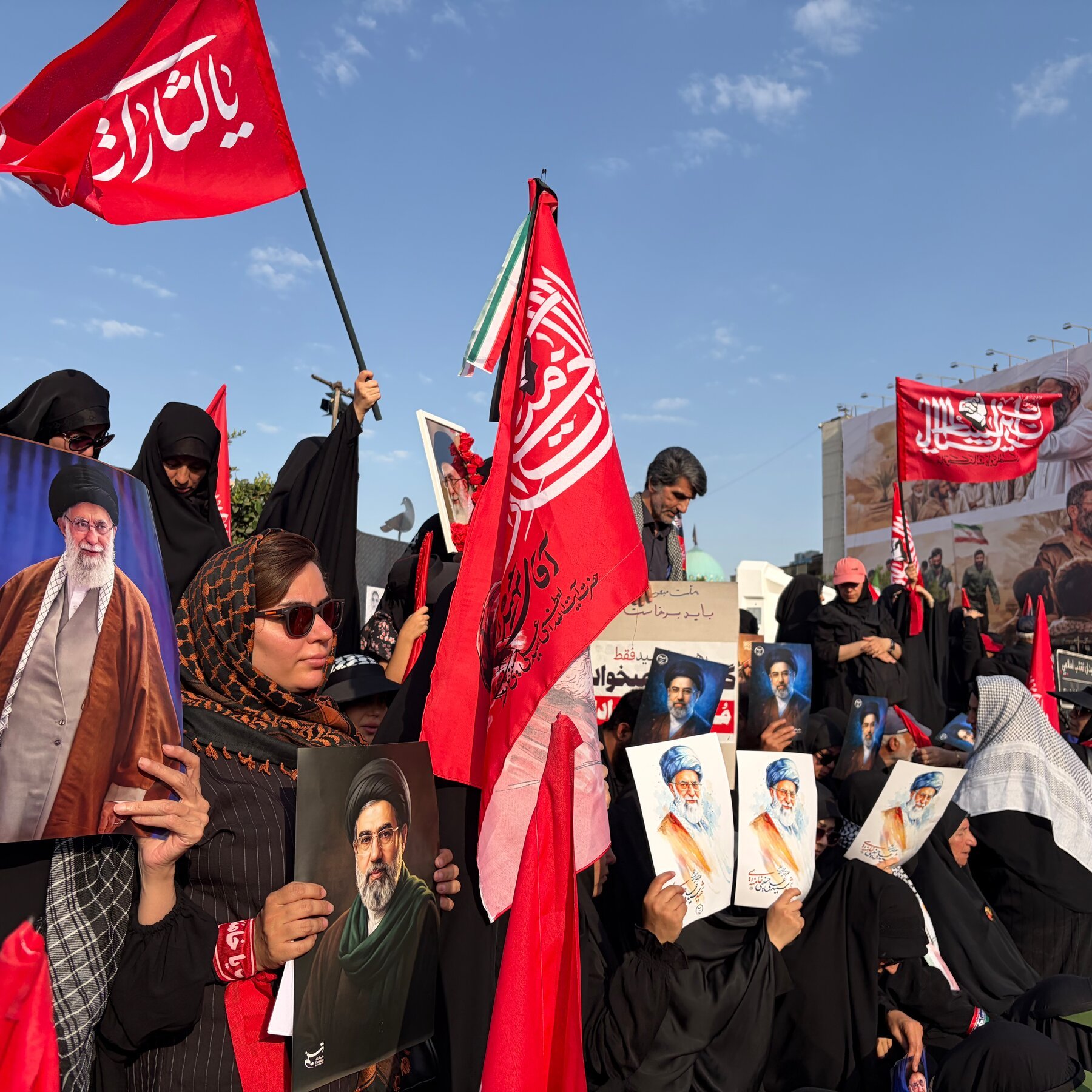
On the afternoon of 4 July 2026, the state-affiliated Tasnim News wire ran three Telegram dispatches inside the same hour describing a farewell ceremony in Tehran for Zahra Haddad Adel, identified by the agency as a teacher, daughter-in-law of the "Martyr of the Revolution's Leader," and wife of a figure Tasnim calls the "Martyr of the Supreme Leader of the Revolution." The first post, at 17:34 UTC, announced the ceremony itself; a second at 16:16 UTC carried a quoted line from the late "Leader of Martyr of the Revolution" — "My greatest wish and honor is to sacrifice my life in this proud and glorious way" — dated in the Iranian calendar to 21 Ordibehesht 1378; the third, at 15:46 UTC, framed the event as transnational, noting that "a group of admirers of the Martyr of the Revolutionary Leader from Turkey arrived in Tehran to participate in the farewell ceremony." None of the three messages names a place of death, a date of death, or a perpetrator. The story Tasnim is telling is not really about Mrs. Haddad Adel. It is about who is allowed to grieve her publicly, and from which foreign capital.
What makes the trio of dispatches worth reading closely is the layering. Tasnim is using an opaque domestic tragedy to project three things at once: the continuity of a martyrological vocabulary tied to the revolution's founding generation, the continuing geopolitical relevance of that vocabulary across a Muslim-majority neighbour, and the regime's capacity to choreograph foreign presence on Iranian soil. The Turkish angle is doing the most work. Naming Turkish journalists and admirers as attendees converts a private family rite into a piece of regional signalling — Ankara's pilgrims photographed in Tehran.
There is a domestic-language register here that Western wires rarely transcribe. The phrases "Martyr of the Supreme Leader of the Revolution" and "Leader of Martyr of the Revolution" are not interchangeable honorifics. In Tasnim's house style, the first denotes an office held at the apex of the Islamic Republic's institutional structure; the second denotes a senior figure of the revolutionary movement whose tenure as that office's head has ended in death. Tasnim is making sure the foreign reader — and the foreign pilgrim — hears both registers in a single afternoon. The Turkish framing, with its invocation of "admirers," recasts the relationship between Tehran and Ankara as one of shared reverence rather than rivalry. That is a soft-power claim, not a factual one.
A counter-reading is available and ought to be aired. The same wire that gives the ceremony transnational reach is also the wire that does not publish casualty counts, investigative reporting on internal security incidents, or independent obituaries. The framing above should be read alongside the well-documented structural fact that state-aligned outlets in Iran operate as messaging instruments: casualty lists are issued by the Ministry of Intelligence when issued at all, and domestic tragedies involving security personnel are typically released only after the political utility of the disclosure has been settled. On that read, the Turkish arrival in Tehran is not evidence of an Ankara-Tehran rapprochement but of a managed, partial opening of consular or cultural contact — the kind that produces photo opportunities but not treaties. Both readings are consistent with the evidence at hand; the wires do not yet let a reader choose between them on facts alone.
What is genuinely new, structurally, is the speed. Three posts inside 90 minutes, in two languages (Persian headline and English explanatory caption), on a Telegram channel that is itself an arm of the Islamic Revolutionary Guard Corps's media ecosystem, is the kind of throughput that a generation ago would have required a state-television evening bulletin. Telegram, for state-aligned outlets from Tehran to Caracas to Moscow, has become the cheapest possible simulcast apparatus: a way to put the same framing in front of a domestic Persian audience, an English-reading diplomatic audience, and a regional neighbour's press corps within a single news cycle. The medium is part of the message.
The stakes are modest but real. If the framing holds — a regional pilgrimage, a martyrdom narrative intact, an Ankara that can be credibly photographed at a Tehran ceremony — then Tehran's room for manoeuvre on cross-border Shia-movement diplomacy widens slightly without any signed document. If the framing cracks — if the underlying killing turns out, as it sometimes does in Iranian security incidents, to involve a factional settling of scores inside the security services — then the same Telegram posts will be cited later as evidence of state media overreach. For now, the dominant reading holds, and it is the dominant reading the Iranian state is paying Tasnim to publish. Western readers who see only the English captions should be aware that the captions are the thinnest part of the product.
Desk note: Monexus has reported the ceremony through the lens of how Tasnim chose to package it, rather than the underlying event, because the underlying event — place, date, and perpetrator of Mrs. Haddad Adel's death — is not on the public record in the source material we were able to verify by 18:00 UTC on 4 July 2026.
Wire provenance
This editorial synthesis draws on the following public wire/social posts:
- https://t.me/s/tasnimnews_en
- https://t.me/s/tasnimnews_en
- https://t.me/s/tasnimnews_en