Tehran's Farewell as Foreign Policy: How a Funeral Becomes a Spectacle of Resistance
Iran's state-aligned coverage of the Imam Khomeini mosque farewell turns ritual mourning into a choreographed address to enemies — and a signal of what comes next for Tehran.
Lead
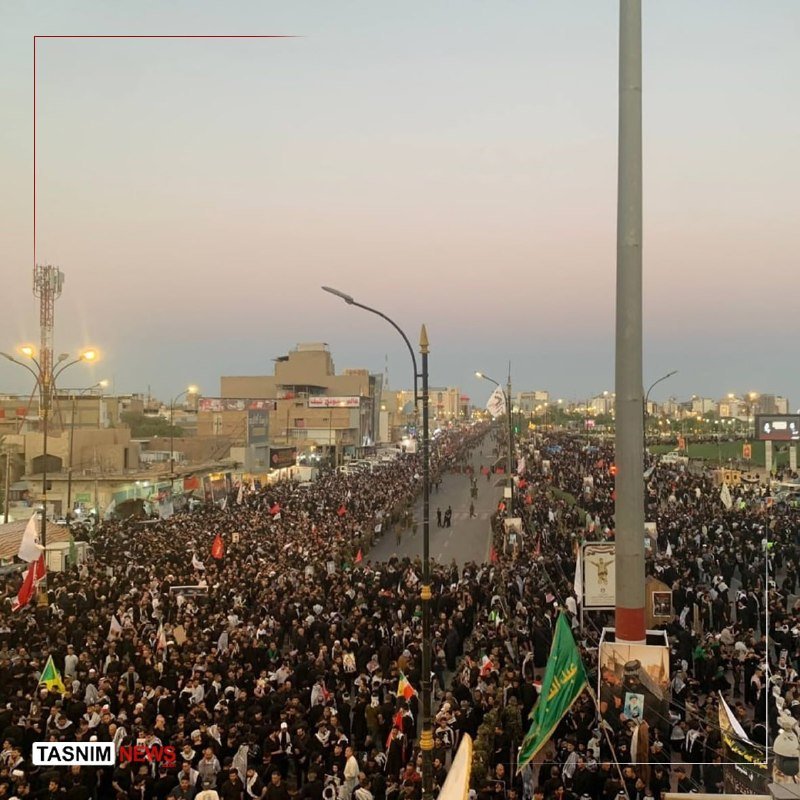
Between midnight and dawn on 4 July 2026, the courtyard of Imam Khomeini's mosque in central Tehran filled with women mourning, teenage volunteers who had camped in city squares for 125 nights, and the morning call to prayer broadcast two hours before the scheduled farewell ceremony for Iran's killed leader. State-aligned outlet Tasnim News transmitted each beat in near-real time — the slogans of "death to America" and "death to Israel," the calligraphic banners, the lanterns carried by teens born in the 1980s — turning a funeral into a sustained piece of political theatre, and revealing how Tehran communicates to its adversaries when its official channels are otherwise closed.
The claim
What looked, at first glance, like grief was operationally a press event. Tasnim's overnight dispatches placed a uniform message — that the martyred leader "kept the country of Iran strong and did not allow the enemy to take a single bit of our country's soil and credit" — into a frame choreographed around the mosque itself. The choice of venue mattered: Imam Khomeini's mausoleum complex is the symbolic pivot of the 1979 revolution, and the slogans were designed to be seen by foreign camera crews as much as by the mourners physically present.
What Tasnim actually broadcast
In a span of roughly four hours, Tasnim posted at least five discrete visual updates from the ceremony preparations. At 21:54 UTC on 3 July, it carried the framing line that the martyred leader "did not allow the enemy to take a single bit of our country's soil and credit." By 23:29 UTC, it transmitted footage of "80s teenagers" — its phrasing — who, after 125 nights in public squares, walked in procession toward the great mosque of Imam Khomeini. At 23:51 UTC, the outlet relayed the dawn call to prayer from the same mosque, marked as two hours before the start of the farewell ceremony for the martyred leader. By 00:55 UTC on 4 July, it posted video of a woman reciting in the courtyard; by 01:26 UTC, it transmitted what it described as "resounding slogans of death to America and death to Israel" rising from inside the mosque as daylight broke.
The editorial sequence is itself the story. From abstract tribute to physical procession to audio to chants, the broadcast escalated in volume and foreign-policy content as the ceremony approached — a deliberate rhythm designed for clip distribution rather than for a domestic audience already in attendance.
Reading against the frame
State-aligned media are easily dismissed as ritual, and there is a real case for doing so: the slogans are formulaic, the slogans' "resounding" quality a function of camera placement and amplification rather than crowd enthusiasm, the teenager-in-the-square motif a recurring image in Iranian regime iconography. The counter-argument is that the broadcast function is precisely what makes it newsworthy. Tasnim and its peers exist to convert religious mourning into a credentialed, attributable signal — one that an Israeli, Saudi, or US audience receives as a captioned press release.
A more skeptical reading holds that what we are watching is mourning that the regime has learned to export, with the mosque functioning less as a site of prayer than as a stage from which Iran's enemies are addressed by name. Both readings are consistent with the same footage; the structural fact is that the ceremony was constructed to be legible outside Iran before it was legible inside it.
What the framing signals
For roughly fifteen years the standard analysis of Iranian state media has emphasised domestic legitimacy work — the Friday sermons, the optional-voter narratives, the staged photo opportunities in front of centrifuges. The Tasnim sequence from the mosque suggests a different emphasis. The visual grammar is calibrated for foreign embassies and Telegram channels abroad: ritual continuity with the 1979 founding moment, mass youth participation that anticipates demographic pressure on the leadership succession, and explicit naming of two principal adversaries. None of that is new content. The packaging, however, is.
It also suggests something about the inheritance question now openly circulating in Iranian politics. By centring the funeral at Imam Khomeini's mosque rather than at a newer state-built shrine, and by framing the martyred leader in the vocabulary of "the next generations," the broadcasts assert a direct lineage to the revolution's founding moment — a continuity claim that doubles as a warning to rivals debating how much the post-assassination order will change.
The stakes
For Tehran's adversaries, the practical takeaway is that the regime retains the capacity to choreograph a national mourning event in a way that doubles as an address to them, even in the immediate aftermath of a leadership killing. The slogans carried internationally are not improvisational; they are policy by other means. For Iran's neighbours and the Gulf states, the broadcast content signals a posture — calibrated, symbolic, and aimed outward — that complicates any reading of post-succession Iran as either chastened or on the brink of retrenchment.
What remains genuinely uncertain is how the choreography will translate into operational posture once the crowds disperse. The sources do not specify whether the "death to" slogans are the prelude to concrete moves — on enrichment capacity, on proxy force deployments, on regional diplomacy — or whether they are the rhetorical ceiling of an event whose subtext is continuity. Western and Israeli intelligence agencies are likely reading the same imagery and reaching different conclusions; the Iranian street, by Tasnim's own frame, has already cast its verdict in advance.
A note on sourcing
The single channel through which most of this story arrived — Tasnim News's English-language Telegram feed — is Iranian state-affiliated, and that fact materially shapes the framing. Every quotation above is drawn directly from the outlet's own captions; every scene-setting detail comes from the same feed. Where the source is silent on specifics — the size of the crowd, the exact start time of the ceremony, the identity of foreign delegations — Monexus has chosen not to estimate. The article's analytic point is that Tasnim's editorial sequence is itself a piece of foreign policy; the reader is free to disagree, but the evidence base is honestly drawn.
This piece is an opinion essay; Monexus presents state-affiliated framing with the same seriousness it would apply to a Western wire, and expects the reader to do the same.
Wire provenance
This editorial synthesis draws on the following public wire/social posts:
- https://t.me/tasnimnews_en
- https://t.me/tasnimnews_en
- https://t.me/tasnimnews_en
- https://t.me/tasnimnews_en
- https://t.me/tasnimnews_en