Tehran's farewell and the politics of succession in plain view
Mourners are filing into the Mosallah in central Tehran for the formal farewell to Iran's long-time supreme leader. The choreography around the body tells you which faction has its hands on the levers.
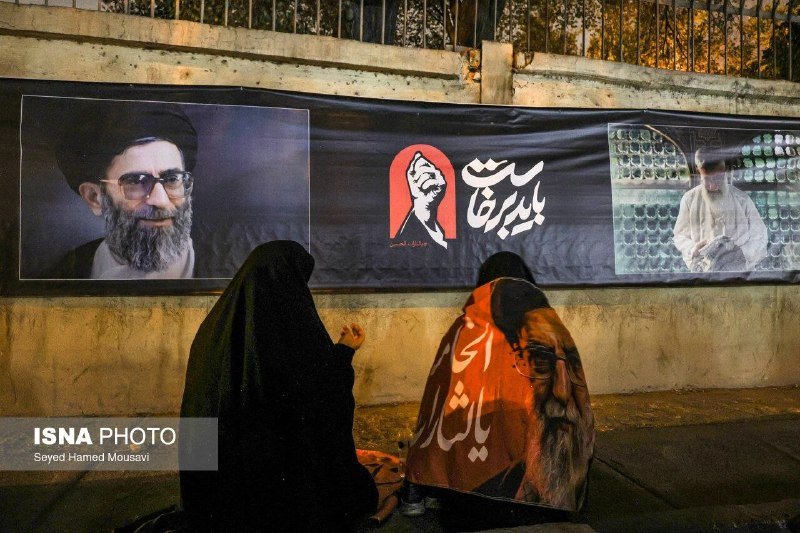
The doors of the Musalla in central Tehran opened to a controlled stream of mourners on the evening of 3 July 2026, roughly five hours before the scheduled start of the formal farewell ceremony. State media showed the eastern gate swung wide shortly after 22:00 UTC, families and Red Crescent volunteers moving into the courtyards, and a logistical apparatus — army medical tents, parking maps, pilgrim guides — already in place along the western flank. By 01:00 UTC on 4 July, the main hall had been opened as well, with Tasnim publishing rolling overhead shots of the late leader's body laid out inside the mosque. The choreography was unusually disciplined for a state funeral of this scale, and that, more than the pageantry, is the story.
Because the next forty-eight hours will determine who speaks for the Islamic Republic abroad, who controls the bonyads, and who has the standing to make or break the next nuclear file. Western analysts spent two decades modelling succession in Tehran as a black-swan event; the actual transition looks less like a rupture than a handover — which is its own kind of warning.
A stage-managed grief, and what it stages
Iranian state outlets have spent the last day directing traffic. The official messaging has been uniform: the body of the martyred leader of the revolution lies in state at the Musalla, doors opened progressively, pilgrims guided through the eastern and main entrances, and a comprehensive pilgrim guide issued in advance covering accommodation, parking and welfare services. Footage circulated by Tasnim from roughly 22:04 UTC on 3 July showed early arrivals; further clips at 23:37 and 23:52 UTC showed the eastern gate opening and the body's location inside the hall; the main doors came open across the 00:26 and 01:00 UTC dispatches on 4 July. By design, the camera was permitted to show grief and scale, but not faces of the senior officials gathered around the bier. The visual grammar is consistent with how the Islamic Republic has televised previous leader funerals: order first, devotion second, politics almost entirely off-frame.
That is the first tell. When a regime under stress wants to project continuity, it pre-produces the optics. The press pool was given framing, not access.
The clerics you don't see
The names that matter in the next seventy-two hours are not the ones doing the public reading of the Quran. The Assembly of Experts — the eighty-odd clerical body that formally names the next supreme leader — meets behind closed doors, normally within days of a vacancy. Its convocation has not been publicly announced in the materials currently moving through Iranian state channels; what has been announced is the funeral schedule, the condolence book locations, and the medical and security perimeter around the Musalla. The pattern is familiar. Succession in Iran is a clerical conclave, and conclaves announce themselves only when the result is ready.
The harder question — whether the new figure will inherit the same doctrine, the same regional posture, the same red lines on the nuclear file — is not answered in any of the source material currently available. Iranian state outlets do not editorialize on this. The Western wires, working off a thin official read-out, have so far run process pieces rather than analysis. The honest answer is that nobody outside a small circle in Qom and north Tehran knows.
The regional readout is already shifting
Even before the formal farewell, the diplomatic weather has changed. Iraqi, Syrian, Lebanese and Houthi-aligned outlets carried condolence statements within hours of the death announcement; Reuters and the wires published those statements in turn. The pattern of who rushed to mourn, and who delayed, is a quiet but legible map of where the post-Khamenei regional order sits. The actors closest to Tehran's axis moved first; the Gulf monarchies and Cairo waited; the European foreign ministries issued measured statements that conspicuously avoided any verdict on the late leader's legacy. The choreography in Tehran is, among other things, a live broadcast to each of those capitals of who is allowed to send what kind of message.
This is the moment when regional rivals will test the new office. Watch the airspace over the Strait of Hormuz, the filing frequency of IAEA inspectors at Natanz and Fordow, and the tone of the next Hezbollah statement. Any of those will tell you more about the succession than the funeral itself will.
What the framing gets wrong
Western coverage of Iranian leadership transitions has a default register: either the black-swan scenario (a revolutionary guards faction seizes the file, regional escalation follows) or the soft-landing scenario (a clerical consensus figure restores predictability). Both are ways of avoiding the harder observation, which is that the Islamic Republic's succession mechanism is a designed institution, not a contingency. It has rules, even if they are unwritten. The relevant question is not whether the system holds, but which coalition inside it inherits the most powerful clerical office on earth. That is a political question, answerable only by the people in the room, and the room is currently the Musalla at three in the morning Tehran time.
For now, the camera is allowed. The door is open. The answer is not.
— This publication writes from the open record. Where the room is closed, the copy says so.
Wire provenance
This editorial synthesis draws on the following public wire/social posts:
- https://t.me/tasnimnews_en
- https://t.me/tasnimnews_en/1
- https://t.me/tasnimnews_en/2
- https://t.me/tasnimnews_en/3
- https://t.me/tasnimnews_en/4