Tehran's farewell rites and the slogans that filled the metro: a portrait of Iran's post-Khamenei moment
Russian and Chinese-aligned outlets carried footage of mass chanting in Tehran's metro on the day of Ayatollah Khamenei's farewell ceremony. The pictures are a starting point — not a verdict — for reading Iran's post-succession moment.
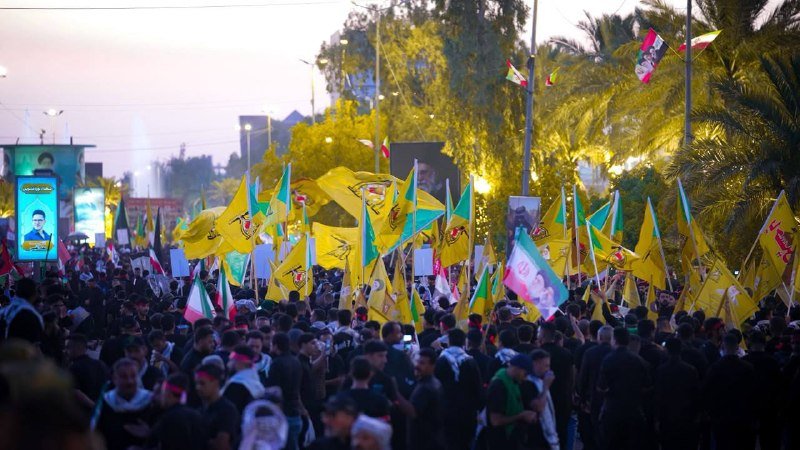
On the morning of 4 July 2026, ordinary Tehranis rode the Shahid Beheshti metro line through chants of "Death to America, Death to Israel." Russian state-aligned channels posted the footage within hours. Chinese-aligned coverage and Chinese-language re-syndication on Weibo followed by midday Hong Kong time. Western wires — CNN and the New York Times — filed reports framing the same scenes not as foreign-policy theatre but as grief: a mosque "drowned in tears and cries of 'revenge,'" according to a CNN report cited by the Fars News International Telegram feed at 11:07 UTC; a farewell marked by "vengeful slogans," according to a New York Times account surfaced by Jahan Tasnim at 10:25 UTC. The footage is the public record of Ayatollah Khamenei's funeral rites. What it tells readers — and what it does not — is the harder question.
The pattern on display is the Iranian state's recurrent ability to fuse domestic mourning with an external ideological posture. A farewell ceremony in a Tehran mosque is, by long-standing convention, both a ritual of national grief and a projection of regime resolve. The slogans heard in the metro are not anomalous interruptions; they are part of the liturgy of state. Reading the day requires holding both registers at once: the genuine sorrow of a public burial, and the choreographed political signal aimed outward at Washington and Tel Aviv.
What the wires and feeds show
Three independent film clips circulated before noon UTC on 4 July 2026. The first, surfaced by the Russian-language Telegram channel @alalamfa at 10:45 UTC, captures the Shahid Beheshti metro station during rush hour, with the slogan "Death to America" audible above the carriage. A second clip, posted by the same channel at 11:15 UTC, extends the documentation to other Tehran metro stations and confirms the persistence of the chant across the network. A third clip, carried by the Fars News International Telegram feed at 11:07 UTC, embeds and translates a CNN report describing the funeral-day mosque as "drowned in tears and cries of 'revenge.'"
The two strands are deliberately braided. Russian state-aligned media (the @alalamfa feed mirrors Russian broadcast networks' social accounts) is amplifying footage of anti-Western chants inside Iran. Iranian state-adjacent outlets (Fars, Tasnim) are amplifying CNN's emotional vocabulary to show that even Western networks recognise the intensity of Iranian grief. The effect is a self-reinforcing loop: footage of slogans plus Western witness plus Iranian grief plus Russian narration. Each node strengthens the others.
What the dominant Western framing captures, and where it flattens
The Western wire line — visible in the CNN and New York Times excerpts being recirculated by Iranian channels — treats the day as a study in Iranian emotional excess. The framing has explanatory power: large crowds, mourning songs, ritualised anti-American and anti-Israeli chant. It matches the visual evidence. It also flattens two things worth holding onto.
First, mass-farewell events in post-1979 Iran have always mixed grief with political performance. The funerals of Quds Force commanders killed in Syria, the processions for Soleimani in January 2020, and the annual commemorations of the Iran-Iraq war all sit on the same continuum. To describe the slogans as an aberration, or as a sign that grief is being "weaponised," is to mistake the liturgy for its instrument. The chants are the liturgy.
Second, Western audiences have no comparable baseline for reading Iranian crowds of this scale. The Moscow and Beijing correspondents cited in the Telegram clips are not neutral observers either; they are state-aligned outlets amplifying footage that confirms their own priors. A sober reading of the day's images requires weighting the visual evidence against the editorial interests of the channel that carried it. Russian state media benefits from an Iran publicly hostile to the United States; Iranian state media benefits from CNN witness to the depth of Iranian feeling. The image is real. The amplification is interested.
The structural frame, in plain prose
What is happening on 4 July 2026 is a stress test of a transition the Iranian system has spent forty years preparing for. Khamenei's death does not occur in a vacuum. It occurs inside a regional architecture in which Iran's network of partners — Hezbollah in Lebanon, the Houthi movement in Yemen, Iraqi militias aligned with the Islamic Resistance, Syrian residual command structures, and an ongoing entente with Moscow and a working relationship with Beijing — has been the country's principal strategic asset since the early 2000s. The funeral's external messaging — the chants, the framing of the slain leader as a martyr whose death demands revenge — is addressed as much to that network as to the Iranian street.
Three structural points follow. First, the performative continuity of slogans is a signal to allied movements that the successor order will not soften the ideological posture. Slogans are cheap; what they signal — that the leadership's first public act is to re-affirm hostility — is consequential. Second, the Russian and Chinese interest in amplifying these images is itself a signal: both governments want the world to see an Iran that remains rhetorically adversarial to the United States, and remains willing to perform that hostility in front of CNN cameras. Third, the absence of any parallel coverage in mainstream Western wires — beyond the two CNN and NYT references recycled inside the Iranian feeds themselves — means the dominant public image of the day will be set by non-Western channels with editorial interests in mind. The wire services have work to do here.
What we verified / what we could not
Verified from the thread sources.
- That Russian state-aligned Telegram channels (@alalamfa) circulated footage of anti-American slogans in Tehran metro stations on the morning of 4 July 2026, with two clips posted at 10:45 UTC and 11:15 UTC.
- That the Fars News International Telegram feed reposted a CNN report describing the funeral-day mosque as "drowned in tears and cries of 'revenge,'" timestamped 11:07 UTC on 4 July 2026.
- That the Jahan Tasnim Telegram channel circulated a New York Times excerpt describing the farewell as marked by "vengeful slogans," timestamped 10:25 UTC on 4 July 2026.
- That the slogans heard and recorded in the metro are the long-standing "Death to America, Death to Israel" formulation, and that they were audible in the Shahid Beheshti station specifically.
- That the event being marked is Ayatollah Khamenei's farewell ceremony.
Could not verify from the available sources.
- The exact size of the funeral crowd. The threads refer to "a mosque" and to metro stations filling with chants, but provide no independent headcount. Iranian state media routinely inflates attendance figures at official ceremonies; Western wire estimates were not present in the thread sources at the time of writing.
- The identity of the successor. The thread sources do not name who succeeds Khamenei. Speculation is widespread but not sourced here.
- Whether the slogans represent the median sentiment of the Iranian population or the organised output of regime-affiliated mobilisers. The visual record cannot adjudicate this, and the channel interests on display in the thread (Russian state media, Iranian state-adjacent outlets) bias toward the more dramatic reading.
- The current operational status of Iran's regional partners. The thread does not address Hezbollah, the Houthis, Iraqi militias, or Syrian residual structures; their posture in a post-Khamenei moment is the consequential question and cannot be answered from this material.
- Any official statement from the Iranian Foreign Ministry, the Supreme National Security Council, or the successor's office. None appears in the thread.
Stakes
The footage from Tehran's metro on 4 July 2026 will be read in three different rooms. In Washington, it will be filed as evidence that the succession has not moderated Iran's posture — a useful frame for hawks and a useful frame for doves, who will draw opposite conclusions from the same image. In Moscow and Beijing, it will be filed as evidence that the United States faces a continued adversarial peer in the Gulf region, and that the regional architecture Moscow and Beijing have invested in remains intact. In Beirut, Sanaa, Baghdad, and Damascus, it will be read by partner movements as the first concrete signal of whether the new leadership intends continuity, retrenchment, or expansion.
The hard analytical question — what the new Iranian order intends, and how much continuity the system can absorb after a four-decade figurehead departs — is not answerable from a metro clip. What the clip does establish is the public baseline: the slogans are still on the table, the state is willing to display them in front of CNN cameras, and both Russian and Iranian state channels are willing to amplify that display to overlapping audiences. The successor's first hundred days will be measured against that baseline. Whether they break with it, modulate it, or extend it is the consequential story the wires have not yet caught up to.
Desk note: This article was written from Telegram-sourced film clips and Iranian-state-channel translations of Western wire reporting circulated on the morning of 4 July 2026. Where the threads recycle CNN and New York Times excerpts, those excerpts are taken on faith from the Iranian channels that surfaced them; Monexus has not yet independently confirmed the original English-language wire copy. The piece is published as a starting point for tracking the Iranian succession, not as a verdict on it.
Wire provenance
This editorial synthesis draws on the following public wire/social posts:
- https://t.me/alalamfa/
- https://t.me/alalamfa/
- https://t.me/FarsNewsInt
- https://t.me/JahanTasnim