Tehran's farewell and the question of what comes next
A farewell ceremony at Imam Khomeini Mosalla has been used to set the public frame around a leadership transition whose outcome is still genuinely contested.
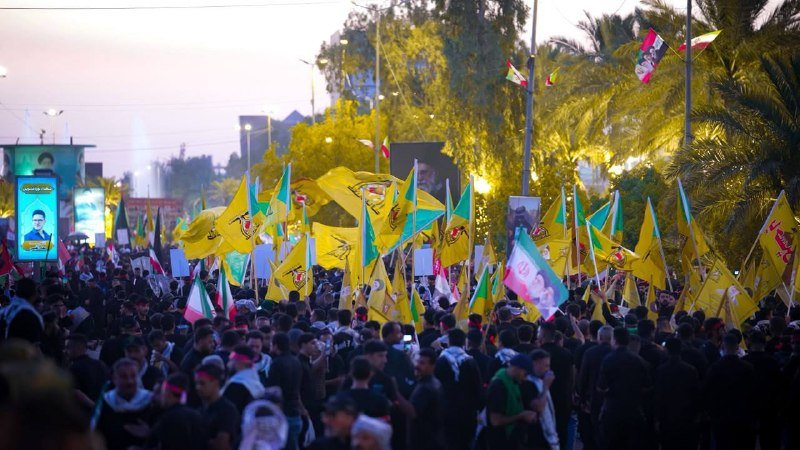
On the morning of 4 July 2026, a public farewell ceremony for Grand Ayatollah Sayyid Ali Hosseini Khamenei opened at Imam Khomeini Mosalla in Tehran. Crowds chanted "Down with USA" and "Down with Israel" as the proceedings began, with state-aligned channels framing the gathering as a tribute to a leader "martyred" in service to faith, dignity, justice, and the defence of the oppressed. The choreography is familiar; the political question it conceals is not. A succession of this weight, in a system where the supreme leader sits atop the security, judicial, and clerical estates, is not a private Iranian matter. It is a regional and global one.
The dominant narrative inside Iran presents the transition as continuity rather than rupture — a martyr whose legacy instructs, rather than a vacancy to be filled. That framing is doing political work. It tells domestic audiences, the Islamic Revolutionary Guard Corps, allied militias in Iraq, Lebanon, Syria, and Yemen, and the broader axis of resistance that the institutional line holds. It also tells external adversaries that the cost calculus of pressure, sanctions, or military action has not changed. Whether either message is true is the story of the next several weeks.
What the farewell is for
Funerals are policy instruments before they are rituals. By staging the ceremony at Imam Khomeini Mosalla, recycling the slogans of the 1979 revolution, and elevating the language of martyrdom, the organising authorities are signalling three things at once. First, that the supreme leader's office is not in interregnum. Second, that the security institutions closest to him — the IRGC and the Intelligence Ministry — retain full operational authority. Third, that the axis of resistance retains its ideological connective tissue. The publication of a dedicated legacy page on Khamenei.ir, framing martyrdom as "the beginning of a new chapter," is part of that same messaging architecture.
The dominant framing inside Iran, in other words, treats this as a handoff rather than a handover. That distinction matters. A handoff preserves the chain of command, the sanctions-evasion networks, and the deterrent posture. A handover opens the door to internal competition among clerics, IRGC commanders, and the Assembly of Experts. The choreography of the farewell is engineered to make the first reading the only reading.
What the framing is hiding
Outside Iran, the picture is less settled. Western intelligence services are reportedly watching the IRGC's communications discipline and the speed at which the Assembly of Experts convenes as the real indicators of how settled the succession actually is. The harder question — whether the next supreme leader will retain the same latitude to operate proxy networks, accelerate nuclear work, or absorb further sanctions — cannot be answered from a funeral platform.
Three structural tensions are likely to surface regardless of the public choreography. The clerical estate is divided between pragmatists who accepted the China-brokered understanding with Saudi Arabia and hardliners who read the post-October 2023 environment as a window for escalation. The IRGC's economic empire — the bonyads, the construction conglomerates, the port operations — has its own incentive structure, which does not always align with clerical preferences. And the regional environment has shifted: the Syria file has changed shape, Hezbollah is recovering under sustained Israeli action, and the Houthi position remains unusually entrenched. Any successor inherits that map, not the one that existed a decade ago.
Why the slogans matter
The decision to lead with "Down with USA" and "Down with Israel" at a moment of grief is not accidental. It tells the street that grief is being weaponised into mobilisation, and it tells foreign governments that the bite of Iranian foreign policy is intact. That posture has real domestic utility in a sanctions economy: it gives the security services a rationale for the budgets and external operations that sustain them.
The counter-read is also coherent. Some Iranian commentators, and a strand of analysis inside Western think tanks, hold that the loudest slogans are often a sign that the regime is compensating for slack. A leadership under genuine strain projects outward; a leadership under genuine confidence can afford quiet. Either reading is defensible. The sources available so far do not let us adjudicate between them.
What to watch next
Three signals will tell readers more than the funeral will. First, the composition and pace of the Assembly of Experts' convocation — a slow, contested process points to factional bargaining; a fast, unified one points to a pre-agreed succession. Second, the public posture of the IRGC commander-in-chief and the head of the judiciary in the days immediately after the ceremony; their silence is data. Third, the operational tempo of regional allies — whether Hezbollah, the Houthis, and the Iraqi militias intensify, hold, or quietly recalibrate their messaging. The regional order does not pause for grief.
For now, the funeral is doing exactly what it was designed to do: it is collapsing a contested political moment into a single image of unity. The question is whether the image survives contact with the institutional bargaining that begins as soon as the crowds leave Mosalla.
The sources for this article are almost entirely state-aligned channels inside Iran and a single Telegram account associated with the IRGC; readers should weight them as primary material from one side of the story, not as a neutral account. Independent verification of attendance figures, casualty figures at any prior event, and the procedural status of the Assembly of Experts was not available at the time of publication.
Wire provenance
This editorial synthesis draws on the following public wire/social posts:
- https://t.me/Khamenei_en/1
- https://t.me/Khamenei_en/2
- https://t.me/Khamenei_en/3
- https://t.me/Khamenei_en/4
- https://t.me/Khamenei_en/5
- https://t.me/IRIran_Military