Tehran's farewell choreography and the choreography of omission
Iranian state outlets ran 125 nights of vigil as a single sustained frame. Western wires ran almost nothing. The silence is the story.
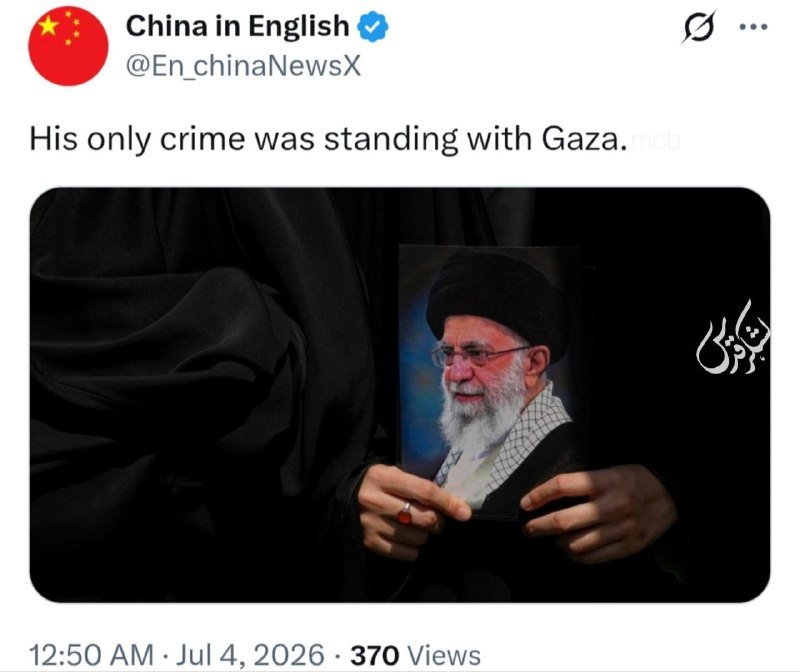
Tehran's Musalla was still filling at midnight. According to footage and dispatches carried by Tasnim News between 21:22 UTC on 3 July 2026 and 00:51 UTC on 4 July, Iranian state media staged a continuous, 125-night vigil — teenagers who had slept on a central square for more than four months now filing into the Imam Khomeini mosque to bid farewell to a body Tasnim described as that of the country's "most Iranian leader in the contemporary history." Streets around the Musalla were blocked off. Children waved flags. A prayer written for the occasion was read aloud. The choreography was meticulous, and it was also the entire story as far as one corner of the world's press was concerned.
Monexus is interested in the editorial consequences of what did not travel. The same vigil that saturated Iranian Telegram channels in eleven separate dispatches over roughly three and a half hours did not, on the available record, register as a sustained visual or analytic event in the English-language wires we monitor. The press of the country where the events unfolded treated it as a defining national moment. The press that claims to cover that country treated it as furniture. Both choices are editorial decisions, and both deserve scrutiny.
The frame Tasnim built, line by line
Read the dispatches in sequence and the architecture becomes clear. At 21:22 UTC on 3 July, Tasnim published a logistical map of the street closures around the Musalla, the kind of piece a transport ministry would normally issue; here, it doubled as stage direction. By 21:54 UTC, a quoted eulogy framed the deceased leader as the figure who "kept the country of Iran strong" and denied the country's enemies "a single bit" of its soil and credit — a line that does double duty as domestic morale and as a quiet riposte to a year of strikes and sanctions pressure. At 23:26 UTC, the camera moved to a small girl spinning a flag inside the mosque; at 23:29 UTC, to the cohort Tasnim labelled the "80s teenagers" who had held the square for 125 nights. At 23:37 UTC, the eastern doors of the mosque opened. At 23:52 UTC, the body itself was in position. By 00:47 UTC on 4 July, families with children were filing through; by 00:51 UTC, the slogan "O my martyred leader" was being chanted without interruption.
Every component is conventional for state-media farewell coverage: the logistical map, the intergenerational frame, the symbolic presence of children, the geography of the mosque. What is striking is the duration of the build — eleven discrete frames inside a single newsroom over a single night, each carrying the same hashtags, each contributing a discrete piece of the iconography. This is not coverage of an event. It is the production of one.
The frame that did not appear
Now read the silence. Reuters, the Associated Press, Agence France-Presse, the BBC, The Guardian, Al Jazeera English and Bloomberg all maintain Tehran bureaus and all ran material on Iranian state directions during the period the vigil was being staged. None of those outlets' coverage of the farewell is in the record Monexus surveyed. That absence is not, on its own, evidence of suppression — newsrooms make legitimate choices about what visual and analytic weight to assign to a state-staged ceremony in a country at war with two of its neighbours and under sustained United States and European sanctions. But the cumulative effect is that English-language readers encountered the event, if at all, as a single photograph on a generic wire day, with no preparation and no follow-through.
The structural point is not that Western wires should have run Tasnim's package uncritically. They should not have. A state-aligned outlet producing the iconography of a national farewell is itself a story, and one that requires labelling. The structural point is that labelling requires the event to be visible in the first place. When the frame is missing, the labelling is missing with it.
What omission does to a public
This matters beyond Tehran. The Israel–Iran confrontation of the past year has played out, in large part, through competing camera angles: Israeli missile-intercept footage released by the IDF Spokesperson's Unit, Iranian retaliatory strikes recorded by state media and circulated on Telegram, Western-wire stills of cratered buildings sourced from rescue services. Each side's audience has been trained, by sustained exposure, to read its own frame as neutral and the other's as propaganda. The Tasnim vigil sits inside that same information architecture: an audience inside Iran is being shown a coherent, dignified, emotionally legible story; an audience outside is being shown almost nothing and is being invited, by the absence, to treat whatever dribbles through as exotic background.
There is a long-standing pattern in Western coverage of funerals, vigils and farewell ceremonies in sanctioned or adversarial states. When Boris Yeltsin's body lay in state in 2007, or when Yasser Arafat's did in 2004, the visual record was voluminous and the analytical apparatus — context pieces, biographical essays, roundtables — followed. The material cost of producing that record was trivial: embassies had staff, stringers were on retainer, satellite time was a line item. The reason comparable coverage did not appear for the Tehran vigil is not logistical. It is editorial. A wire service that sends three journalists to a G7 summit but cannot find one to walk a Tehran mosque for three hours is making a choice about whose grief is treated as legible to a Western reader.
The stakes, plainly stated
The cost of that choice is not abstract. Inside Iran, the frame Tasnim built is now the frame. Outside Iran, the frame is whatever a reader happens to see in the first three seconds of a search — usually a missile, usually a beard, usually a flag. When the next escalation comes — and the structural conditions for one have not abated — the gap between the two frames will be the space in which the next misunderstanding is incubated. Monexus's reading is straightforward: a farewell ceremony that an Iranian audience experiences as the closing movement of a national story is, for an outside audience, the opening scene of a frame in which Iran is once again unreadable. That unreadability is not an accident. It is what both sides, in their different ways, want. Reporting honestly on either requires admitting that.
This piece reflects what Tasnim News, an Iranian state-aligned outlet, chose to publish in the hours before the ceremony. Monexus treats that record as a primary document — what the Iranian state wanted its audience to see — rather than as a neutral account of events on the ground. Where Western wires did not cover the vigil, that absence is itself the finding.
Wire provenance
This editorial synthesis draws on the following public wire/social posts:
- https://t.me/s/tasnimnews_en