Tehran's farewell rites and the choreography of martydom politics
A farewell ceremony at Tehran's Mosalla is built to broadcast unity, grief and succession all at once. Reading the choreography against the slogans is the point.
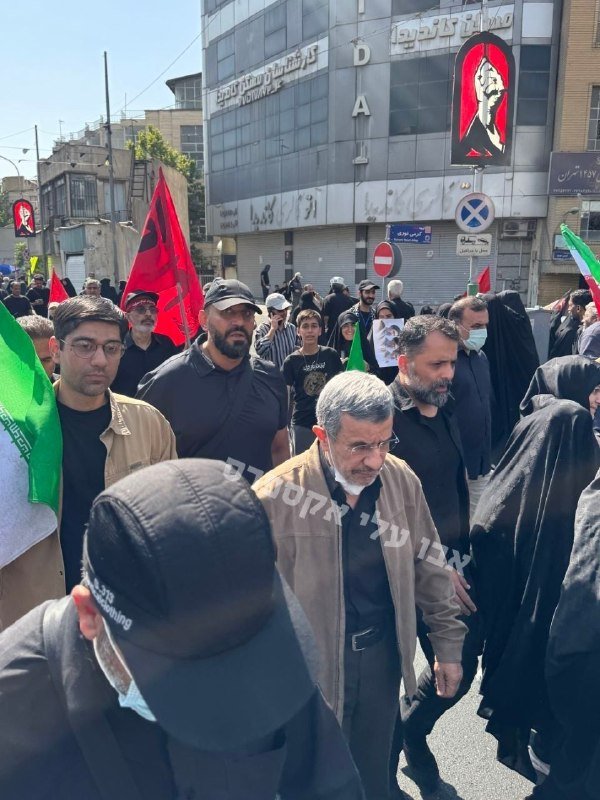
On the afternoon of 4 July 2026, the forecourt of Tehran's Mosalla filled with mourners for what state-aligned media billed as a farewell ceremony for a "leader of the martyred nation." Tasnim News's English channel published a rolling sequence of clips from 17:46 to 18:52 UTC: chest-beating crowds, hand-clapping chants, a vocal recital from Zanjan, and a slogan that recurred across the hashtags — we all love the blood of the father, listen to the command of the son.
The ritual itself is the story. A martyrdom farewell is not a private grief; it is a mass-media event designed to translate one life into a line of succession. The slogans do the translation in real time, signalling that the grief is to be read vertically, as inheritance, not horizontally, as condolence.
What the footage actually shows
The five clips Tasnim released in a 66-minute window are not candid. They are cut to a common rhythm: wide shots of a packed forecourt, close-ups of coordinated chest-beating, a poetry segment, and the slogan track. The framing language is consistent — "magnificent ceremony," "rare attendance," "a place not to throw a needle" — which is itself a tell. Crowd-size claims in Iranian state media at political-religious funerals tend to function as a sovereignty statement: this turnout is the proof of legitimacy, addressed as much to external audiences as to internal ones.
The chant "listen to the command of the son" is the load-bearing line. In a republic that officially venerates the father of the revolution and his institutional heirs, the public rehearsal of that line at a funeral is a way of pre-answering the question Western analysts always ask after an Iranian leadership event: who is up, who is down. The slogan answers before the obituary is printed.
Why this differs from a normal funeral
Iranian state funerals have an established grammar: state media broadcasts the procession, the leadership appears in clerical dress, foreign dignitaries file past, and a Friday sermon ties the deceased to the resistance narrative. What Tasnim's feed emphasises is the public body — chest-beating, clapping, slogans — and the absence (in the clip descriptions) of named foreign mourners, of clerical eulogies, or of the institutional choreography that normally surrounds a senior official's farewell.
The result is a hybrid event: a martyrdom farewell in form, a populist rally in texture. The framing tells the audience the deceased belongs to the people rather than to the state — even as the state is the only producer of the imagery.
The counter-reading
Two readings compete. The first, dominant in Iranian state-aligned outlets, treats the turnout and slogans as a public affirmation of continuity: grief absorbed into the existing line of authority, with no institutional disruption. The second reading, common in opposition commentary abroad, treats the ritual as a stress event — the heavy-handed choreography of martydom signalling that the gap between the official narrative and the street is widening, not closing.
Both can be partly right. Rallies can be both sincere and staged; turnout can be both voluntary and mobilised. The footage Tasnim published is consistent with both interpretations, because it was selected to be. That is the point of state-aligned martyrdom footage: it is deniable as proof of anything.
Structural frame: martydom as succession technology
What the ceremony shows, beyond any single figure, is how martydom is used as succession technology in the Iranian system. A leader's death is converted into a public obligation to inherit — the blood of the father, the command of the son — which binds the audience to the next holder of the role before any formal announcement is made. The funeral is the moment a contested succession becomes a slogan. Once it is a slogan, it is harder to contest.
This is the same logic, in milder form, that any state funeral performs: convert a private loss into a public compact. Iran does it louder, and with martydom as the binding agent, because the system's claim to legitimacy rests less on procedure than on sacrifice.
Stakes
If the framing holds, the funeral consolidates a designated successor and closes off intra-elite challenges for the medium term — through the mourning window, which Iranian political culture treats as untouchable. If the framing frays, the same footage becomes evidence in the longer-running contest over who speaks for the street: the state broadcaster that produced it, or the diaspora channels that will rebroadcast and re-label it within hours.
For external readers, the test is simple. Watch what appears in the Iranian state feed over the next 72 hours: which clerics speak, which military commanders appear in rank, which foreign embassies send delegations, and which slogan clips are re-cut and re-issued. The substantive answer to the succession question will not be in the farewell itself. It will be in the editing that follows.
Desk note: This piece reads state-produced martyrdom footage against itself, treating Tasnim's clip selection as a primary source rather than as neutral reporting. The alternative — treating it as either authentic document or pure stagecraft — produces less analytical purchase than asking what the curation is built to do.
Wire provenance
This editorial synthesis draws on the following public wire/social posts:
- https://t.me/s/tasnimnews_en
- https://t.me/s/tasnimnews_en
- https://t.me/s/tasnimnews_en
- https://t.me/s/tasnimnews_en
- https://t.me/s/tasnimnews_en