Tehran's Farewell Theater and the Question It Conceals
Public mourning in Tehran on 4 July 2026 was choreographed to a tee. The harder question is what the choreography is meant to bury.
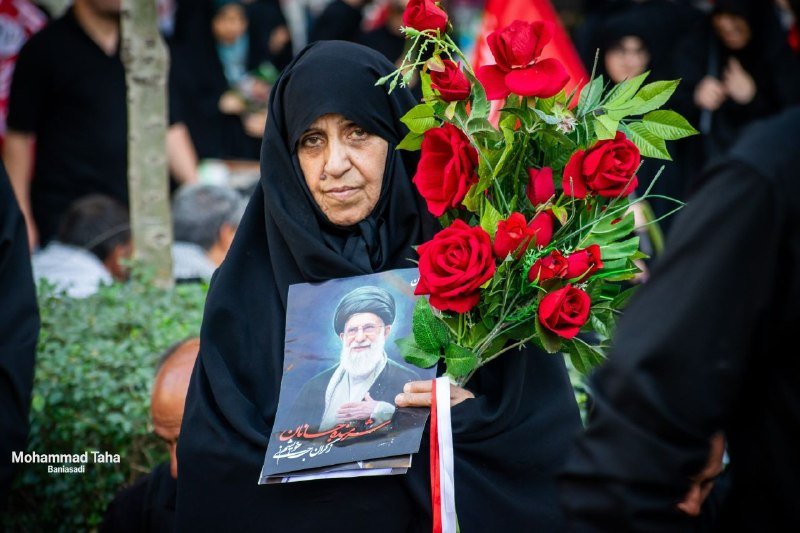
The streets leading into Tehran's Imam Khomeini Mosque were full by mid-afternoon on 4 July 2026. According to Al-Alam, the Iranian state-aligned satellite channel, a convoy carrying families of the so-called Minab martyrs was moving on the capital to attend a farewell ceremony for "the martyred leader of the nation," with crowds performing the Maghrib and Isha prayers in congregation at the mosque before the formal rites. The choreography is familiar: bunting, banners, the standard iconography of Iranian state ritual, broadcast live across the republic's domestic media.
What is less familiar is the analytical posture. The Western wire line on Iran runs on sanctions, enrichment percentages, and IRGC casualty lists; the ritual here, with its dense emotional register, tends to be filed under "culture" and skipped. That is a mistake. Public mourning in an authoritarian-modernising state is not a sideshow. It is a load-bearing institution, and reading it on its own terms — rather than as a backdrop to nuclear-file reporting — is one of the few ways outside observers can register what the regime thinks it is, and what it wants its citizens to feel.
The ceremony as signal
Al-Alam's rolling coverage on the afternoon of 4 July framed the gathering in the language the state has standardised over four decades: loyalty, martyrdom, and the continuation of the Imam's line. The reference to "Minab martyrs" — a town in Hormozgan Province that has been the site of past deadly incidents tied to Iran's southeastern frontier — supplies the symbolic raw material. Each ritual object, from the destination (the Imam Khomeini Mosque complex, the regime's founding shrine) to the timing (afternoon Maghrib and Isha, the canonical pair of evening prayers), is doing political work.
The structural point is this: when an embattled state stages a farewell, it is rarely a farewell. It is an audition. Every clergy member on the podium, every general in the reviewing stand, every senior technocrat on camera is being read by every other one of them. The ceremony is a way of pre-deciding succession without ever calling it a succession contest — and, crucially, of allowing the public to imagine they are watching grief while the elite are watching personnel.
The coverage gap
Outside Iran, the day's footage has, at the time of writing, been filtered almost entirely through state-channel reporting. That has predictable consequences: every image of dense crowds confirms one narrative, and every image that does not fit it goes un-reported. The asymmetry is not new. Foreign desks run on bureau presence in Tel Aviv, Beirut, Dubai, Istanbul, Doha, and occasionally Riyadh. Iran is a closed shop for most Western news organisations, which means the default frame on any given day in Tehran is, in effect, what Iranian state media wants the world to see.
This publication's read: that filter is consequential precisely on the days it matters most. A funeral is a moment when the regime's internal hierarchy becomes briefly legible to outsiders — who stands where, who is permitted to speak, who is kept off camera, whose uniform is on display. Without independent reporting on the ground, even the most careful Western analysis of Iranian politics is, on these days, half-blind.
What the ritual is for
The ritual does several things at once, and serious coverage has to hold all of them.
First, it manufactures consent. A republic that cannot persuade its citizens of the legitimacy of its institutions by means of a free press must do so by other means: spectacle, pilgrimage, the careful recycling of founding mythologies. Second, it disciplines the elite. Public grief is mandatory; the form of the grief is curated; deviation is noted. Third, it projects outward. State media's multilingual reach — Al-Alam Arabic, HispanTV Spanish, PressTV English — exists in part to ensure that the ritual registers beyond Iran's borders, particularly in the Arab street and the wider Muslim-majority audience, where Iran has long competed for standing with Saudi Arabia, Turkey, and the Gulf monarchies.
None of this is exotic. It is what states do. What is unusual here is the persistence of the form. Most successor regimes in the developing world have, within a generation, traded revolutionary ritual for technocratic pageantry. The Islamic Republic, four-plus decades in, is still staging mass ceremonial on the model of its founding moment.
What remains uncertain
Al-Alam's coverage does not name the specific identity of "the martyred leader of the nation" beyond the ritual register. The thread supplied to this desk references the ceremony and its participants but does not, in the materials available, specify the deceased's office, cause of death, or succession implications in plain text. The absence is conspicuous. State media naming conventions in Iran are precise: the title used in domestic bulletins is itself a clue to the institutional standing of the deceased. Without an independent reading of the underlying reporting, this publication cannot responsibly assert more than the ceremonial facts.
What can be said is that the framing — "martyred leader," farewell at the Imam Khomeini Mosque, convoy of martyr-family representatives from a frontier town — is the canonical form for a senior figure of unmistakable political weight. That weight will become plain in the coming days, when the formal announcements are made and the succession geometry hardens. For now, the streets of Tehran are telling the world what they can, within the bounds they are permitted.
Stakes
A regime's ritual vocabulary is one of the few continuous records it produces about its own self-image. When that vocabulary is read seriously — by analysts willing to do the slow work of decoding who is on the dais, who is absent, and which institutional faction controls the camera — it yields information that no sanctions list or enrichment inspection can. Conversely, when it is dismissed as scenery, the outside world arrives at every inflection point — succession, war, succession-then-war, the next war — with a thinner map than it needs.
The honest assessment on 4 July 2026 is that the day's footage, taken on its own, does not resolve the question of what comes next in Tehran. It does, however, sharpen it. The ceremony is the question.
Desk note: Monexus has, for this piece, declined to amplify either the regime's "martyred leader" framing or the Western default of dismissing such events as theatre. The reading here treats the ritual as evidence — and names, plainly, the limits of what can be inferred from state-channel footage alone.
Wire provenance
This editorial synthesis draws on the following public wire/social posts:
- https://t.me/s/alalamfa
- https://t.me/alalamfa