Tehran's funeral diplomacy and the choreography of an unfinished succession
A public mourning ritual that doubles as a regional alignment test: foreign envoys in clerical dress, an invitation to online testimony, and a daughter of a martyred Hezbollah chief on the record — all pointing to a leadership transition Iran has not yet named.
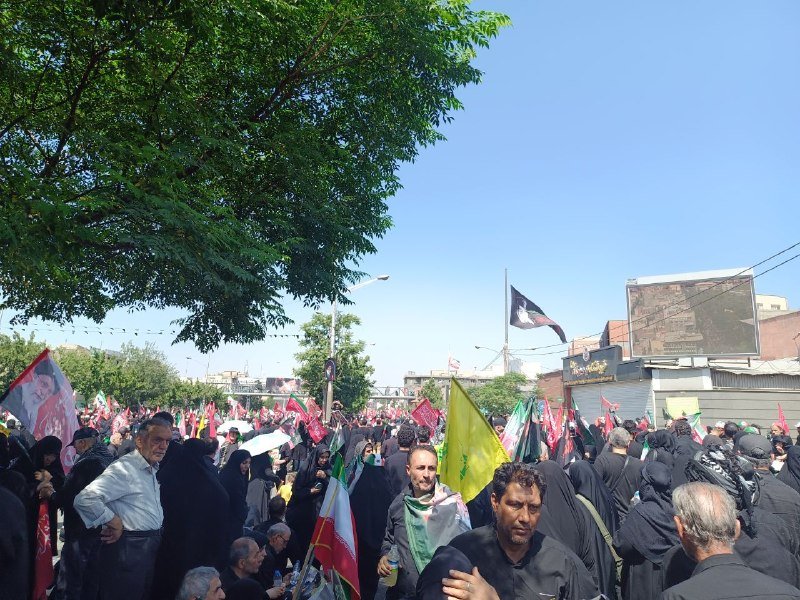
On 4 July 2026, three separate posts on the English-language Telegram channel of Iran's Supreme Leader's office converged on a single event: a public funeral procession for Grand Ayatollah Ali Hosseini Khamenei, who is repeatedly described in the channel's own language as the "martyred Leader of the Islamic Revolution." The framing is not accidental. In a single afternoon, an editor scanning the feed could read a daughter of the former Hezbollah secretary-general reflecting on her father, a Yemeni ambassador in clerical dress offering a foreign testimony, and a video invitation to the Iranian public to record their own eulogies for online republication. The three items together read less like coverage of a death than like the staging of a transition that no one in Tehran is yet prepared to name.
The thesis this publication advances is straightforward: what is on display in these posts is not grief management but alignment choreography, with succession as the unspoken subtext. The funeral apparatus is being used to convert mourning into a public credential — a way for foreign envoys, allied-movement figures, and ordinary partisans to perform fealty while the formal question of who follows Khamenei is deliberately held back.
What the three posts actually contain
The earliest of the three items, timestamped 16:04 UTC, is an interview with Ibrahim al-Dailami, the Yemeni ambassador to Iran, recorded on the official Khamenei.ir outlet. Al-Dailami's appearance inside an Iranian state platform is itself the headline: a man who speaks for the Houthi-aligned Republic of Yemen government is being given a foreign-vanity slot in the Supreme Leader's own English-language feed. The second item, at 16:15 UTC, is a call to the Iranian public inviting users to record short videos beginning with the words "I learned from him that…" — a grassroots-eulogy campaign in which ordinary testimonials are folded back into the official channel. The third, at 17:01 UTC, is an interview with Sayyida Batoul al-Musawi, identified as the daughter of the late Hezbollah secretary-general Sayyid Abbas al-Musawi, on the occasion of the funeral procession. The three items were published within a single 57-minute window; the rhythm suggests curation, not reaction.
Reading the lineup
Nothing here forces a single conclusion. There is a plausible alternate read: this is exactly what an authoritarian clerical state does when its paramount figure dies, regardless of whether a succession is contested — managed mourning, regional ambassadors on the record, familiar faces from allied movements on camera. Under that reading, the choreography is ritual, not signal.
The counterweight is in the choices made about who appears. The al-Musawi interview places a Hezbollah family voice — not a current Hezbollah spokesman — on the official Iranian outlet during an Iranian funeral. That is a doubling of loyalties: a martyrdom lineage from Lebanon's Shia paramilitary politics, presented to an Iranian audience by the Iranian state. Al-Dailami's appearance does the same thing on the Houthi axis. The plain inference is that Tehran is staging a contiguous bloc — Hezbollah, the Huthis, the clerical estate, and the base — at the precise moment when the institutional answer to "who next" is being withheld from the public.
The pattern is structural. When a one-party or one-leader system loses its central figure, the period between death and announcement is itself a contest — of narratives, of foreign recognitions, of which faction can mobilise footage first. Iran has run this playbook before, in 1989. The difference is that the 1989 transition was concealed for days; the 2026 transition is being staged in real time, with allied ambassadors in the camera frame, on the assumption that visibility rather than secrecy now maximises the regime's position.
Stakes, and what remains uncertain
What is at stake, concretely, is the cohesion of what regional analysts still call the Axis of Resistance at the moment its patron-in-chief is being mourned rather than governing. Hezbollah in Lebanon, the Huthis in Yemen, and a constellation of Iraqi Shia militias have for decades drawn institutional gravity from Tehran; the funeral programming is doing two things at once — restoring that gravity in ritual form, and demonstrating to those movements' leaders (and to external observers in Washington, Riyadh, and Tel Aviv) that the patronage relationship has not frayed.
The uncertainty is real. The three Telegram items do not specify the cause of death, the date of death, or whether Iran's Assembly of Experts has convened; the channel's repeated use of "martyrdom" rather than "natural death" leaves that question open, and it is a question with legal and political consequences inside Iran. The al-Dailami interview does not specify who he represents within the fragmented Houthi-aligned state apparatus, and the al-Musawi interview identifies the speaker by lineage without summarising what she said. The campaign video does not disclose editorial review — whether submissions are moderated, curated, or amplified through the channel's algorithm. A reader relying solely on the channel cannot resolve any of these. What can be said is that the curation pattern — one regional ambassador, one allied-movement heir, one mass-participation appeal, within an hour — is a deliberate programmatic choice, and the choice is the news.
The desk framing: where international wires will report this as a single funeral event, this publication treats the three Telegram items as a sequenced alignment exercise and flags the succession question as the load-bearing fact the official channel is not yet answering.
Wire provenance
This editorial synthesis draws on the following public wire/social posts:
- https://t.me/Khamenei_en/
- https://t.me/Khamenei_en/
- https://t.me/Khamenei_en/