A Funeral in Tehran, a Truce From Washington, and the Gap Between Them
Donald Trump's claim of a one-week US-Iran halt sits against the backdrop of a state funeral in Tehran. The two narratives don't quite agree on what they are witnessing.
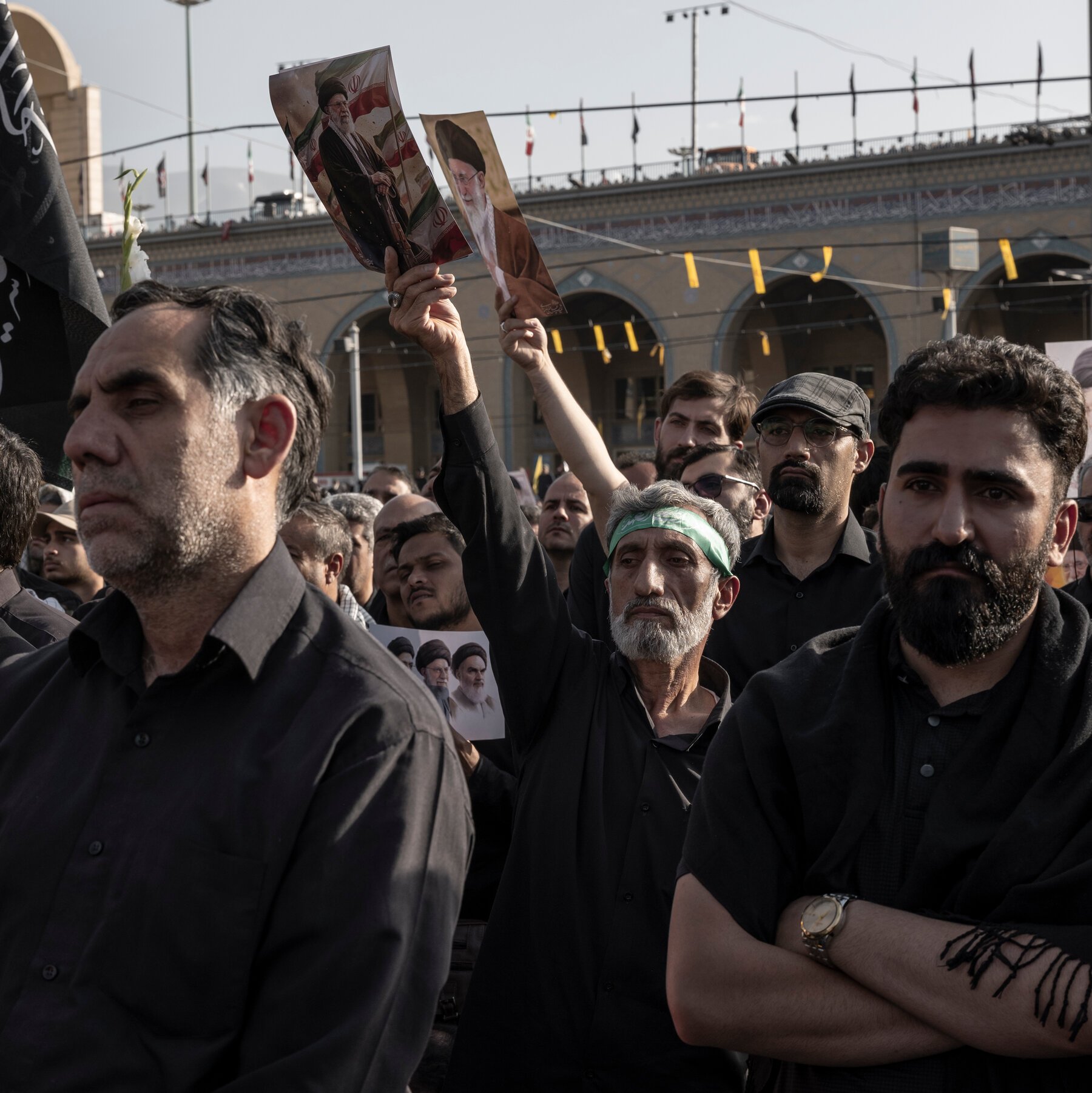
Two stories collided in the early evening of 4 July 2026. In Tehran, a state funeral drew crowds that "continue to grow by the minute," according to Tasnim News, with mourners processing past the casket of Ayatollah Ali Khamenei, the Islamic Republic's longest-serving supreme guide. Hours later and several time zones away, a remark attributed to US President Donald Trump circulated on the same wire, captured at 17:09 UTC and again in expanded form at 17:08 UTC: that he had been "surprised to see the Iranian people crying at [Ayatollah] Khamenei's funeral" because, in his framing, he had assumed they hated him. The same message string carried a separate Trump claim — that there would be "no attack during the one-week stoppage" and that Iran was "begging for an agreement."
The pair belongs together. Each one reads strangely without the other.
What Tasnim is showing
Tasnim News, an outlet operated by Iranian state-aligned foundations, posted video frames from the funeral starting in the late afternoon UTC window on 4 July. One frame carried an on-screen caption that praised a Khamenei ally killed in the recent war, with the hashtag marking him as a "martyr." A second update described the crowd as expanding continuously. A third framed Trump's reaction. All three are State-favourable evidence: they exist to demonstrate that the Iranian public is grieving visibly and at scale.
The wire is not neutral here. It is curated. A sceptical reader treats the venue figures as claims to be verified rather than measurements, and the "God is alive" caption as liturgy rather than journalism. But the underlying fact — that a major public funeral is taking place in central Tehran — is independently plausible, given that the same news cycle is saturated with traffic and that the framing would not need to be invented from whole cloth.
What Trump is claiming
The two Trump items are unverified by any non-Tasnim source in this thread. The first is a reported remark attributed to him about the size of Iranian mourning — a comment that, on its face, treats public grief as a referendum on the regime's standing. The second is a tactical claim: a "one-week stoppage" during which "there will be no attack," with the implicit negotiation frame that Iran is the supplicant. Both are stage-managed. The first is an attempt to read a crowd photograph as a political signal. The second is an attempt to convert a paused operation into a negotiating posture.
Each is consistent with an administration that prefers televised diplomacy. Whether either corresponds to verifiable ground truth — a binding halt, an actual Iranian counterparty — is not resolvable from these posts alone.
The structural frame
A state funeral is a load-bearing event for the regime it serves. It re-narrates the leader's life, distributes grief as public ritual, and signals succession without yet naming it. Washington, meanwhile, performs its own ritual: the calibrated threat, the timed pause, the implicit offer. Two competing grammars of legitimacy are running at the same hour, aimed at very different audiences.
The cost of confusion here is asymmetric. If the US reads the funeral as evidence of regime weakness — that the public would not mourn this hard for a hated figure — it may misjudge the resilience it is negotiating with. If Tehran reads a week-long halt as a Western win, it may misjudge what comes after the week ends.
Stakes
The week-long window is the operational unit. Inside it, Tehran runs a domestic ritual whose primary audience is Iranian; the United States runs a signalling campaign whose primary audience is markets and Gulf capitals. The two can coexist. The risk is in treating one's own performance as the other's verdict.
What the sources do not resolve is the question that sits underneath both stories: who is the acting principal for Iran in this negotiation cycle. That answer will determine whether a pause is a prelude or a pause is the point.
This publication framed the event as competing rituals with overlapping deadlines, rather than as either a diplomatic breakthrough or a propaganda win — neither of which the source material supports.
Wire provenance
This editorial synthesis draws on the following public wire/social posts:
- https://t.me/tasnimnews_en
- https://t.me/tasnimnews_en
- https://t.me/tasnimnews_en
- https://t.me/tasnimnews_en