Tehran's Martyr Frame and the Closing of an Era
State-aligned channels are already narrating Ayatollah Khamenei's death as martyrdom. The framing tells us less about what happened than about who now owns Iran's future.
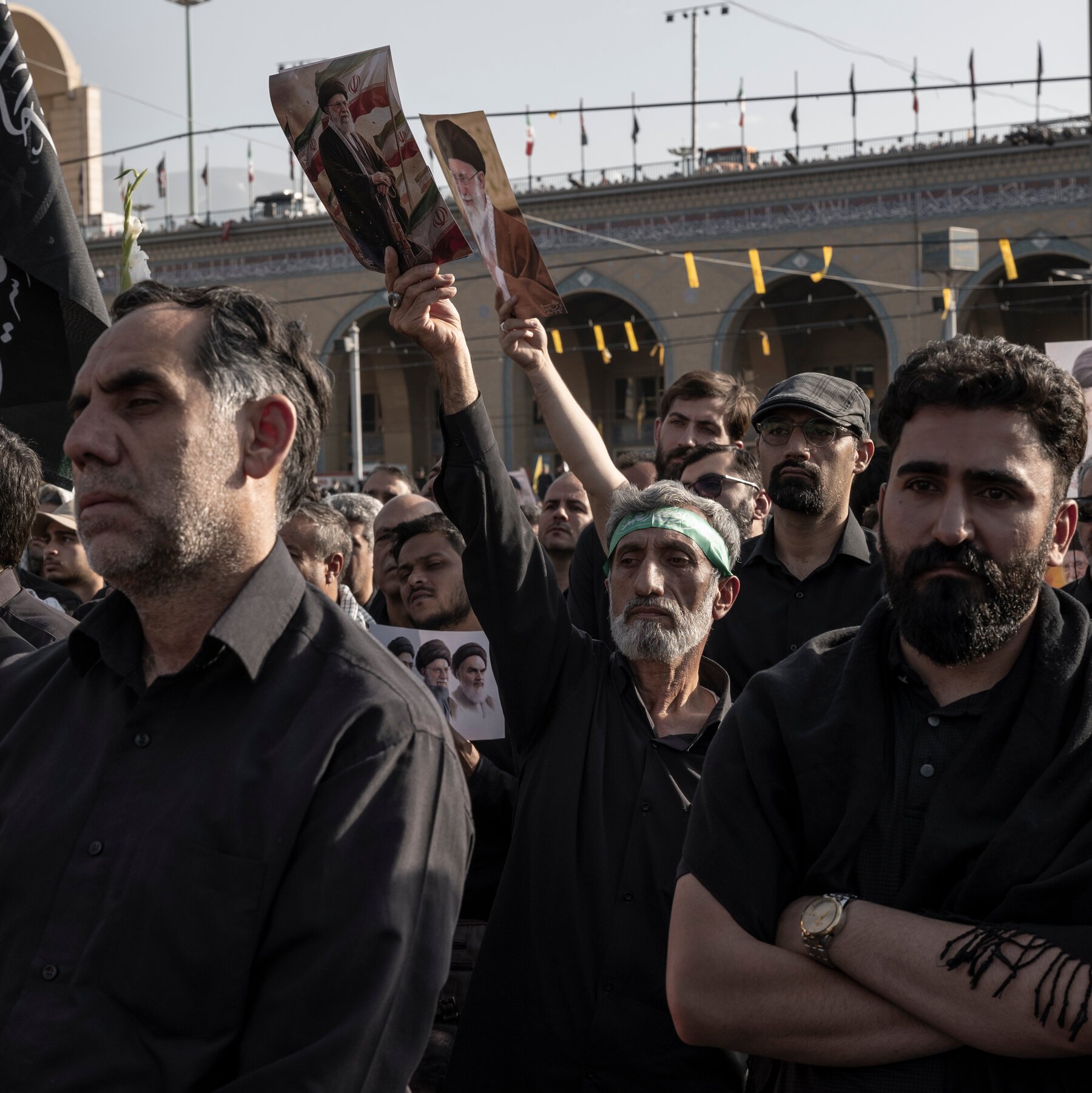
The Telegram channel of Iran's Tasnim News Agency carried, at 16:31 UTC on 4 July 2026, a hashtagged post titled "The strategic capabilities of martyr Imam Khamenei according to the narrative of the leader of the Islamic Revolution." Half an hour earlier, the Arabic-language Khamenei account on the same platform published a close-up of what it described as the "pure body" of "martyr Grand Ayatollah Imam Sayyid Ali Khamenei" laid out in a prayer hall. The two posts, taken together, do not describe a transition. They describe a canonisation.
The grammar matters. Within hours of an unconfirmed death, the dominant state-aligned channels have locked in a single word — shahid, martyr — and refused to let any other frame compete. That is not reporting. It is the opening move of a succession struggle that will be fought, above all, over who gets to define what the Islamic Republic was.
A word chosen before a body is cold
Tasnim's framing is significant because Tasnim is not a fringe outlet. It is one of the two or three Farsi-language platforms most closely identified with the Islamic Revolutionary Guard Corps, and its English channel has, for years, served as the regime's preferred first translation of internal rhetoric. When Tasnim attaches shahid to a sitting Supreme Leader, it is signalling — to insiders — that the institution has already decided what kind of departure this is. The Arabic Khamenei account repeats the frame in a second language and a second audience.
The Western wire line has been more cautious. As of the time of writing, no Reuters or Associated Press bulletin cited in the thread context confirms the underlying event; both Telegram posts treat the death as already settled fact. That asymmetry — a closed frame in Farsi and Arabic, an open question in English — is itself the story. A leadership change in Iran does not become real for the outside world until Western outlets can confirm it; it becomes real for the Iranian street the moment the correct vocabulary is used.
What the martyr frame buys
There is a domestic logic to the choice. A martyred Supreme Leader cannot be succeeded in the ordinary political sense; he can only be continued. The frame shifts legitimacy away from the clerical institution that must now choose his replacement — the Assembly of Experts, the Guardian Council, the office of the Supreme Leader itself — and onto the leader's person, whose baraka survives him. In practice, that protects the field of candidates who were closest to him and weakens rivals who argued, even privately, that the post-Khomeinist order needed correction.
It also constrains the United States and Israel. A regime that has lost its leader is, by Western analytical reflex, a regime on the back foot; a regime that has gained a martyr is a regime with a cause. The language of "strategic capabilities," which Tasnim borrows from the deceased leader's own published writings, is designed to remind regional adversaries that deterrence outlives the man who built it.
What the frame cannot hide
The structural problem is older than the man. Khamenei inherited an institution built for one ruler and held together, for thirty-seven years, by his personal arbitration of every internal fight. The martyr frame papers over a succession machinery that has never operated in public, on a crisis of this scale, under sanctions, with a weakened economy and an open regional front stretching from Beirut to Sanaa. No amount of vocabulary can substitute for that.
Western coverage, where it engages at all, has tended to default to "who succeeds Khamenei" — as if the answer were a single name. The Iranian evidence suggests the more honest question is whether the institution that picks the name still commands the loyalty of the security services, the bazaar, and the street at the same time. The martyr frame, in other words, is being deployed precisely because that question is open.
Stakes, and what we do not yet know
The immediate losers, if the frame holds, are the domestic reformists who spent the last decade arguing that the post-1989 system had outlived its founding premise. They cannot honour a martyr and dissent from his legacy at the same time. The immediate winners are the IRGC-aligned clerical networks that have spent three decades preparing for exactly this contingency — and the regional partners, Hezbollah above all, who are now being asked to demonstrate continuity in exchange for continued patronage.
What the sources do not specify is the cause of death, the date of any official confirmation, or the identity of any acting leadership in the interim. The Telegram posts treat each as settled; the available material does not let this publication confirm any of them. Until a Western wire or Iranian state television bulletin lands, the martyr frame is a claim about what just happened, not a description of it.
Desk note: Monexus reports the framing already deployed by Tehran's state-aligned channels without endorsing it, and flags the gap between Farsi/Arabic-language certainty and English-language uncertainty as the analytically significant fact.
Wire provenance
This editorial synthesis draws on the following public wire/social posts:
- https://t.me/tasnimnews_en
- https://t.me/Khamenei_arabi