Tehran's mourning choreography and the politics of a public farewell
Iranian state outlets have spent 48 hours framing a farewell procession in Tehran as a national rite. The choreography tells you what the regime wants you to feel — and what it wants you to ignore.
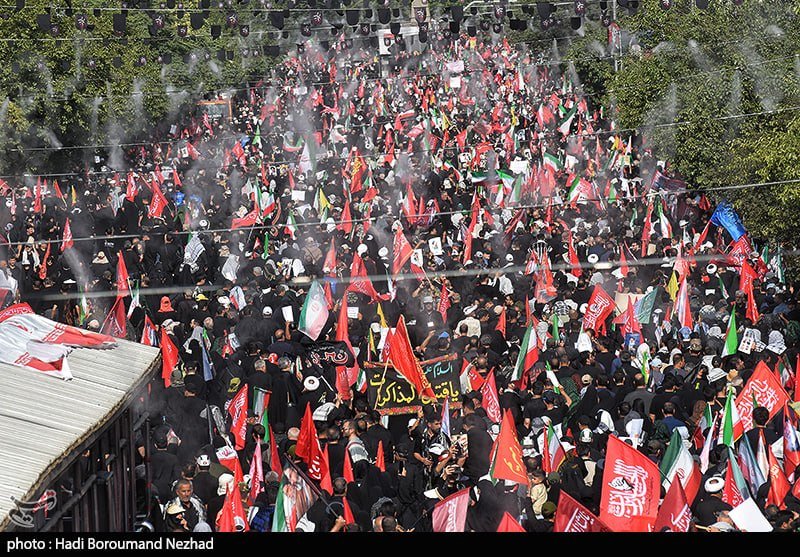
For roughly forty-eight hours, the English-language feed of Iran's Tasnim News Agency has run a single emotional register. The posts do not name the dead. They do not say when he died or how. They offer, instead, a sequence of images and refrains: a father of Iranian children; tears at a mosque before a martyred imam's body enters the farewell ceremony; "you went away, goodbye to the moon and the mirror"; a fire-department spokesperson instructing citizens not to bring private cars into the centre of Tehran. The hash-tag that threads them together — #Badarqa_Aghai_Shahid_Iran — functions less as a label than as a refrain.
Read those posts in order and a familiar pattern emerges: the Iranian state's English-language apparatus does not break news, it stages it. The dead are summoned as archetypes. The crowd is asked to behave as one. And the traffic logistics are issued by a uniformed spokesperson whose presence in the feed signals that the choreography is an official production. The absence of a name is itself the headline.
What the feed actually shows
The five wire items running on Tasnim's Telegram channel between 05:38 UTC and 07:10 UTC on 4 July 2026 are short, repetitive, and intensely curated. They describe a crowd weeping as a body is brought into a Tehran mosque for a farewell ceremony; they quote mourners addressing the deceased as a father figure to Iranian children; and they carry a fire-department advisory asking the public to use public transport to reach the ceremony rather than private cars. The visual material — photographs of crowds, of an empty road being cleared, of a flag-draped coffin — is distributed alongside the same hashtags across each post.
What the feed does not contain is also worth noting. There is no casualty bulletin with a cause of death. There is no date of the killing. There is no institutional byline beyond Tasnim itself. The deceased is described as a "martyred imam," a phrase with a long history in Iranian state discourse, but the underlying event — strike, assassination, or natural death — is not specified in the items available to this publication.
The counter-read
Two readings are available, and a serious account has to hold both. The first is the regime's own: a revered religious figure has been killed, the public is grieving authentically, and the state is performing its duty by managing a dignified farewell. On this reading, the fire-department advisory and the orderly crowd footage are evidence of competence, not control.
The second reading is structural. Iranian state media has decades of practice in converting a single death into a national rite. The grammar is recognisable: anonymising hash-tags that reframe the dead as collective property, crowd imagery shot from angles that maximise density, advisories that double as mobilisation tools. The English-language feed exists primarily for outside consumption; the repetition is not for Iranians, who already know, but for foreign correspondents, diplomats, and analysts who will quote the wire. The choreography is itself the message.
Neither reading cancels the other. The grief on those streets, if genuine, is genuine; the framing of that grief is still a political act.
Why the silence on the cause matters
A farewell of this scale, with traffic restrictions across central Tehran, would in most countries be preceded by a clear, dated statement: who died, when, and how. The Tasnim feed offers none of those things. That silence narrows the interpretive space considerably. Western and Iranian opposition outlets will, in the coming days, attempt to reconstruct the underlying event — and the gap between their reconstructions and the official version will itself become a story. Foreign ministries in Washington, London, and the Gulf will be reading the same five posts and asking the same question: who, exactly, are we being asked to mourn, and what are the political costs of joining the refrain?
For Tehran's regional adversaries, the absence is an opportunity. For Gulf media and Israeli outlets, an un-named "martyred imam" is a useful blank canvas on which to project competing narratives — Iranian martyrdom complex, regime manipulation, sectarian mobilisation. For ordinary Iranians, the practical question is more mundane: whether the city will function on Monday, whether the metro will be free, whether the bazaars will reopen on time.
What to watch
Three things will become clearer in the next 48 hours. First, the identity and office of the deceased, once Iranian-language outlets break the embargo. Second, whether foreign governments send representatives to the ceremony, which would signal diplomatic weight behind the mourning. Third, whether opposition channels inside and outside Iran produce footage or testimony that contradicts the official choreography — and how the state responds if they do.
Until then, the English-language wire is doing what it is designed to do: not telling you what happened, but telling you what to feel about what happened. That distinction is the entire game.
This publication treats state-aligned wires as primary sources for what the regime wishes to project, and not as neutral accounts of underlying events. Where Western and Iranian opposition outlets later produce independent reporting on the underlying death, Monexus will revisit the framing.
Wire provenance
This editorial synthesis draws on the following public wire/social posts:
- https://t.me/tasnimnews_en
- https://t.me/tasnimnews_en/1
- https://t.me/tasnimnews_en/2
- https://t.me/tasnimnews_en/3
- https://t.me/tasnimnews_en/4