Tehran's Taziyeh: a ritual of grief staged against the cameras
State-aligned cameras are documenting the mourning rites of Tasua and Ashura in central Tehran. The footage says as much about the Islamic Republic's media apparatus as it does about the rituals themselves.
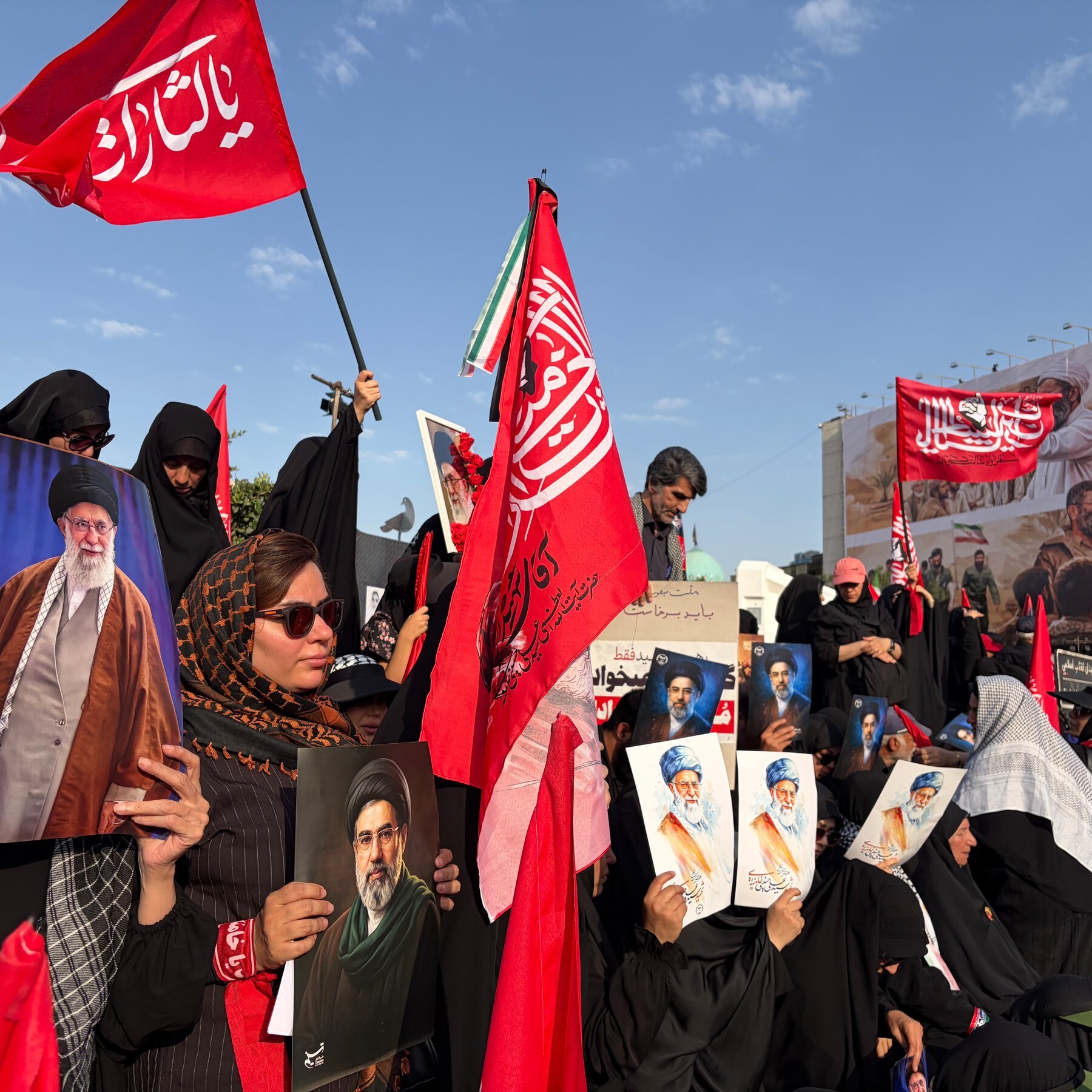
In the courtyard of the Mosala in central Tehran on the eve of Tasua, mourners pressed against roped-off lanes while camera crews from Fars News Agency threaded between them. Frames published by the agency's Telegram channel at 22:29 UTC on 3 July 2026 showed the logistical scaffolding of the ritual as much as the ritual itself: traffic restrictions, marked-off pavements, organised queues of onlookers waiting behind the doors of the complex. By 23:27 UTC the channel was broadcasting the mood inside — "the expectations of the people behind the doors of Mosla" — and at 23:55 UTC it was streaming Nariman Panahi's rokh-khani, the traditional narration of the Karbala epic, from the courtyard. By 00:18 UTC on 4 July, as Tasua fell, the framing had shifted: "today, Tehran's great mosque is not like usual; here, today, a great sadness and longing has cast a shadow."
This is not a neutral news feed. It is the visual grammar of a state-aligned outlet choreographing the most politically sensitive forty-eight hours in the Shia calendar — Tasua and Ashura, the days marking the 7th-century killing of Imam Hussein at Karbala. The substance of the ritual is grief; the substance of the broadcast is governance. Both are worth examining.
What the cameras are actually showing
The four clips published between 22:29 UTC on 3 July and 00:18 UTC on 4 July follow a deliberate sequence. First, traffic restrictions and perimeter management at the Mosala, signalling the security perimeter that descends on central Tehran each Ashura. Then, the human queue: ordinary Iranians waiting to enter the complex. Then, the canonical act — the rokh-khani, a recitation performed from a raised platform, here by Nariman Panahi, a well-known performer of the form. Finally, the editorial caption that converts the entire scene into a national mood statement: a sadness and longing that "casts a shadow" over the mosque.
That sequence is itself the story. Tasua and Ashura are days when the Islamic Republic's ideological legitimacy is most exposed to public scrutiny, and when the regime's rivals — both reformist and secular — read the turnout as a barometer. The official camera is therefore not a passive observer. It is competing, frame by frame, with hundreds of phones in the crowd, each of which can publish its own version of the same courtyard within seconds.
The counter-read the cameras cannot allow
The dominant Western wire line on Iranian religious broadcasting treats it as window-dressing for authoritarian rule — choreographed piety to mask repression. There is something to that. But it is not the whole picture, and presenting it as the whole picture is its own form of laziness.
A more honest reading has to hold two things at once. First, the regime does instrumentalise the mourning: traffic restrictions, vetted camera placements, captions drafted in the editorial register of Fars rather than the colloquial language of the mourners, all of it constructs a national-imaginary version of the day that flatters the state. Second, the rokh-khani is a genuine popular form. Karbala narratives draw crowds that no security service could manufacture, and Nariman Panahi's audience is not a captive one. The state-aligned framing and the lived ritual are running on parallel tracks, sometimes overlapping, often diverging. The footage on Fars's Telegram is the seam where they meet.
The structural pattern, in plain language
What this scene illustrates — beyond the theology — is a recurring problem of media systems everywhere, just in a more concentrated form than most. When the state owns or steers the principal camera in the courtyard, and when the principal camera is also the principal editor, the news product becomes inseparable from the regime's self-presentation. The hazard is not that the broadcast lies; it is that it tells the truth selectively, at the rhythm of the state's needs. The traffic restrictions become the lead; the queue becomes colour; the rokh-khani becomes atmosphere; the editorial line becomes the headline.
This is not unique to Iran. The same logic runs through any tightly held broadcaster covering its own patron's rituals, whether in Moscow, Pyongyang, or a statehouse in any democracy. The difference in the Iranian case is the size of the gap between the official narrative and the dissent that travels on parallel networks — reformist outlets, diaspora Persian-language media, and the ungovernable torrent of phone footage that no traffic restriction can fully contain.
What is genuinely uncertain
The footage tells us that the organisers wanted the world to see orderly crowds, popular veneration, and the gravity of the day. It does not tell us how many people were actually present, what they were chanting in the parts of the courtyard the cameras did not cover, or how the security perimeter was enforced at the perimeter's edges. It does not tell us what the reformist and secular Iranians who observe Tasua in private, or not at all, made of the broadcast. The Fars framing is a confident read of national mood; it is not, on its own, evidence of one.
The honest assessment is this: the cameras at the Mosala are doing exactly what state-aligned cameras at state-aligned rituals always do. They are producing the version of the day the regime wants archived. The ritual itself is older, larger, and more contested than any single frame can hold.
This publication's framing differs from the wire in two ways. We have treated Fars's Telegram feed as primary editorial material rather than as neutral reportage, on the grounds that a state-aligned outlet producing the only live frames of its own patron's ritual is not in the same epistemic category as a wire correspondent filing from the press pen. And we have held open the space between official framing and popular practice, rather than collapsing the day into either pure state propaganda or pure popular piety.
Wire provenance
This editorial synthesis draws on the following public wire/social posts:
- https://t.me/farsna
- https://t.me/farsna
- https://t.me/farsna
- https://t.me/farsna