When the World Cup stops being a tournament and starts being a prediction market
France beat Paraguay 1-0 on a Mbappé goal on 4 July 2026. The match itself is almost beside the point: prediction markets now sit on top of the broadcast, treating the announcer's word choice as a tradable asset.
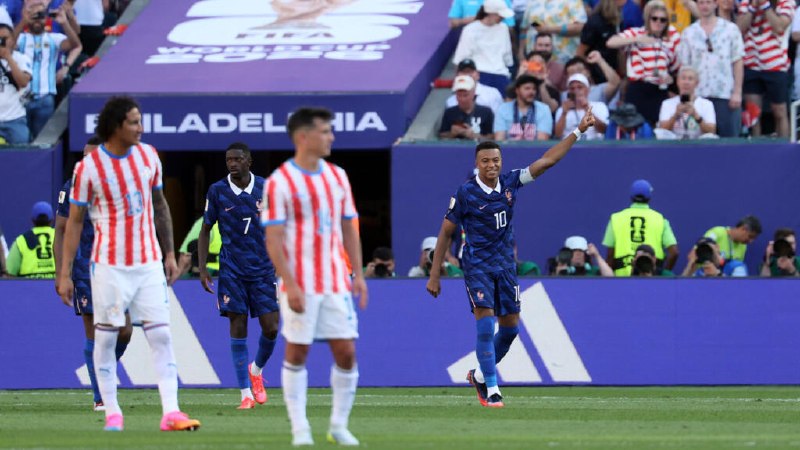
On 4 July 2026, Kylian Mbappé put France ahead of Paraguay inside the opening phase of their World Cup meeting, a fixture that, on the field at least, looks like the kind of thing Mbappé does. The goal itself, the channel wfwitness flagged across two Telegram posts at 22:34 and 23:05 UTC on 4 July 2026, settled the scoreboard. France eliminated Paraguay, 1-0.
The match is not the interesting story. The interesting story is what is now growing on top of the match.
The framing that deserves scrutiny isn't "Mbappé scored." It is the moment a fan opens a tab on their phone and has to decide whether Mbappé's next goal is a near-certain trade, and whether the phrase the commentator uses to describe it ("clinical", "poacher's finish", "the hat-trick hero") has its own real-time price tag attached. The 2026 World Cup is being treated, simultaneously, as a sport and as a financial instrument — and the conversion is happening faster than the rule books can keep up.
Trading the broadcast, not the pitch
Prediction-market outfits are now running markets on World Cup commentary in real time. Polymarket listed a market titled "What will the announcers say during Paraguay vs France World Cup Match?" on 3 July 2026, the day before kickoff. A separate market on the Argentina vs Cape Verde match went live on the same platform the day prior.
These are not markets on the result. They are markets on the language used to describe the result. The tradable thing is a commentator's vocabulary.
That distinction matters. A bet on France to win is a familiar kind of wager, the kind Las Vegas has been writing for decades and that US states have legalised in various forms. A bet on whether the on-air voice reaches for "clinical" or "world class" at the moment Mbappé slots the ball home is something else. It is a market on a performative utterance, priced and priced again, second by second, by people who are watching the same broadcast.
The pitch is the substrate. The product is the broadcast.
What changes when commentary becomes an asset
Once a market exists on commentator word choice, several things happen at once, none of them obviously healthy for the underlying sport.
First, the boundary between coverage and advertising collapses. Any in-game observation is now a potential price-mover. A commentator who shouts something quotable becomes, momentarily, a market participant, whether they want to be or not. The incentives on producers drift toward moments that are easy to translate into the trading interface.
Second, broadcasters who have spent a generation arguing they are not bookmakers — that they are simply showing the game — inherit bookmaker obligations, including the obligation to be neutral, the obligation to disclose material information, and the obligation to defend against market manipulation. They have not, in any visible sense, asked for these obligations. They have simply been priced into them by a parallel market sitting on top of their signal.
Third, the integrity of the underlying match gets reframed. When the tradable layer is the commentary, the question is no longer "did Mbappé score" but "how was Mbappé's goal narrated, and by whom, in what half, against which opponent." That is a narrower question, and it is more tractable. Markets optimise for tractable questions. They do not optimise for the sport itself.
What the framing has trouble admitting
The standard defence of these markets is the same defence given for every novel derivative: it is just price discovery. It is just liquidity. It is what the audience wants.
That defence deserves to be pressed on. Price discovery is a useful answer when the underlying thing is hard to value — say, the future price of wheat, or the credit risk of a corporate borrower. It is less obviously useful when the underlying thing is a comment made by an announcer on a feed the trader is already watching. In that case, the market is not discovering a price. It is actively shaping the broadcast environment, by paying attention to one feature of the feed and ignoring the rest.
There is also a quietly uncomfortable fact about who benefits. The platforms running these markets earn transaction fees on every trade. Broadcasters earn nothing from the market layer built on top of their work, unless they have negotiated a deal that the public record does not yet disclose. The audience trades its attention for the chance to participate in something that, on a moment-by-moment basis, mostly hands fees to the platform.
And there is the matter of jurisdiction. The legal status of event-contract trading on sports outcomes has been fought over in US courts for years, with some platforms withdrawing from particular states under regulatory pressure. The status of markets on commentary is even less settled. The contracts exist. The law has not caught up. The arbitrage, as ever, is to operate before the law does.
Stakes: the World Cup as substrate
If this model proves durable, the 2026 World Cup becomes the template rather than the experiment. By the 2027 edition, every match will plausibly carry a parallel set of commentary markets. By the 2030 edition, no major broadcaster will be able to pretend that the trading layer is not part of the product they are delivering.
The Mbappé goal will keep being scored. France will keep advancing or being knocked out. Paraguay will go home. But the thing the audience watches — the broadcast, the wording, the moment a commentator reaches for one adjective over another — becomes a tradable surface in its own right.
The sport survives. What grows on top of it is no longer the sport.
Desk note: this article leans on two sports-news Telegram posts and two Polymarket market listings. Wire-level outlets covering the match as a match were not yet available in the thread at the time of writing; the framing analysis proceeds from the listing data and the channel context rather than from reporter-on-the-ground match coverage.
Wire provenance
This editorial synthesis draws on the following public wire/social posts:
- https://t.me/wfwitness
- https://t.me/wfwitness