Charles Seliger and the Quiet Tradition of Looking Closer
A Hyperallergic retrospective on Charles Seliger, who joined the Abstract Expressionist circle as a teenager and spent six decades drawing what the eye cannot see — the geometry inside a leaf, a seed, a cell.
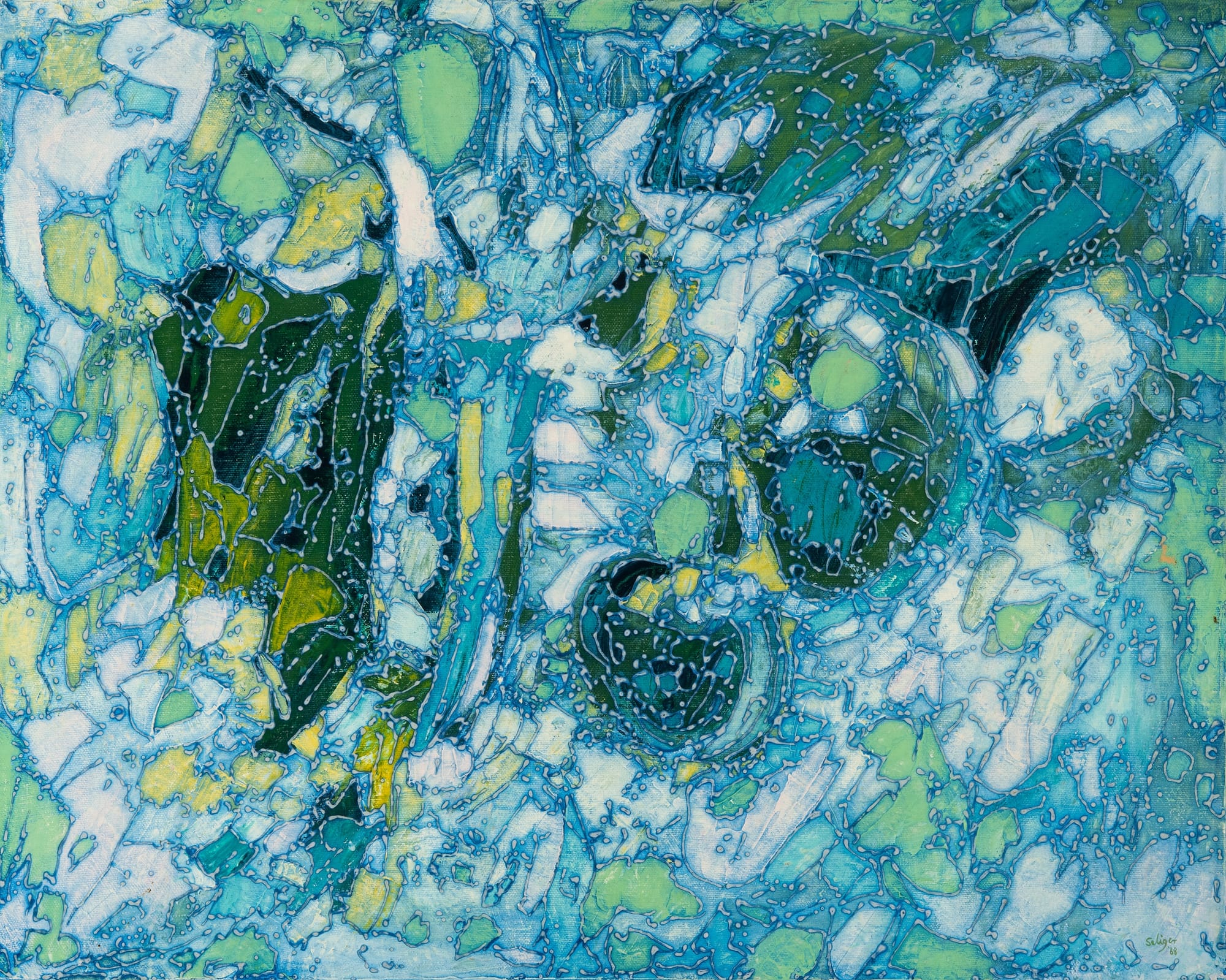
On 4 July 2026, Hyperallergic published a long-form retrospective on Charles Seliger, the painter who entered the New York School as a teenager and spent the next sixty years mapping structures too small for the naked eye. The piece, filed by the outlet's editorial team under the headline "Charles Seliger Painted Nature's Invisible Architecture," treats Seliger not as a footnote to Abstract Expressionism but as a parallel case — a painter who absorbed the gestural vocabulary of his elders and immediately began to bend it toward something closer to microscopy.
The thesis worth underlining is plain. Seliger's career is a useful corrective to the standard story of postwar American abstraction, which tends to flatten its protagonists into a handful of macho silhouettes. The standard story rewards scale — the drip, the slash, the all-over field. Seliger worked small, slowly, and with a magnifying glass.
A painter in the orbit, but off-script
Seliger came up inside the orbit of the Abstract Expressionist generation — artists associated with the galleries and bars of Tenth Street in Manhattan in the late 1940s and early 1950s. According to Hyperallergic, he was among the youngest painters to participate in that milieu, an early membership in a movement that prized improvisation and a sense of painterly risk.
But the Hyperallergic account makes clear that Seliger's instincts ran the other way. Where his peers tended to treat the canvas as a site of confrontation — with the self, with the viewer, with the history of European painting — Seliger treated it as a site of observation. He drew, in meticulous layered oil, forms that recalled seed pods, cellular cross-sections, leaf venation, and the lattice of bone. The reference points were not de Kooning or Pollock, but rather the natural-history illustrations of the nineteenth century and, increasingly as his career progressed, the optical instruments of the mid-twentieth-century laboratory.
The effect, as the Hyperallergic piece describes it, was an art of patient accretion: small marks, repeated, building up into geometries that suggest growth rather than gesture.
The counter-narrative: an outlier, or just an unfashionable taste for detail?
The dominant story of postwar American abstraction has, for half a century, been told as a story of triumph. Pollock on the cover of Life in 1949. Rothko at the Four Seasons. The United States Information Agency shipping the movement overseas as soft power. Against that arc, a painter who spent decades depicting the inside of a bean pod is, by construction, an outlier.
There is a plausible counter-narrative. Seliger's relative obscurity may not be a verdict on the work but a verdict on the work's unfashionable allegiance to representation, however abstract. The dominant line — that the great American painting of the mid-century was the painting that gestured at nothing but itself — was always a curatorial preference, not a fixed law. Seliger's paintings, which always pointed outward at the world, sat awkwardly inside a story built on the opposite premise. The Hyperallergic retrospective reads in part as an act of recovery: a reminder that the New York School was wider than its mythology suggests.
What the microscope gives the canvas
The structural move of Seliger's career, the through-line the Hyperallergic piece traces, is the decision to treat the natural world as a source of formal vocabulary. The cell, the leaf, the seed, the bone. Each becomes a problem of structure: how does a thing hold itself together at the scale where the eye gives up?
This is, in plain terms, a tradition in American art — one that runs from the nineteenth-century naturalists through the pattern-and-decoration movement of the 1970s, and into contemporary painters and sculptors who work from scientific imaging. Seliger belongs to that tradition, even as the dominant mid-century story tried to make such looking unfashionable. The Hyperallergic framing is at its strongest when it places him inside that longer arc, rather than as a quirky member of a movement that did not quite want him.
The deeper argument, made implicitly across the piece, is that a painting's scale and pace are choices with political weight. A canvas that takes months to build, made of marks no wider than a fingertip, insists on a kind of looking that the gestural sublime does not reward. Seliger asked the viewer to lean in. The dominant idiom of his moment asked the viewer to stand back.
What the record does not resolve
Two things remain genuinely uncertain. First, the Hyperallergic piece is a single editorial intervention in a longer conversation about Seliger's place; it is not the final word. The institutional valuation of the work — auction records, museum acquisitions, scholarly monographs — is the metric by which a career is finally placed, and on that score the sources reviewed here do not give a complete picture. Second, the question of how the cellular and botanical motifs should be read — as a private devotion, as a quiet political-ecological statement, or as a formal exercise in geometry borrowed from nature — is one the artist himself, in the absence of extensive published statements in the source material, does not resolve for us.
What the Hyperallergic piece does establish is that the work is coherent, durable, and worth sustained attention. Six decades of looking, with the same instrument, at the same world, is not a small thing.
This Monexus piece treats Seliger as a counter-example to the dominant mid-century story rather than as a forgotten genius in the romantic sense. The work is what is worth attention; the framing is a recovery, not a coronation.