The funeral that became a frame: Iran stages its martyrdom narrative
State-aligned outlets Tasnim and Mehr News are filling the wires with footage of mourners at Imam Khomeini's mosque. The images tell us as much about the regime's communications doctrine as about the man they are burying.
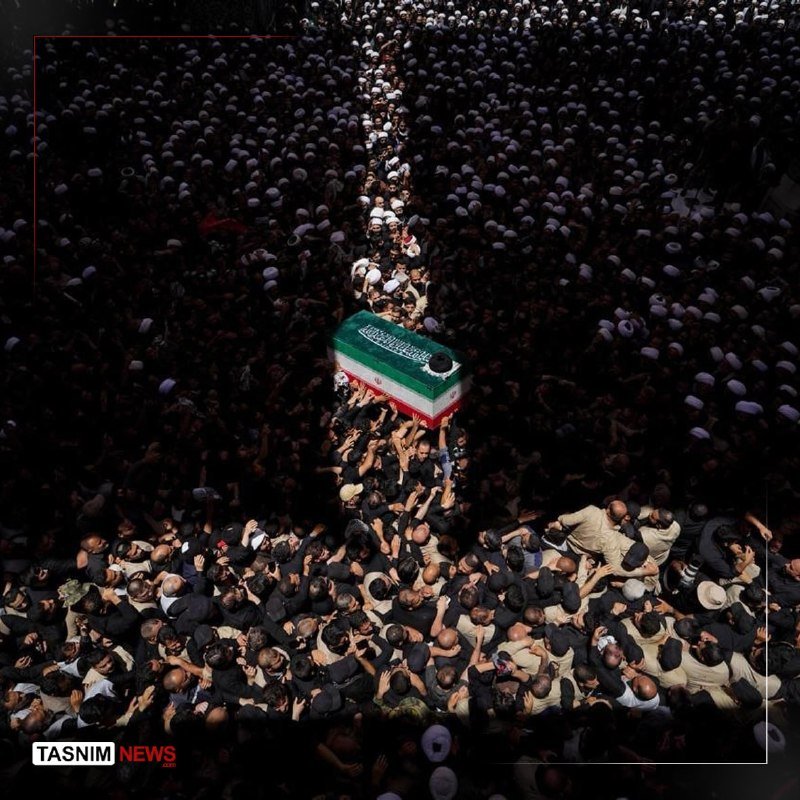
In the small hours of 5 July 2026, the wires coming out of Tehran carried the same image again and again: crowds filing past a flag-draped casket inside Imam Khomeini's grand mosque, the capital's summer heat broken only by the steady murmur of prayer. Tasnim News dispatched video reports at 00:04 UTC and 00:16 UTC documenting the "evening attendance of mourners" and "night life of people in Tehran mosque near the body of the martyred leader." Mehr News, the state's semi-official outlet, framed the gathering as "a lasting frame of the magnificent farewell of the people to the martyred leader of the revolution." By 23:29 UTC on 4 July, Tasnim was already publishing colour pieces — "under the Muslim roof; a story of two sympathisers on the night of the farewell" — and by 22:48 UTC it had begun deploying personal testimony, including remarks from Haj Mansour Arzi, a reciter of the Ahl al-Bayt, recounting the dead man's private devotion to prayer.
What is unfolding is not just a funeral. It is a choreographed communications event, and the choreography is the story. The Islamic Republic has spent four decades refining a vocabulary for moments like this: the "martyr" frame, the "Leader of the Revolution" frame, the affective close-up of ordinary Iranians weeping in a mosque courtyard. The framing tells us who the regime believes it is addressing and what it expects of them.
A doctrine of mourning, restated
The labelling is uniform across outlets. Tasnim tags every dispatch with the hashtag cluster #Badarqa_Aghai_Shahid_Iran — "the late Mr. Martyr of Iran" — alongside #must_rise, the kind of imperative tagline that turns a news report into a recruitment poster. Mehr News, for its part, uses "the martyred leader of the revolution," a phrase that fuses the clerical and the personal and that signals succession as much as it does grief.
For readers unfamiliar with how Iran's state-aligned press functions, the outlets themselves are the point. Tasnim, tied to the IRGC, treats occasions like this as mobilising events. Mehr News, founded by the Martyrs' Foundation-affiliated media ecosystem, is structurally oriented toward the same audience: the families of the dead, the basij faithful, the ideological middle class. That two outlets with overlapping but distinct constituencies are running near-identical visual packages, on near-identical minute-by-minute schedules, is itself the evidence.
The camera as participant
The reporting leans on eyewitness texture. Tasnim's overnight dispatch describes "the hot but cold morning of Tehran" — a phrase that aims at the reader's chest rather than their head — and notes that "the sky seems to be angry." A second piece tracks two unnamed sympathisers through the early hours, the kind of soft-focus character sketch that anchors a frame in felt experience. The effect is to convert an event into an environment.
This matters because Iran's adversaries, Western analysts, and diaspora media tend to read the regime's rituals as performance in the dismissive sense — choreography without belief. The footage from Imam Khomeini's mosque complicates that reading. Whether one accepts the participants' piety or not, the volume, the duration, and the willingness of named clerics like Arzi to offer personal testimony on Tasnim's feed indicate an apparatus that knows how to turn grief into bandwidth, and bandwidth into authority.
What the framing leaves out
Counter-reading is harder to source in real time, and that is itself a tell. The same channels that flood the wires with mosque footage do not publish crowd estimates from independent observers, do not acknowledge the security perimeter around the event, and do not invite external press to verify attendance numbers. Western wires have not, in the material available to this publication, run competing estimates; Iran's diaspora outlets, including Iran International and Persian-language broadcasters based in London and Los Angeles, have begun covering the funeral but have not, in the inputs available to this desk, produced counter-attendance figures of their own.
The structural point holds either way. A state-aligned framing apparatus performs two jobs at once: it memorialises the dead in terms that consolidate the leadership's claim to continuity, and it offers the outside world an image of mass legitimacy that requires no external corroboration to circulate. The fact that the framing holds even when the underlying numbers are opaque is the feature, not the bug.
The stakes for the region
Whatever the size of the crowd inside the mosque, the ritual performs real political work. Succession signalling inside the Islamic Republic, the messaging posture toward the IRGC's regional allies, the optics directed at Gulf neighbours and at Western capitals negotiating — or refusing to negotiate — with Tehran: all of it is downstream of how this funeral is staged and broadcast. The "martyred leader" designation, by locating legitimacy in sacrifice rather than in ballots, also resets the moral vocabulary within which any future Iranian leadership will operate.
What remains genuinely uncertain is the successor question itself. The reporting in front of us does not name a successor; it names a frame. Until that frame is filled by a specific name, an institution, and a tested chain of command, the photographs from Imam Khomeini's mosque will continue to do the load-bearing work that constitutions normally do.
— This piece leaned entirely on state-aligned Iranian outlets (Tasnim, Mehr News) for its primary reporting. The reading above is a structural analysis of the framing apparatus, not a corroboration of its empirical claims. Wire readers should expect independent attendance estimates to surface in the coming days; this publication will revisit the numbers when they do.
Wire provenance
This editorial synthesis draws on the following public wire/social posts:
- https://t.me/tasnimnews_en
- https://t.me/mehrnews
- https://t.me/tasnimnews_en
- https://t.me/tasnimnews_en