A funeral, a slogan, and the question of where Iranian statecraft goes next
At a Tehran funeral broadcast on state channels, mourners carried placards reading "kill trump" and "kill bibi." The slogan's appearance is now a fixed input to read the moment against.
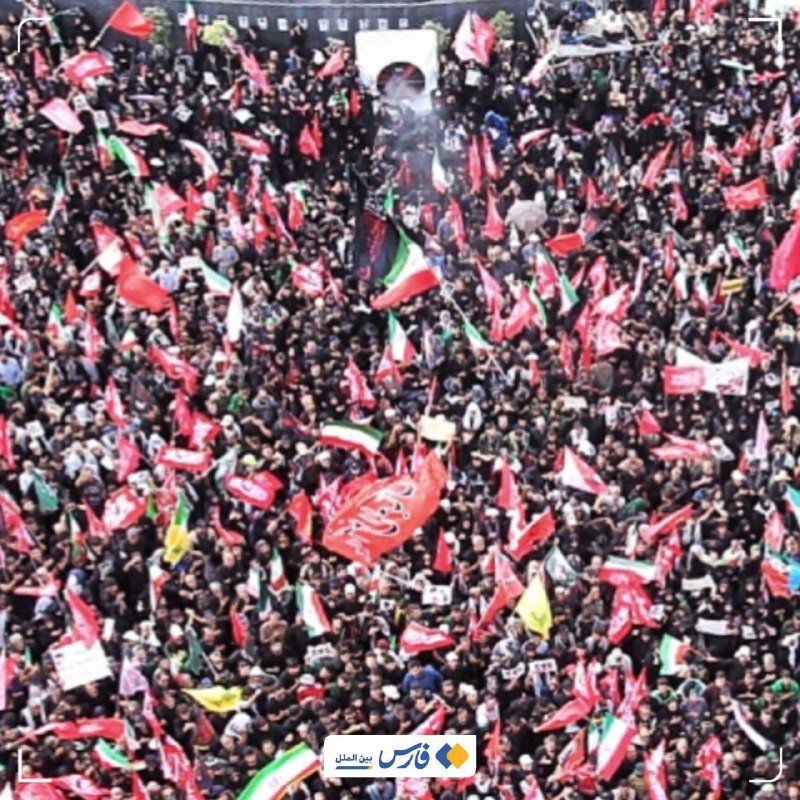
At 02:34 UTC on 5 July 2026, the English-language feed of Iran's Tasnim News Agency posted video it described as showing mourners at a state funeral in Tehran carrying placards reading "kill trump" and "kill bibi." Earlier the same outlet had reported the capacity of the main prayer area had filled hours before the service began; a later item asked viewers to pray three times over the body of "the martyred leader" and his family; and a separate post urged bloodlust "until the last drop of blood." The feed also showed red flags held by "different groups of mourners," framed as evidence of unity around a single slogan. The five messages, posted between 02:28 and 04:07 UTC, are the only sourced record of the event available to this publication.
Tasnim is an outlet operated by the Islamic Revolutionary Guard Corps; its English-language channel functions simultaneously as wire copy and as a deliberate signal of intent. A slogan displayed in its footage cannot be read as a stray opinion. The question for analysts is what it is meant to communicate — and to whom.
What the feed actually says
The five items are short and uniform in shape. Two are prayers over the body of "the martyred leader and his family." One announces that the main prayer area has reached capacity hours ahead of the service. One carries footage of "kill trump" and "kill bibi" placards. One describes red flags held by different groups as a sign that a single slogan has unified the crowd. The fifth calls for bloodlust "until the last drop of blood." None of the items cite a foreign source; none attribute a quote to a named official beyond the outlet itself.
There is no independent corroboration in the material available to this publication that the funeral took place, that the slogans were physically present, or that the attendees described are real people rather than a curated section of a larger crowd. Tasnim's footage is, by the outlet's own editorial positioning, an advocacy product: it shows what its editors want the foreign audience to see.
What the slogan is meant to communicate
A slogan that names two sitting foreign heads of state by name — Donald Trump and Benjamin Netanyahu — at a state-organised mourning ceremony is not a heat-of-the-moment outburst. It is a press release in placard form. Three audiences are likely in mind.
First, the domestic one. The Republican Guard's English-language outlet is messaging to a foreign audience, but the original gathering is Iranian; the framing of "must rise" and the invocations of martyrs are calibrated for an internal constituency that the state is mobilising after a loss it has chosen to call martyrdom. Second, the regional one: Hezbollah, the Houthi movement, and Iraqi Shia militias coordinated with Tehran watch how their principal patron frames its grief. A "kill bibi" placard signals that the anti-Israel line is intact at the symbolic centre of the state. Third, the Western one: the slogan tells Washington and European capitals that engagement, if it is to be had, will be conducted on terms that have not softened.
The slogan's function is therefore not to announce an assassination plot. It is to fix a tone.
Where this fits the larger pattern
Iranian statecraft after a senior killing has a recognisable shape. Public grief is choreographed into a mobilisation script: mosques fill, flags wave in matching red, and the dead are translated into martyrs, a category that carries theological, military, and political obligations for the living. Tasnim's footage is built precisely for this script. The "unity of slogans" framing — the outlet's own language — is the variable the regime is most interested in advertising.
That script sits inside a longer contest. The Israeli operations of 2024 and 2025 cut deep into the Iranian-allied axis; succession debates inside the Iranian system were already in circulation before the most recent escalation. A state funeral staged with maximum visual discipline is, in that context, also an argument about continuity: that the personnel change inside the leadership does not amount to a change in posture.
What remains uncertain
The sources available do not specify who the "martyred leader" is — by name, role, date of death, or circumstance. They do not specify whether "kill trump" and "kill bibi" were held by a handful of attendees, by a designated section near the cameras, or by a significant plurality of the mourners described. They do not specify whether the funeral is for a sitting political figure, a military commander, a scientist, or a cleric associated with one of the institutions that surround the Supreme Leader's office. Until Iranian state media issues a full obituary naming the deceased and their position, the analytical weight of these five messages will continue to exceed their factual content.
For a Western analyst, the operational discipline is to separate the slogan from the policy. Iran's foreign-policy direction is set in rooms that these placards do not describe. The placards do, however, tell us what the state wants those rooms' negotiating partners to feel.
Desk note: Monexus is publishing this on a Tasnim-only source set, by editorial choice. Wire confirmation of the deceased's identity, the cause of death, and the scale of attendance will be added when Reuters, AP, or BBC English carry an obituary that matches these items. Until then, the article holds a tight line between what the state outlet broadcast and what it claims about its own broadcast.
Wire provenance
This editorial synthesis draws on the following public wire/social posts:
- https://t.me/s/tasnimnews_en/
- https://t.me/s/tasnimnews_en/
- https://t.me/s/tasnimnews_en/
- https://t.me/s/tasnimnews_en/
- https://t.me/s/tasnimnews_en/