Iran stages a martyr's farewell — and the framing war begins
State-aligned channels broadcast the funeral of the Islamic Republic's martyred leader. The ceremony doubles as a domestic legitimacy test and an external signal — and Western wires have barely begun to parse it.
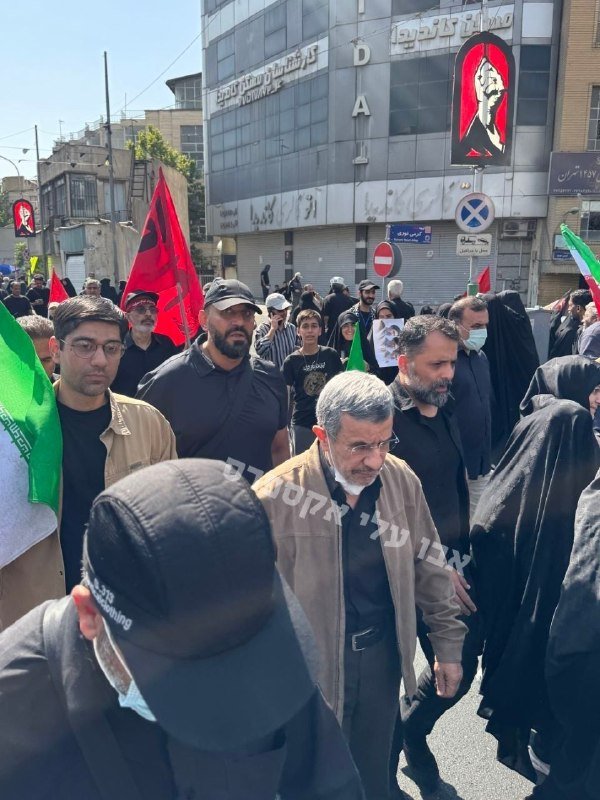
In the small hours of 5 July 2026, two Iranian state-aligned outlets ran almost identical frames within minutes of each other. Al-Alam Arabic posted at 04:29 UTC that the funeral prayer over the body of the Islamic Republic's martyred leader had begun at Imam Khomeini Mosque in Tehran. Tasnim English followed at 04:40 UTC, adding a single, jarring detail: alongside the senior clerics and security chiefs stood the small coffin of Shahida Zahra Mohammadi Golpayegani, the fourteen-month-old granddaughter of the departed leader, also described as a martyr of the Revolution.
The synchronised framing matters more than the ceremony itself. Iran's state-aligned media apparatus has spent the hours since 03:00 UTC staging a controlled image of national grief — heads of forces assembled in the mosque (Al-Alam, 04:28 UTC), religious recitations timed to the prayer (Tasnim, 04:19 and 02:56 UTC), and the technical rulings of the janazah delivered hours before the body arrived (Al-Alam, 03:57 UTC). For Western wires still catching up on the underlying death, this is the picture they are being handed. The question is whether they will pass it through unfiltered.
The ceremony as choreography
Iranian state media has not left the framing to chance. The sequence is deliberate: pre-dawn laments in the mosque, the formal statement of funeral rulings, the staged arrival of the heads of the armed forces, and finally the prayer itself. Al-Alam's posts function as colour narration; Tasnim's function as doctrinal captioning — the hashtag architecture around each Tasnim item ("#Badarqa_Aghai_Shahid_Iran", "#must_rise") is itself a kind of editorial. Western correspondents who arrive in Tehran over the next day will be walking into a pre-built visual vocabulary, and the temptation to use that vocabulary straight will be strong.
What the framing does — and what it obscures
The recurring epithet, "Mr. Martyr of Iran," is doing serious work. It fuses a religious concept (shahid) with a nationalist one (Iran) in a way that reaches beyond the cleric's own clerical base. Pairing the infant granddaughter with the senior cleric under the same banner extends that fusion across generations and across the boundary between combatants and non-combatants. The image is being prepared for an audience that includes both the domestic street and sympathetic viewers across the Shia arc — Lebanon, Iraq, Bahrain, parts of the Gulf.
The counter-read is straightforward: a one-party state with near-total control of its own airwaves can stage any framing it wants. That does not make the grief in the mosque unreal, but it does mean the dominant image of the next 48 hours will be the image the apparatus chose to send. The counterpoint is the harder journalistic problem — finding witnesses outside the security perimeter, opposition voices, diaspora reactions, and the views of Iran's Sunni and ethnic-minority citizens, none of whom appear in the Telegram thread.
The wire lag is the story
Western outlets are not in the room. Reuters, AP, the BBC and the Guardian cannot match Tasnim's minute-by-minute access inside Imam Khomeini Mosque. They will buy the same pictures Tasnim and Al-Alam are feeding out, or they will wait for official Iranian state television footage and re-process it. Either way, the visual template for the next global news cycle is being written in Tehran tonight, by Iranian hands, in Farsi.
This is the same structural problem that recurs around any state with a disciplined media machine and limited foreign-press access. The fix is not to refuse the imagery but to surround it. Name the staging as staging. Quote the hashtags. Carry the readings, the laments, the rulings as what the state is broadcasting rather than what happened. Most of all, seek out the voices the ceremony is not built to include.
What is still uncertain
The thread carries no confirmed Western-wire corroboration of the death, no independent verification of the granddaughter's identity, and no explanation from Iranian authorities of the operational circumstances that produced both losses. Tasnim and Al-Alam are the only two sources in the cluster; both are Iranian state-aligned. Reporting that treats their framing as fact — rather than as the official line that requires confirmation — will end up writing the state's own obituary.
What this publication will be watching in the next 24 hours: confirmation of the succession process inside the Islamic Republic's institutions; statements from Washington, Riyadh, Baghdad, Beirut and Moscow; and the first dispatches from Western correspondents actually on the ground in Tehran. Until then, the picture is the Iranian state's, and the framing war is already underway.
How Monexus framed this: where the wire will likely transmit Tasnim's framing with light context, this piece treats the funeral as a media event first and a religious one second — because that is how it was assembled.
Wire provenance
This editorial synthesis draws on the following public wire/social posts:
- https://t.me/alalamfa
- https://t.me/alalamfa
- https://t.me/alalamfa
- https://t.me/tasnimnews_en
- https://t.me/tasnimnews_en
- https://t.me/tasnimnews_en
- https://t.me/tasnimnews_en