Iran's farewell to 'the Shahid of Iran': a state funeral as political choreography
A 97-year-old Grand Ayatollah leads prayers for a man the state calls 'the Shahid of Iran.' The ceremony is as much a message about what comes next as it is a goodbye.
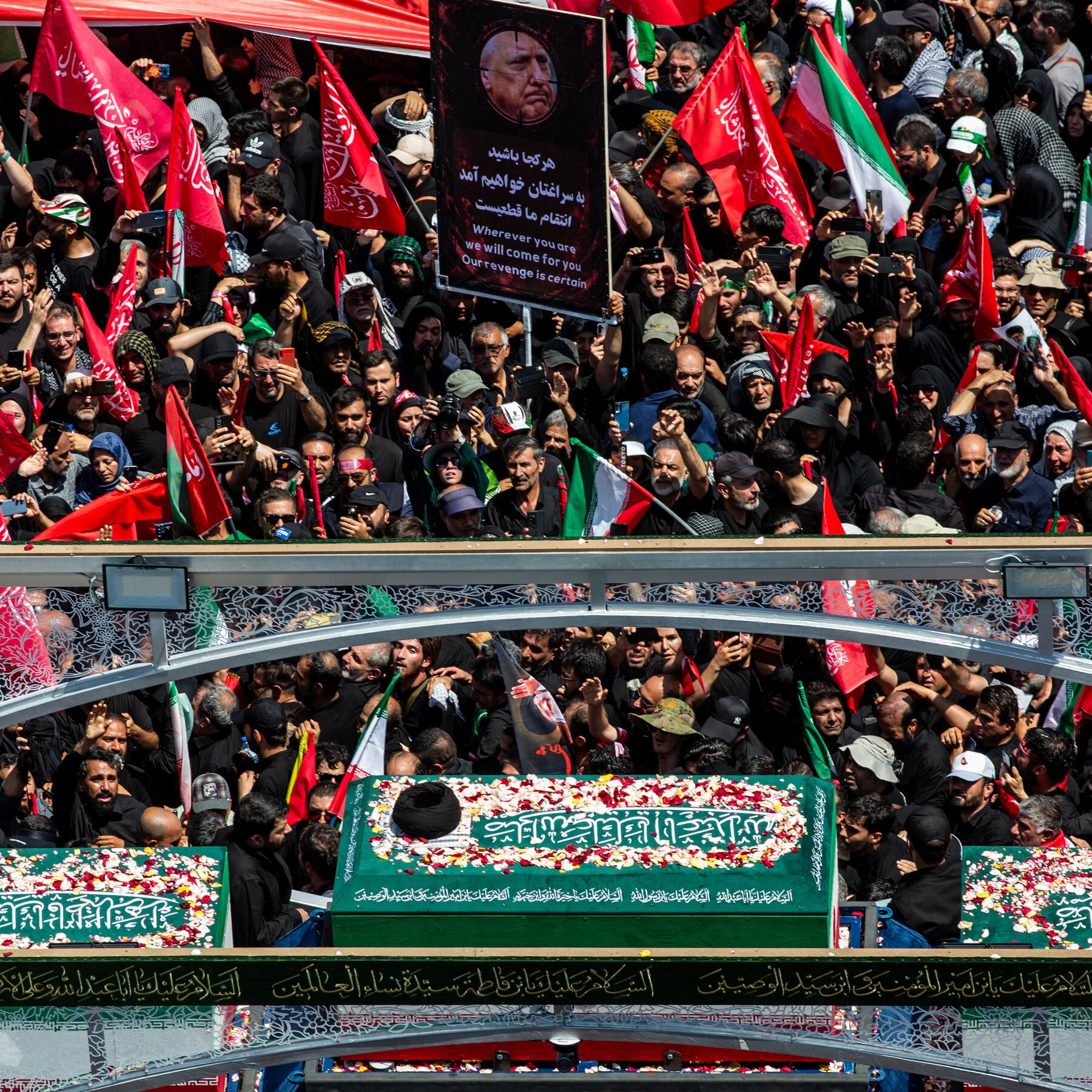
At 02:51 UTC on 5 July 2026, Telegram channels aligned with the Iranian state began reporting that the funeral prayer for a figure referred to only as "Imam Khamenei" — and elsewhere as "Mr. Shahid of Iran" — would be led in Tehran by the 97-year-old Grand Ayatollah Ja'far Sobhani, "one of the most prominent and well-respected religious authorities in Iran," according to a Middle East Spectator wire of the announcement [Middle East Spectator, 2026-07-05T02:51 UTC]. By 03:23 UTC, Mehr News was broadcasting aerial footage of the crowd pouring into the central mosque; by 03:57 UTC the camera was on Beheshti Street, packed with mourners; by 04:34 UTC Sobhani was on the prayer mat, his voice carried on state media [Mehr News, 2026-07-05T03:23, 03:57 and 04:34 UTC]. The choreography was tight, the language reverent, and the identity of the dead conspicuously abstract.
What is on display in Tehran today is not a normal funeral but a succession stress test performed in public. The man the Iranian state is calling "the Shahid of Iran" — "martyr of Iran" — is being treated as an icon whose death must be ritually resolved before the politics of his replacement can begin. Sobhani's role matters: at 97, the Grand Ayatollah is one of the oldest living senior clerics in Qom, and his willingness to lead the prayer is itself a factional signal. The regime has chosen its most universally respected religious authority to sanctify the moment.
The grammar of an Iranian state funeral
Iranian state funerals are not improvised. They are scripted set-pieces in which the choice of officiant, the location of the bier, the chants permitted on state television, and the officials permitted to speak in sequence all communicate a hierarchy. Sobhani leading the prayer signals that the death is being treated as a matter of national — not factional — mourning. The decision to release aerial footage of "the flood of people" inside the mosque, and to publish that footage through Mehr rather than a combatant-aligned outlet, signals that the regime wants the optics of a popular farewell rather than a partisan one.
The use of "Shahid" — martyr — is heavier than translation suggests. In Iranian state vocabulary the term is reserved for figures whose death is read as sacrificial in service of the Islamic Republic's founding narrative. To confer it on a living political figure, even posthumously, is to argue that his life belongs to that story.
What the sources do — and do not — say
The thread material this article is built on is unusually narrow. Four items, all from 5 July, all describing the same event: Sobhani's prayer; the crowd in Beheshti Street; the aerial footage of the mosque interior; and the initial announcement. None of the four items names the deceased beyond "Imam Khamenei" and "Mr. Shahid of Iran." None gives a cause of death, a date of death, or an institutional affiliation beyond the prayer-leader himself. None quotes a family member, an official communiqué, or a successor.
That absence is the story. In a state media ecosystem that normally saturates mourning coverage with biography, hagiography, and succession theatre within hours of a senior figure's death, the reticence is itself a signal: either the announcement has not yet been formalised, or the regime is staging the announcement through ritual before it is staged through text. Readers should treat the identity of "the Shahid of Iran" as something the Iranian state is actively constructing, not something the sources have reported.
The succession question underneath the ceremony
The phrase "Imam Khamenei," used by Middle East Spectator, is the language Iranian state media reserves for the Supreme Leader — the office held since 1989 by Ayatollah Ali Khamenei. If the figure being mourned is the Supreme Leader, then the funeral in Tehran is the first act of a transition that has been deferred for years. Sobhani's role as officiant would then be doubly weighted: the most senior jurist in Qom is not merely burying a head of state but, in effect, consecrating the moment at which his successor will be chosen. The Assembly of Experts, the clerical body tasked with that selection, has not been named in any of the four source items as having met or announced a procedure.
The alternative reading is narrower: "Imam Khamenei" could be a kinship reference — a Khamenei-family member being given a state funeral for reasons of dynastic politics rather than constitutional succession. Iranian state media has historically used the honorific "Imam" sparingly outside the Supreme Leader, but not exclusively for him. The four source items do not resolve the ambiguity.
What the Western wire line will look like, and why it will be incomplete
When Western outlets pick up the footage from Mehr — and they will, because the aerial shots are the only major visual of the day — the framing will almost certainly treat the event as either (a) the death of the Supreme Leader and the start of a succession crisis, or (b) the funeral of a Khamenei-family member and a piece of dynastic theatre. Both readings are plausible on the available evidence. Neither is settled by the four source items this analysis is built on.
The structural point, which sits underneath either reading, is that the Islamic Republic uses religious ritual as its primary mechanism for legitimating political transitions. A Grand Ayatollah leading the prayer is not a detail; it is the constitutional event. The Western press will cover the crowd. The Iranian state is covering the officiant.
Stakes
If the figure being mourned is the Supreme Leader, the regional stakes are immediate. Iran sits at the centre of an axis that runs through Hezbollah, the Syrian corridor, the Iraqi militias, and the Houthi front. A transition at the top does not change Iranian doctrine overnight, but it changes the probability that doctrine will be contested internally, and therefore the probability that Iran's partners will test the boundaries of what is still permissible. Oil markets, which already price a risk premium for Hormuz disruption, will reprice on the first credible successor. The European negotiating posture on the nuclear file — already thin — will need a counterpart.
If the figure is a family member rather than the Supreme Leader, the stakes are lower but still real: the Iranian state has spent political capital on a maximum-effort funeral, which means it needs the moment to do work. That work is most likely internal — a signal to the clerical elite about who in the Khamenei network still commands the choreography of grief.
What remains uncertain
The sources do not name the deceased, do not give a cause of death, do not state the time of death, and do not identify any successor mechanism. The four items are ceremonial in tone and operational in detail — they tell us where the body was, who prayed over it, and how large the crowd was. They do not tell us who died. Until that gap is closed by an official communiqué or a credible wire confirmation, the most analytically honest position is that the Iranian state is performing grief on a figure it has not yet finished defining.
That is, in itself, the point of the performance.
Desk note: this piece was built from four items in a single Telegram cluster, all timestamped 5 July 2026 and all sourced to Iranian state-aligned channels. Where Western wires would lead with the identity of the deceased, this analysis foregrounds the absence — because the absence is what the source material actually shows.
Wire provenance
This editorial synthesis draws on the following public wire/social posts:
- https://t.me/Middle_East_Spectator
- https://t.me/mehrnews