A funeral procession and a vacuum: reading the Khamenei succession signal
Funeral imagery from Tehran is doing more than honouring the dead — it is telegraphing who inside the Islamic Republic gets to define the next era.
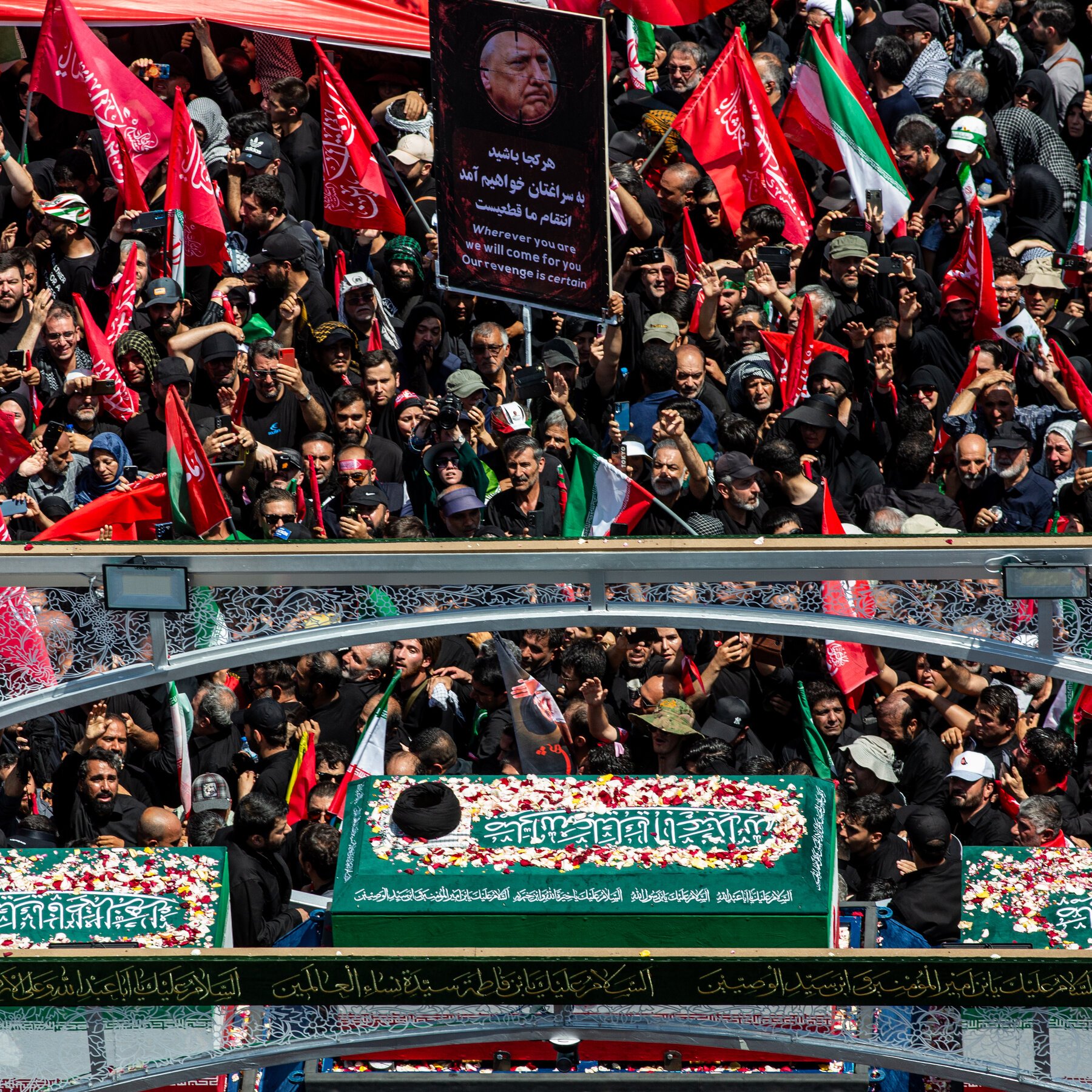
At 04:43 UTC on 5 July 2026, Iranian state-aligned channels Tasnim News and Al-Alam published parallel video of a cleric — identified as Ayatollah Jafar Sobhani, a senior marja — leading prayers over the body of Grand Ayatollah Seyyed Ali Khamenei in central Tehran. By 06:11 UTC, dense funeral processions were already streaming out of the capital, and Tasnim was tagging the footage with a slogan reading, in transliteration, "must rise." Theatrical as that language sounds, it captures the operative question now hanging over the Islamic Republic: who fills the space Khamenei occupied for nearly four decades, and on what terms.
What looks like ritual is, in fact, a credentialing exercise. The names attached to the coffin — and the names conspicuously absent — will shape Iranian politics, the nuclear file, and the regional balance for the next generation.
The choreography of succession
Iran does not pick a Supreme Leader the way a party picks a chair. The Assembly of Experts, a body of senior clerics, vets and votes; the Guardian Council ratifies; the Islamic Republic's security and political elites broker the field. None of that is on television. What is on television, hours after the announcement of a Leader's death, is the assembled clerical hierarchy publicly performing grief and deference. Every frame of Sobhani leading prayer is a message about who is recognised, who is excluded, and whose voice carries weight in the post-Khamenei settlement.
The hashtags Tasnim is attaching — the Arabic-Persian slogans rendered as "Badarqa" and "must rise" — are doing the same work. They signal not just mourning but a preferred narrative direction for the mourning: a martyrdom frame, in which the deceased Leader is absorbed into the Islamic Republic's founding martyrology rather than treated as a politician whose policies are up for revision.
What the imagery does not show
Two things are worth naming out loud. First, none of the official footage released by Tasnim or Al-Alam shows direct statements on the succession from inside Iran's military-security apparatus — the Islamic Revolutionary Guard Corps, the Ministry of Intelligence, or the office of the President. Those are the actors who, in any realistic transition, hold the practical veto. Their silence in the early hours is not neutrality; it is discipline.
Second, the Western-wire ecosystem that would normally be first to read a Khamenei death — Reuters, the BBC, the Associated Press — is not yet on the record in the available footage trail. That gap matters because it means the first global image of post-Khamenei Iran is being set, in real time, by Iranian state media. The framing of "martyred Leader, grieving nation, orderly transition" is the frame the outside world will absorb if no counter-frame arrives within the next news cycle.
A structural reading, in plain prose
A long-supervised political order does not collapse the moment its central figure dies. It re-bargains. What looks like cohesion — televised prayers, mass processions, unified slogans — is in fact the opening round of an intra-elite negotiation in which every actor is signalling alignment to potential allies and warning to potential rivals.
The deeper pattern is that supranational Islamic-revolutionary legitimacy is being tested against domestic Iranian state interests. A Leader who survives as the lone "father of the revolution" for decades has, by construction, suppressed the rivalries that his absence now uncorks. The funeral is the stage on which those rivalries will be performed as consensus.
Counter-frames and what to watch for
The most plausible alternative read is that the funeral imagery is not a contest at all — that the Islamic Republic's succession machinery has, in fact, functioned smoothly for years and will simply ratify a candidate within days. There is real evidence for that view: Iran's institutions are designed to absorb exactly this moment, and the IRGC's silence can be read as confidence rather than as calculation.
What tilts the balance toward "contest," at least for now, is the speed and theatricality of the propaganda output. Restrained transitions do not need slogan hashtags. Theatrical ones do. The next forty-eight hours will tell: if a successor is named without visible factional friction, the funeral imagery was indeed ritual. If the slogans sharpen into named candidate endorsements, or if rival clerical centres begin publishing competing prayer videos, the procession was the first skirmish of the real contest.
The stakes, plainly
Whoever emerges will inherit three live files: the nuclear dossier, the regional axis running through Hezbollah and the Iraqi Shia militias, and an economy under sanctions pressure that has already hollowed out the Iranian middle class. A Leader chosen by the security apparatus would likely harden all three. A Leader chosen through a more clerical-legitimist path might hold the regional posture but ease the nuclear file. A Leader chosen through an internal compromise would muddle through and buy time.
For readers outside Iran, the practical question is narrower: which version of "post-Khamenei Iran" gets to define itself in the global conversation over the next week. The answer is being written, frame by frame, on Iranian state channels right now.
Desk note: This piece reads the early footage against the institutional reality of how Iranian succession actually works, rather than treating the funeral as a stand-alone story. Where the evidence is thin — no IRGC statement yet, no Western-wire confirmation of the death in the footage trail — we say so explicitly rather than smooth it over.
Wire provenance
This editorial synthesis draws on the following public wire/social posts:
- https://t.me/tasnimnews_en
- https://t.me/alalamfa