Tehran's farewell and the succession question the wires will not name
Huge crowds have gathered in central Tehran for the farewell ceremony of Ayatollah Seyyed Ali Khamenei, and the political question his death opens is being treated very carefully in Western coverage.
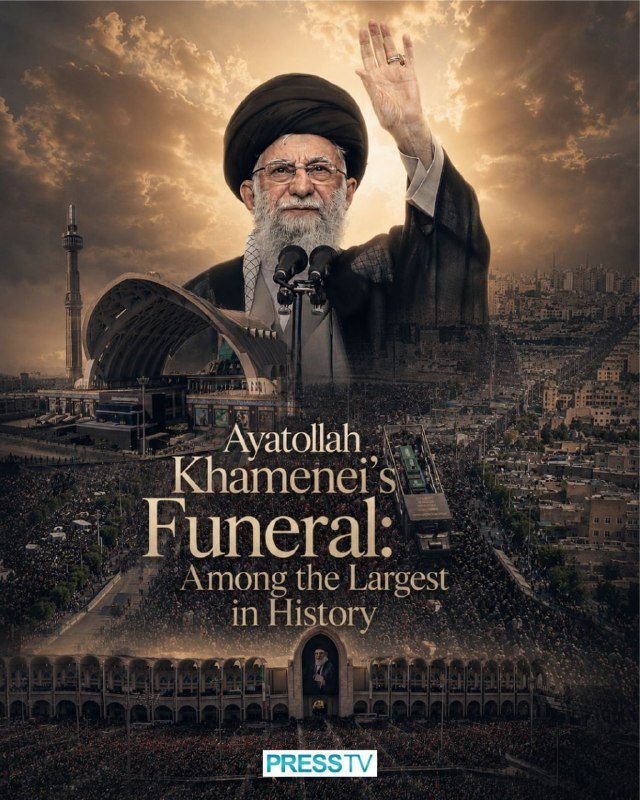
Hundreds of thousands of Iranians streamed through central Tehran in the small hours of 5 July 2026, packing the Grand Mosalla compound and surrounding metro stations well past midnight to bid farewell to Ayatollah Seyyed Ali Khamenei. State-aligned press has framed the turnout as a national rite of passage. The political fact underneath is sharper: the Islamic Republic is now conducting, in real time, the most consequential leadership transition in its forty-seven-year history, and the choreography is being broadcast at maximum volume precisely because the outcome is not yet settled.
The Western wire line on Iran after a leader's death is predictable and, in its own way, honest about its assumptions: a power struggle, a faction fight between so-called pragmatists and hardliners, an opportunity for sanctions leverage, a possible opening. Each of those framings contains a grain of truth and a great deal of projection. The harder question — who actually chooses, by what mechanism, and on what legitimacy — is the one that Tehran's allies and adversaries alike are now watching most closely.
The choreography is the message
The scale of the public farewell is itself an instrument. PressTV's overnight coverage from 4–5 July 2026 described "hundreds of thousands" continuing to throng the Grand Mosalla hours past midnight, with Tehran's metro stations "bustling past midnight" as mourners made their way to the ceremony. The framing — "martyred Leader of the Islamic Revolution," repeated across the network's image captions — is not a translation of an Iranian legal term. It is a deliberate signal that the late Supreme Leader is being placed in a register reserved, in Shi'a political vocabulary, for figures whose deaths carry redemptive weight rather than ordinary mortality.
That choice matters. The Islamic Republic's founding compact rested on a very specific claim: that the jurist-guardian speaks for a hidden imam, and that his authority is not transferable by ordinary political means. When a Supreme Leader dies, the institution that selects his replacement — the Assembly of Experts, in theory; the inner circles of the Islamic Revolutionary Guard Corps and the office of the Supreme Leader, in practice — has to demonstrate that the transfer is continuous, not elective. Crowds of this size, framed in this language, are part of that demonstration. They are evidence, manufactured for domestic and foreign consumption, that the office will not be contested in the street.
What the regional allies are saying out loud
Palestinian Islamic Jihad's public statement, carried by PressTV in the early hours of 5 July 2026, did something unusual. It described Khamenei as a "pillar of support for Palestine" — language that ties the late leader's legacy directly to the armed resistance axis and, in doing so, signals to Tehran's allies that the relationship is not on the table during the transition. The choice of "martyr" in the same statement is a further signal: it places Khamenei in the same symbolic register used for Iranian military commanders killed in action and for senior figures of allied movements killed by Israel.
For Western readers accustomed to a binary of "moderates" and "hardliners" in Tehran, this kind of statement is easy to file as boilerplate. It is not. It is a pre-negotiated public marker from a movement that operates close to the Iranian security establishment, and it tells the next Supreme Leader two things: the regional portfolio is non-negotiable, and the vocabulary around the late leader is being set before the new one is named. Whoever inherits the office inherits the position on Palestine as a fixed asset, not a discretionary policy.
The succession question the wires will not name
Western coverage of Iranian leadership transitions has a recurring blind spot. It treats the post of Supreme Leader as if it were a presidency with a known shortlist, and it spends the days after a death cataloguing candidates by their last public statements on the nuclear file or on relations with Washington. That framing assumes the office is policy-driven and the man is secondary. The institutional reality is closer to the opposite: the office is a structure of clerical and security authority, the man is its current occupant, and the selection process is designed to ratify a continuity the system has already arranged.
The honest version of the question — what does the Islamic Republic become when the founding generation is no longer at the centre? — is rarely asked in those terms on Western op-ed pages, because it implies that the regime is more durable, more ideologically coherent, and more institutionally serious than the standard account allows. A reader who took only the Western press seriously would be left with a portrait of Iran as a brittle theocracy one bad succession away from implosion. The evidence on the ground in the first hours after Khamenei's death — disciplined crowds, pre-coordinated allied statements, a unified state media line — points in a different direction. The system is showing its capacity to absorb a shock of the first order without visible fracture. That is the story, and it is the one the wires are under-serving.
Stakes, honestly stated
For Tehran, the immediate stakes are legitimacy and continuity: demonstrating to its own population, to its regional axis partners, and to its adversaries that the transition is a renewal rather than a rupture. For Washington and its Gulf partners, the stakes are tactical: whether the post-Khamenei leadership is a more manageable interlocutor on the nuclear file, or a more ideological one, and whether the regional axis recalibrates or doubles down. For Israel, the calculus is sharper — the Iranian response to any strike during a leadership vacuum is the most consequential variable in its deterrence planning. For Palestinians in Gaza and the West Bank, and for Lebanese and Iraqi constituencies of the axis, the question is whether the public commitment to the "pillar of support" line translates into the same operational tempo they have lived with for the past two years.
What remains genuinely uncertain, on the evidence available in the first hours, is the identity of the next Supreme Leader. The sources do not specify. They do not need to: the public choreography is itself the argument that the office, whatever name is attached to it, will be the same office. The thing to watch is not who is named. It is whether the naming is contested, and whether any faction inside the system is prepared to test the demonstration of unity now being staged in central Tehran.
This publication takes the framing choices of state-aligned Iranian media at face value as primary sources for what is being said and shown inside Iran, while reserving judgment on the political claims attached to them — a distinction the major Western wires have been less careful to draw in the first 24 hours of this transition.
Wire provenance
This editorial synthesis draws on the following public wire/social posts:
- https://t.me/presstv/
- https://t.me/presstv/
- https://t.me/presstv/
- https://t.me/presstv/
- https://t.me/presstv/