Tehran's mourning as mobilisation: what the funeral crowds tell us about the next phase of the Iranian confrontation
Iranian state media broadcast a national funeral on 5 July 2026 for figures killed in the 13‑June strikes. The crowd language — flags, chants, targeted placards — signals how Tehran intends to frame what comes next.
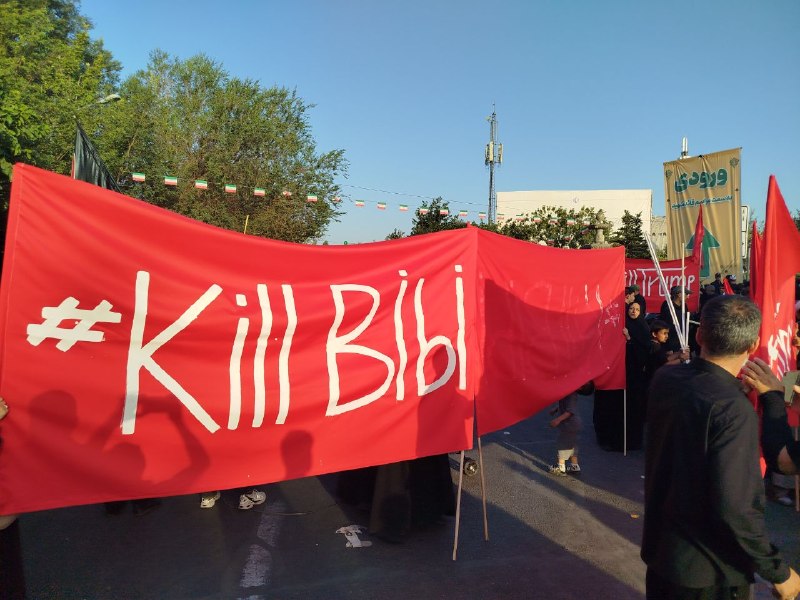
At 02:28 UTC on 5 July 2026, the Iranian outlet Tasnim published a short caption over footage of a Tehran funeral prayer: red flags in the hands of different groups of mourners, displayed to show "the unity of the slogans in seeking the blood of the revolutionary leader." Two hours earlier, the same channel reported mourners carrying placards reading "#kill trump" and "#kill bibi." By 02:43 UTC the main prayer area had filled hours before the service was due to begin; by 03:46 UTC, organisers closed the mosque doors an hour ahead of the prayer itself. The choreography is the story. The official headline of the day — a martyrdom frame, a leader-and-family funeral, a call to rise — is not improvised grief. It is a directed mobilisation, broadcast live, timed for maximum reach.
What matters now is not the eulogy but the script. The pieces are visible in the captions Tasnim itself posted in the early hours of 5 July: a closing-off of the venue, a staged overflow, sectarian taunting of Israel and explicit hostility toward the US president, the deliberately chosen vocabulary of revenge. The funeral is being run as a public instrument. The regime is using a day of mourning to convert casualty into political capital — at home, in the region, and on the signal channel that Israeli, Gulf and Western intelligence services cannot stop watching.
What Tasnim showed, and what it left out
Read the captions chronologically and a deliberate build is visible. The 02:34 UTC item is the most arresting: placards in English-language hashtag form, naming the US president and the Israeli prime minister by first name, deliberately shaped to travel on Western social media. The 04:51 UTC item escalates with sectarian language directed at "the island of child eaters" — the regime's standard formulation for Israel — and wraps itself in the martyrdom frame that any future retaliation is meant to inherit. None of this is spontaneous mourning. Tasnim is the formal news arm of the Islamic Revolutionary Guard Corps; what it publishes at 02:00 UTC is designed to be on screens in Jerusalem, Washington and the Gulf by the morning news cycle.
What Tasnim does not show is also informative. The captions omit the names of the funeral participants beyond the general descriptor of a "martyred leader and his family," omit the location of the prayer, and omit any statement from a named Iranian official about who is to blame or what response is contemplated. The platform is setting mood, not making arguments. That is the point: the audience is being prepared, not briefed.
A regime that knows how to make a crowd
Iran's revolutionary state has had forty-plus years to perfect the funeral-as-mobilisation. The format is well rehearsed: a tightly delimited martyrdom narrative, a tightly scripted overflow, English-language signals aimed at foreign audiences, and a vocabulary of vengeance that the security services can either cash in or freeze according to the political weather. The June 13 strikes on Iran — which preceded these funeral images — gave Tehran martyrdom footage of the kind it has not had since the Soleimani killing in January 2020. The crowd Tasnim documented on 5 July is the regime converting that footage into leverage for the diplomacy it knows is coming.
The structural reality is that Iran's retaliatory vocabulary has always run ahead of its operational bandwidth. The IRGC and the regular armed forces have been beaten hard enough in successive rounds that no serious analyst expects the regime to gamble its survival on a full-scale strike campaign against Israel or US bases in the Gulf. What it can do is sustain ambiguity: a credible threat of retaliation priced into Western and Israeli risk calculations, kept alive by the right footage at the right hour. The funeral is one input into that pricing.
Why the venue choices matter
Two pieces of detail in the Tasnim feed carry more weight than the chanting does. The first is the orderly control of the service: doors closed an hour ahead, the main area filled hours ahead, deliberate crowd imagery shot through a single lens. That is the visual grammar of a state that has rehearsed this scene. The second is the multilingual signalling, with English hashtags used to make sure the placards are not a domestic artefact but a regional one. The rhetoric is not pitched at the mosque courtyard; it is pitched at every intelligence analyst within earshot.
What the next ten days will look like
The funeral is the opening move of a sequence that will play out over the next two weeks. Western and Israeli capitals should expect three signals in particular. First, a calibrated funeral-period pause: maximal noise, minimal kinetic action. Second, attempts to lock the martyrdom frame into the diplomatic record through statements read aloud at the funeral itself and amplified by state media. Third, the quiet movement of regional assets — Iraqi militias, Houthi media outlets, Hezbollah media arms — into a posture that lets Tehran claim a wider coalition when, and if, retaliation comes. None of these moves requires the regime to spend the strategic reserves it built up over years of sanctions.
The alternative read is more cautious. It is possible this is simply a funeral: grief given a standard choreographic shape, a regime securing its own legitimacy at home without preparing a specific external response. Tasnim's own captions certainly lean in that direction in their quieter moments. The captive press will of course call this a "massive show of national unity." That claim does not stand up to scrutiny if you read the captions in order. The sequence reads as a script, not a response.
What is not yet known is what is said on the floor of that mosque in the moments the cameras cannot reach, or which names sit on the headstones Tasnim is being coy about. The sources confirm only the choreography. It is the choreography, not the news the rest of this week, that should be watched.
This article was filed by the Monexus newsroom using wire and official-channel inputs. Monexus treats Iranian state media as a primary source for what Tehran wants the world to see today, and pairs that footage with the structural context that the official captions leave out.
Wire provenance
This editorial synthesis draws on the following public wire/social posts:
- https://t.me/s/tasnimnews_en/1
- https://t.me/s/tasnimnews_en/2
- https://t.me/s/tasnimnews_en/3
- https://t.me/s/tasnimnews_en/4
- https://t.me/s/tasnimnews_en/5
- https://t.me/s/tasnimnews_en/6
- https://t.me/s/tasnimnews_en/7