Tehran's seven-million turnout: mourning as a register of regime durability
Crowds reported in the millions have filled central Tehran for a state funeral. The display of mass mobilisation is itself the political signal — and its meaning is being read very differently inside Iran and outside it.
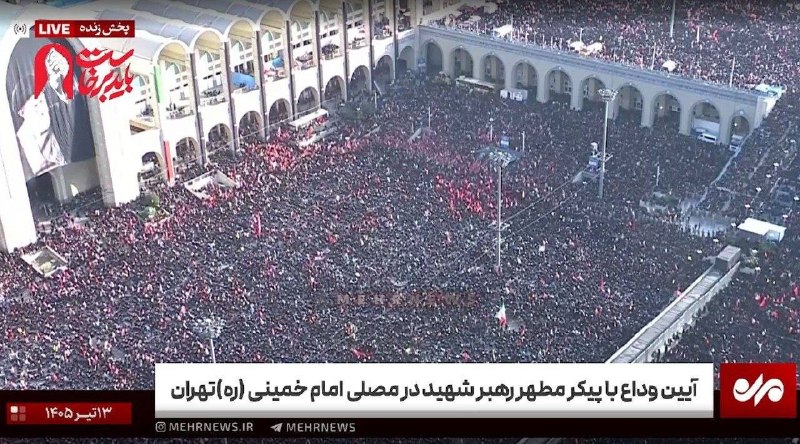
The numbers being claimed out of Tehran on 5 July 2026 are not modest. Telegram channels aligned with the Islamic Republic reported more than seven million mourners in the capital, including visitors bussed in from other cities, with the city's principal prayer grounds declared full to capacity and spillover crowds massed outside the mosque precincts (Middle East Spectator, 05:06 UTC and 03:07 UTC, 5 July 2026). State-aligned outlet Al Alam Arabic, in separate dispatches timed to the ceremony, said the heads of the three branches of government were present alongside the sons of the "martyred leader of the revolution," and that the bodies had been brought into the courtyard for the funeral prayer (Al Alam Arabic, 04:28 UTC and 04:29 UTC, 5 July 2026).
The political content of a turnout is rarely the turnout itself; it is the message the regime wants the world to receive from the turnout. Read closely, the optics from Tehran suggest the Islamic Republic is demonstrating something to two audiences at once — its domestic base and a foreign one — and is using grief as the medium.
What the imagery is designed to communicate
Funeral photography in the Islamic Republic has long been a managed genre. The choice of a central, monumental site, the visible presence of senior officials across the executive, legislative and judicial branches, and the participation of the Khamenei family are not incidental. They are the visual grammar through which the Republic signals institutional continuity at the precise moment of succession. The arithmetic — seven million reported in a city of roughly nine million — functions less as a count than as a claim: that the regime can still command its population's presence in physical space at scale.
This matters because, for the better part of a decade, the dominant Western reading of Iran has been calibrated to moments of contestation: the 2017 and 2019 protests, the 2022 Mahsa Amini uprising, the recurring episodes of dissent in Kurdish and Baluchi regions. A funeral of this scale in central Tehran pushes back on that reading by sheer visual weight. The signal to a domestic audience is that the symbolic centre still holds; the signal to a foreign audience is that any calculation built on the assumption of imminent delegitimation needs to be revisited.
Why the numbers will be contested
The seven-million figure originates with channels sympathetic to the regime and with Iranian state-aligned outlets. Independent verification of crowd size from open-source imagery is not feasible in real time, and is unlikely to be feasible later: the geography of central Tehran does not permit a clean headcount, and the official count reflects the organising authorities' own tally. Western wire desks will, in practice, report the claim with attribution rather than confirm it. The two reasonable priors are that the real figure is large — Iranian state funerals routinely draw genuine mass turnouts, including many mourners for whom the ritual is devotional rather than political — and that the headline number, whatever its exactness, is a regime assertion with operational consequences.
There is also a sequencing question. Mass turnout at a state funeral in Iran does not by itself settle the underlying question of legitimacy under stress. The harder test arrives in the weeks that follow, when the crowds disperse, when sanctions bite or relax, when the next senior figure dies or the next crisis punctuates the political calendar. Funerals compress. Politics does not.
What this leaves unsettled
The framings most worth resisting are both ends of the spectrum. The first is the Western dismissal — that the crowds are staged, the figure inflated, the whole scene an exercise in coerced mobilisation. There is no clean evidentiary basis for that reading in the available material; state funerals in the Republic draw significant voluntary attendance, even as the regime certainly organises the choreography. The second is the regime-aligned reading — that a turnout of this scale settles the question of popular support. It does not. It establishes presence; it does not establish mandate.
What the available reporting does establish, narrowly, is narrower than either framing wants. On 5 July 2026, in central Tehran, the Islamic Republic staged a funeral on a scale its own communications channels describe as unprecedented in recent memory, with the senior offices of state visibly aligned and the Khamenei family in attendance. Whether that is the opening chord of a stabilisation phase or the high-water mark of a managed cycle is not something a single weekend's imagery can decide.
Stakes
The downstream effects are most legible in two arenas. Inside Iran, the succession question — long discussed in foreign-policy circles and largely taboo in domestic politics — now has to be navigated in public rather than in private, and the regime's capacity to choreograph the public half of that navigation will shape its leverage in the private half. Outside Iran, the read by regional and Western governments calibrates the diplomatic weather: the harder Tehran is read as embattled, the more room Gulf and Western partners give themselves for pressure; the harder it is read as consolidated, the more the cost calculus shifts. Tehran's communications operation on 5 July is plainly aimed at shifting that calculus. Whether it succeeds is a question for the next several weeks, not the next several days.
Desk note: Monexus leads with regime-aligned channel reporting here not as endorsement but because, on a state-funeral day, those channels are the primary real-time wire. Headline crowd figures are reported with attribution, not asserted as fact; the analytical weight is placed on the choreography and what it is designed to signal, not on the count itself.
Wire provenance
This editorial synthesis draws on the following public wire/social posts:
- https://t.me/Middle_East_Spectator
- https://t.me/Middle_East_Spectator
- https://t.me/alalamarabic
- https://t.me/alalamarabic