Tehran's Grand Mosalla and the choreography of an Iranian farewell
PressTV frames the funeral of Iran's martyred Leader at Tehran's Grand Mosalla as a national moment. The cameras tell one story; the politics of succession will tell another.
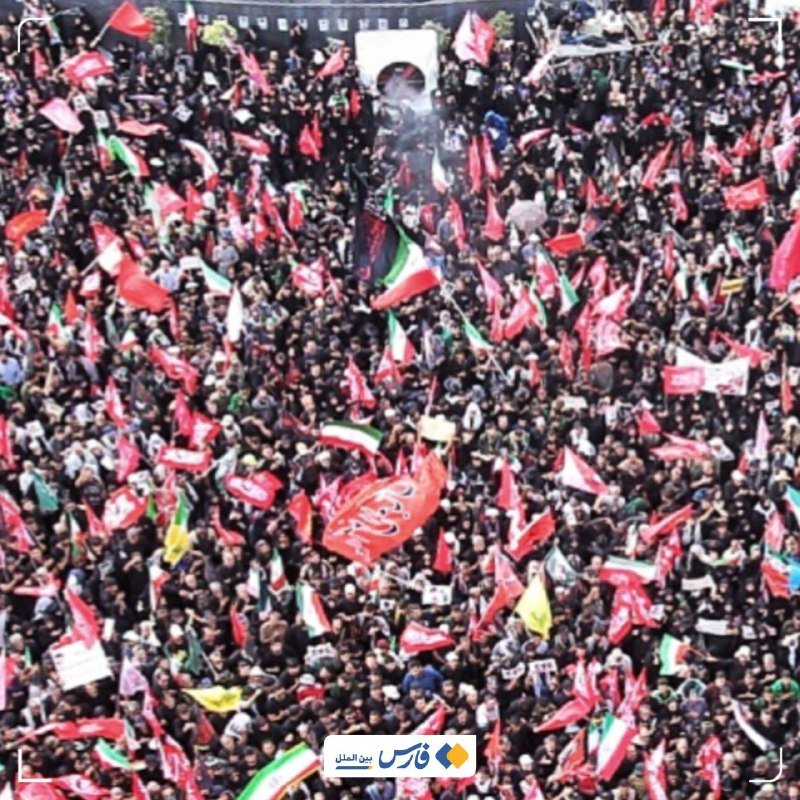
Long before sunrise on 5 July 2026, the caravans were already moving. By 03:37 UTC, PressTV's wire was posting aerial footage of "countless mourners" threading toward Tehran's Grand Mosalla, the great prayer hall north of the capital. By 04:14 UTC the same channel had switched to overhead shots of an "overwhelming crowd" filling the courtyards; by 04:31 UTC the coffin had arrived. The frame is unmistakable: a leadership cult in its most public liturgy, broadcast in real time to an audience the state has spent four decades building.
The ceremony matters less for what it shows than for what it tries to settle. A martyrdom framing, repeated by every PressTV caption with the hashtag #MartyrKhamenei, forecloses certain questions and opens others. The cameras are performing a verdict; the politics underneath is still being negotiated.
What the pictures show
The PressTV thread is monotonous by design. From 03:37 to 05:17 UTC the channel runs a single template: mourners, coffins, sons, a granddaughter's coffin, a farewell for "Iran's martyred Leader and his family." The repetition is the point. Funeral rites in the Islamic Republic are not private grief; they are state choreography, and the choreography is meant to be legible from a satellite feed.
The specifics that do break through are small and telling. The sons are named and visible. The granddaughter's coffin is filmed arriving at a separate moment — a deliberate sequencing that signals the family's sacrifice as collective rather than individual. Yemeni mourners are shown making the journey to Tehran, a visual reminder that the leadership's claimed constituency extends well beyond Iran's borders. The Grand Mosalla, a venue built for very large assemblies, is used to its capacity.
None of this is incidental. It is the visual grammar through which the Islamic Republic has long communicated legitimacy — mass presence as evidence of right rule.
What the framing does
Read across the eight dispatches in the thread, the word "martyred" appears in every caption. It is doing legal and political work, not merely descriptive work. In Iranian state discourse, martyrdom transfers a leader from the category of the dead into the category of the sacred, and confers on the office — and on whoever now holds it — a debt that cannot be repaid in ordinary politics.
This is the lever the broadcast is trying to pull. By the time a successor is named, the cameras will already have argued that the departed was not merely a head of state but a shahid, and that his project is therefore not negotiable but inherited. The framing is not new; the scale is.
What the cameras do not show
PressTV's coverage is total within its own frame and silent outside it. The thread contains no reference to who will now occupy the office, no naming of a successor, no institutional account of how the transition is being managed. The press arm of a one-party state does not broadcast the meeting where a succession is settled; it broadcasts the funeral that ratifies it afterward.
The audience is invited to read absence as inevitability. Outsiders should read it as information withheld. The very completeness of the visual record is the tell: when a regime controls every pixel of a national moment, the question to ask is which pixel is missing.
Stakes
For the Islamic Republic, the next seventy-two hours will determine whether the martyrdom frame is sufficient to carry the transition, or whether the unsettled questions the cameras refuse to film — succession, the role of the IRGC, the future of the nuclear file, the pressure from a US administration that has spent two years treating the previous leader as a sanctioned individual — reassert themselves in less choreographed settings.
For the wider region, the answer matters in concrete ways. A leadership cult that survives a leadership change can absorb shocks that would topple a normal state; one that fractures around it cannot. The funeral at the Grand Mosalla is being staged to ensure the first outcome. Whether it succeeds is a question the next set of broadcasts, from outlets far less obliging than PressTV, will answer.
The sources for this piece are limited to a single Iranian state outlet's Telegram wire. Where the framing is total, so is the silence. Monexus will widen the citation ledger as independent reporting on the succession becomes available.
Wire provenance
This editorial synthesis draws on the following public wire/social posts:
- https://t.me/presstv/1
- https://t.me/presstv/2
- https://t.me/presstv/3
- https://t.me/presstv/4
- https://t.me/presstv/5
- https://t.me/presstv/6
- https://t.me/presstv/7
- https://t.me/presstv/8