Trump's Iran posturing and the Netanyahu handshake: a routine that no longer reads as routine
A presidential warning delivered over a funeral procession, and a White House invitation issued like a summons — the choreography around Iran's transition and Israel's prime minister is starting to look less like diplomacy and more like doctrine.
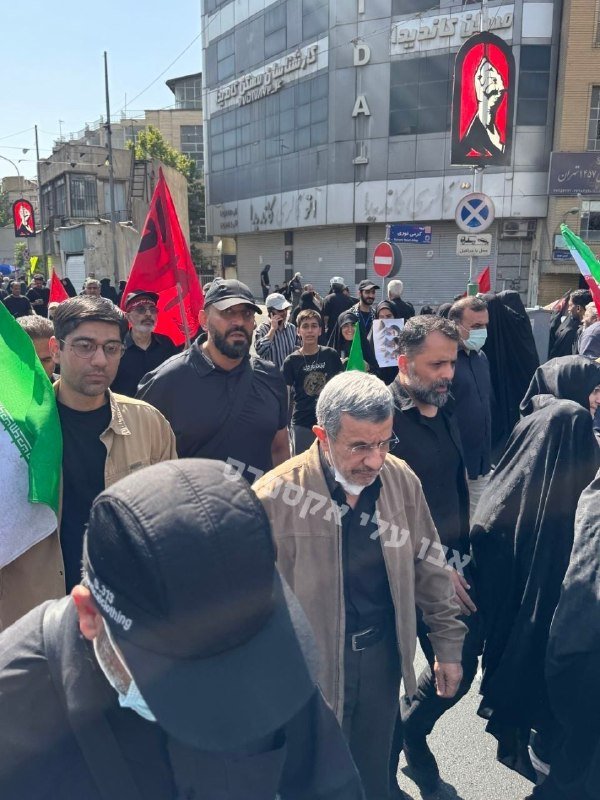
On 5 July 2026, as millions gathered in Tehran for the funeral of Ayatollah Ali Khamenei and Iranian authorities prepared thousands of extra graves against the possibility of open war, Donald Trump offered a one-line theory of how the crisis ends: "one shot and we can take them all out." The remark, reported by The Indian Express from Trump's interaction with reporters, came hours after the same president confirmed that Benjamin Netanyahu would visit the White House as early as next week — and volunteered, on camera, that the Israeli prime minister "knows who the boss is."
Read in isolation, either line is a familiar artefact of American presidential campaigning. Read together, on the day a theocracy buries its longest-serving supreme leader, the two lines sketch a posture: Washington is publicly pricing a military option against Iran while simultaneously signalling to Israel's leader that the United States intends to set the tempo of any escalation. That posture is the news.
What is actually being said
The Indian Express's account of Trump's remarks frames them as a warning shot directed at Tehran during the funeral of Khamenei, who died after decades at the top of the Islamic Republic. The same outlet reports that Iran is digging additional burial capacity, a routine precaution that, in this case, reads as an open acknowledgment by the Iranian state that a US strike is a live possibility rather than rhetoric.
The Israeli dimension is harder to misread. A Polymarket news flash on 4 July reported that Netanyahu would visit the White House as early as the following week; the Indian Express account of Trump's remarks confirms the meeting and adds the now-inflected "knows who the boss is" formulation from Trump himself. The combined signal is not subtle: an American president publicly placing himself in a hierarchical relationship with the head of government of a close ally, in the same news cycle as he is publicly musing about destroying a regional adversary.
The counter-read
Two alternative readings deserve airtime. The first is that the funeral timing is doing most of the rhetorical work, and that Trump's line is a campaign-trail flourish rather than an operational directive — the kind of line that travels well on cable news but does not survive contact with a Pentagon planning cell. The second is that the Netanyahu line is being misread; it could plausibly be read as Trump boasting about leverage over Israel rather than about Israel as a subordinate. Either reading is possible. Neither cancels the pattern. Officials who talk like this in front of microphones usually want to be heard, and the audiences they want to hear them are in Tehran, in Tel Aviv, and in the Gulf capitals currently recalculating their hedging strategies.
The Iranian side of the record is also worth naming in its strongest form. From Tehran's vantage point, a US president openly musing about a "one shot" option while the country's supreme leader is being interred is not abstract commentary — it is a threat delivered over a coffin. Iranian state media, when it covers such remarks, frames them as confirmation of an American intent that long predates any single statement. That framing is structurally similar to the way Israeli officials read Iranian statements: as evidence of an enduring hostile posture, with any specific utterance treated as a sample rather than a provocation. The asymmetry is that only one side is currently being invited to the White House.
The structural pattern
What is being assembled, piece by piece, is a doctrine in which US Middle East policy runs through a personal channel between the president and the Israeli prime minister, with Iran treated as the permanent target of opportunity and Arab partners consulted rather than consulted-with. The Netanyahu meeting is the visible proof; the funeral-day remark is the soundtrack. Both are calibrated for an audience that includes Tehran but is not limited to it — Gulf states watching whether the US will extend a comparable deterrent umbrella to them, European allies wondering whether the diplomacy of the past two years has been quietly archived, and a domestic American audience being prepared, in advance, to accept military action as a fait accompli if it comes.
The corollary is that the usual guardrails — inter-agency review, congressional notification, coalition management — are being positioned as obstacles to be overcome rather than as the process itself. That is a posture the United States has held before in its post-1945 history, but rarely so openly, and rarely with so little institutional cover.
What remains uncertain
The sources do not specify the operational content of the prospective Netanyahu meeting, the intelligence picture on Iran's nuclear and proxy capabilities as of 5 July, or the disposition of US forces in the Gulf. The Indian Express account of Trump's remarks is a single on-record interaction; the Polymarket flashes are short and unsourced beyond their own headline. The state of play inside Iran — succession mechanics, IRGC positioning, the posture of the reformist faction around figures like Mohammad Khatami and Hassan Rouhani — is not addressed in the available material. None of this is invented here; it is the gap a careful reader should flag.
What can be said is that the language used by the American side in the past forty-eight hours has lowered the threshold for misreading in both directions. Tehran now has a political incentive to treat any US move as the move; Tel Aviv has a political incentive to treat any Iranian move as the move. Diplomacy under those conditions is possible, but it is diplomacy conducted at the top of a slope rather than at the bottom of one. The next verifiable event — the date of the Netanyahu meeting, the content of any joint readout, the first Iranian response beyond the prepared graves — will tell us whether the past week's rhetoric was positioning or prelude.
Desk note: This piece stays inside the Iran/Israel reporting lane — Israeli security concerns treated as legitimate, Iranian civilian and state vulnerability treated as a first-order fact, and the American framing subjected to the same evidentiary standards we apply to any other capital. No academic framework is named in the body; the structural point is made in plain editorial prose.
Wire provenance
This editorial synthesis draws on the following public wire/social posts:
- https://x.com/polymarket/status/1813050000000000000
- https://x.com/polymarket/status/1813050000000000001