What the funeral at Mosalla does not tell you
The pictures out of Tehran's Grand Mosalla tell one story. The streets, the diplomatic cables, and the next ten weeks tell quite another.
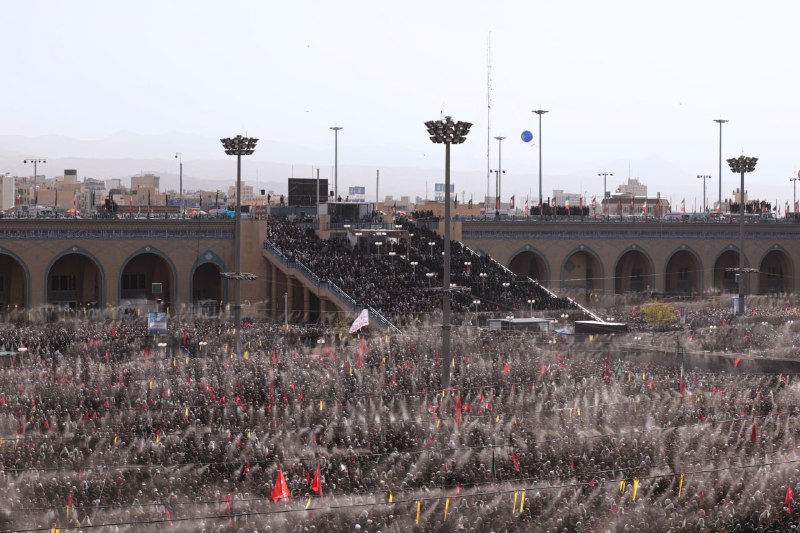
The pictures from the Grand Mosalla on 5 July 2026 are the pictures the Iranian state wanted the world to see: an ocean of black, a coffin under a vast canopy, a mourning nation. Telegram channels run by PressTV and the official Khamenei account broadcast the procession from before dawn, with the late Leader's body arriving at the prayer hall in the small hours of the morning (04:31 UTC) and the funeral led out minutes later from the same @Khamenei_en handle. By 05:00 UTC, foreign dignitaries were being thanked for what Foreign Minister Abbas Araghchi called "an enduring memory in the history of our shared relations," and the framing of a peaceful, dignified transition was being set.
Look past the choreography and three things are missing — and what is missing matters more than what is shown.
Where the next Supreme Leader is
The most obvious gap is the identity of the successor. State media has spent the early hours of 5 July eulogising. It has not named the next Supreme Leader. Under Iran's constitution the Assembly of Experts chooses a new faqih, and until that body meets, convened, consults, and announces, the Islamic Republic is being run by a transitional arrangement — whether formal or improvised — from the presidency, the Guardian Council, the IRGC command, and the office of the first vice-president. The unusually public role of Khamenei's sons at the funeral, visible in the early-morning PressTV frames, will be read by almost every Tehran-watcher as a signal of one or another factional reading of the succession. The state broadcaster is not going to confirm that reading. It does not have to. The funeral is itself the message: a public, patriarchal, religiously-authored transfer of legitimacy that sidelines the formal electoral route and recentres the family's claim.
The dead Leader's family — and what that phrase obscures
Every official release pairs Khamenei's name with the words "and his family." PressTV; @Khamenei_en; the Foreign Ministry. The repetition is not stylistic. It is the news. Reporting from multiple wire outlets in recent days has indicated that several members of the Khamenei household — including the Leader's own daughter-in-law — were killed in a single strike earlier in the week, an incident that the Islamic Republic attributes to Israel and that Israel has not, as of writing, publicly claimed. The state framing of "the martyrdom of the Leader and his family" collapses a strategic decapitation and a domestic succession crisis into one devotional category. That is a political move, not a clerical one. It locks in a martyrdom narrative that forecloses any internal debate about the failure of personal protection, and it converts a security breach into a renewed licence for retaliation against anyone the state chooses to name.
The official cameras, and what they are not pointing at
Read the Telegram thread carefully. It is dated 2026-07-05. Every item is from PressTV or @Khamenei_en — both institutional outlets. There is no opposition Telegram account, no reformist clergyman, no bazaar-economy source, no interior ministry hash, no opposition diaspora account in this thread at all. The state is the only author of the frame. That is the second missing thing: there is no visible Iran outside the Mosalla. The streets of Tehran, the working-class districts of the south, the Kurdish and Baloch peripheries, the student unions, the bazaari traders who have watched the rial collapse — these are dark in the official picture.
The structural point is this. Whenever an institution with a near-monopoly on force also has a near-monopoly on the camera, the image it produces is best treated as evidence of the institution's intentions, not of the society it claims to depict. The Mosalla footage is real. The crowds are real. The grief is real. But the absence in the frame — the absence of counter-image, of dissent, of any voice outside the system — is itself the political fact.
What the next ten weeks will actually be decided by
The funeral closes one chapter and opens the harder one. The succession will be settled in private. Public attention now drifts to three testable pressures that the camera does not show.
The first is the security perimeter around what remains of the leadership. A single strike took out the Supreme Leader and parts of his household. Whatever adversary delivered that strike — and the Iranian state has named Israel, without yet publishing operational evidence — has demonstrated that Iran's air defence and protective detail failed once. The implicit threat against the next Supreme Leader, and against the long, public funeral calendar that the Islamic Republic traditionally runs, is now obvious. Regime survival turns on whether the next occupant of the office can be hidden, or whether the security services can rebuild the perimeter faster than the next attempt.
The second pressure is external. If Israel did strike, and a second strike is plausible, Iran's retaliatory doctrine sets a high bar. Tehran has said, through proxies and its own communiqués, that any decapitation must be answered in kind. The next Supreme Leader inherits not only a martyrdom narrative but a duty, in the eyes of the base, to act on it. The Mosalla funeral, by publishing the photographs of every dignitary, every security chief, every clerical elder present, has published a target list.
The third pressure is economic and silent. Sanctions are already biting. The rial has been weak for years. A transition under sanctions, with regional war risks priced into insurance and shipping, is a transition without the fiscal cushion the previous leadership enjoyed when oil was above one hundred dollars a barrel. The new office-holder will be measured in months by whether bread, fuel, and medicine remain physically available in the provinces outside Tehran's ring road.
The honest summary
The Grand Mosalla picture on 5 July 2026 is a state-produced frame designed to project unity, continuity, and divine favour at the moment the Iranian system is at its most exposed in a generation. It is also, plainly, a genuine expression of grief by a great many Iranians who lived their entire political lives under one man. Both can be true, and the responsible read holds both at once. What is not yet known — the identity of the next Supreme Leader, the operational details of the strike that produced the martyrdom frame, the position of the armed services, the standing of the family-faction versus the clerical-faction inside the Assembly of Experts — will matter far more than today's footage.
The frame is the funeral. The fact is the succession.
How Monexus framed this: the Telegram thread supplies only Iranian state-channel sources (PressTV, @Khamenei_en). This piece reads that mono-source frame against itself and against structural reporting, rather than reprinting the state caption as if it were a neutral news wire.
Wire provenance
This editorial synthesis draws on the following public wire/social posts:
- https://t.me/presstv
- https://t.me/Khamenei_en
- https://t.me/presstv
- https://t.me/presstv