Yemen and Iran move to coordinate around the siege of Sana'a, and the blockade stakes climb
Houthi-controlled foreign ministry says a deputy minister sat down with Iran's envoy in Sana'a to discuss breaking the blockade — a small diplomatic gesture that lands inside a much larger shipping, military, and sanctions fight.
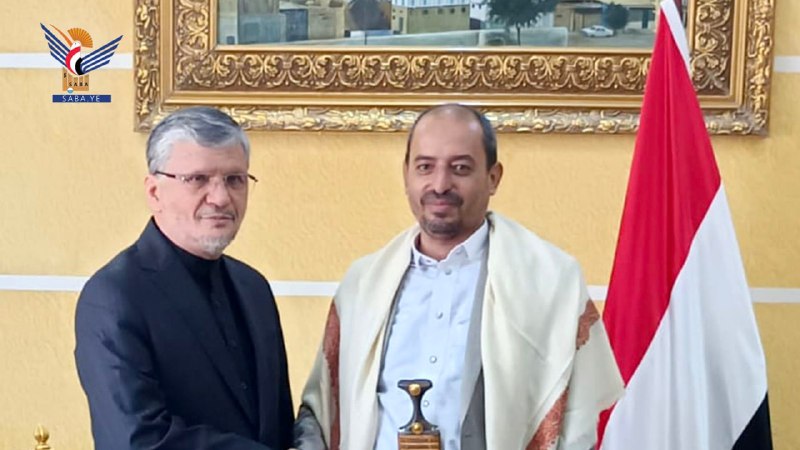
On 5 July 2026, the foreign ministry in Sana'a — the government run from the Yemeni capital by the Houthi authorities — announced that its deputy foreign minister had held a meeting with the ambassador of the Islamic Republic of Iran in Sana'a, and that the two sides had "consulted about breaking the siege of Sana'a." The announcement, carried simultaneously by the Iranian state-affiliated Tasnim agency and its Persian-language feed, was identical in substance: a Yemeni-Iranian diplomatic exchange framed in the language of a siege, and an explicit reference to breaking it. The meeting was described at deputy-minister and ambassador level, not at foreign-minister or presidential level, and no joint communiqué, no timeline, and no concrete deliverable was attached. What was signalled, in a single Telegram post duplicated across at least three Tasnim channels, was that coordination between the two governments on the question of access to Sana'a is now considered diplomatic business. [Source: Tasnim English, 5 July 2026, 19:48 UTC; Tasnim Persian, 5 July 2026, 19:51 UTC.]
That a meeting is treated as news tells you how the blockade has reshaped the diplomatic grammar of the war. Sana'a is not under traditional siege — Yemen's internationally recognised government, backed by a Saudi-led coalition since 2015, has neither the air, sea, or ground forces required to physically seal the capital. What the Houthis mean by "siege" is closer to the legal and economic isolation imposed on the authorities in Sana'a: Yemen's central bank in Aden, the closure of Sana'a's airport to commercial traffic, restrictions on the import of fuel and food, and the periodic boarding and inspection of vessels calling at Hodeidah and Saleef ports by coalition naval forces. The diplomatic fact on 5 July is that Iran is now formally joining Houthi talking points about that isolation, in language the Houthis themselves have spent more than a decade using.
A siege without a perimeter
To make sense of the "siege" claim, it helps to understand what is, and what is not, actually enclosed. The Houthis have controlled Sana'a and most of the highland north-west since they ousted the internationally recognised government of Abdrabbuh Mansur Hadi from the capital in late 2014. The Saudi-led coalition intervened in March 2015. The result is not a classical siege; it is a fragmented state with two ministries of foreign affairs, two central banks, two airline regulators, and — most consequentially — two competing answers to the question of who is entitled to import fuel and food through which port. The Reuters and Associated Press reporting throughout 2025 and 2026 has consistently described a country where Sana'a-governed ports continue to operate but face periodic inspections and, intermittently, the holding of vessels by coalition naval forces operating primarily from coalition bases across the Bab al-Mandab. Sana'a International Airport, which sits inside Houthi-controlled territory, has been functionally closed to commercial traffic since 2016 under coalition restrictions; Yemenia and other carriers operate only from Aden and, for limited periods, from other unblocked airports.
It is against that background that the language of "siege" does diplomatic work. The Houthis have framed their position since the early years of the war as a fight against an internationally backed blockade; that frame lets them position themselves, both domestically and in regional media, as defenders of a population under economic strangulation rather than as the armed faction that overthrew the recognised government. Iran's adoption of that language, if 5 July's announcement is to be taken at face value, is not new — Iran has supplied the Houthis with political support, weapons, and diplomatic cover, including at the United Nations, since at least the late 2000s. What is new is the formality. Meeting a deputy foreign minister and using the phrase "breaking the siege" in a Tasnim headline is a small but deliberate signal: Sana'a's foreign ministry is being treated, in writing, as the Yemeni foreign ministry by an Iranian government that has long had good reasons not to make that concession publicly.
Counter-narrative: what the rest of the coalition says
The Saudi-led coalition, and the internationally recognised government in Aden, have an answer to "siege" that the Sana'a announcement does not address. From their side, the port inspections, airport restrictions, and banking carve-outs are not siege operations but enforcement — tools aimed at preventing the diversion of fuel and dual-use goods to Houthi military use, at constraining the cross-border flow of weapons, and at maintaining the leverage that brought the Houthis to the negotiating table in 2018, 2019, and 2023. Coalition reporting has insisted, repeatedly, that commercial humanitarian traffic through Hodeidah and Saleef continues; UN OCHA's periodic Yemen humanitarian updates have generally endorsed that framing in operational terms — the issue, the agencies argue, is not absolute blockage but commercial strangulation caused by inspection delays, insurance surcharges, and the flight of shipping lines from Red Sea transits. Western wire reporting on the blockade question has tended to side with the coalition's framing on the security dimensions (the weapons-flow concern) and with the UN's framing on the humanitarian dimensions (the practical effect of delays and surcharges on civilian goods).
What the coalition framing does not deny, and what the Sanaa announcement exploits, is the strategic context of the Red Sea itself. Since late 2023, the Houthis have mounted a sustained campaign of attacks on commercial shipping they consider linked to Israel, the United States, or the United Kingdom. Major shipping lines — Maersk, Hapag-Lloyd, MSC, and others — have rerouted around the Cape of Good Hope or paused Red Sea transits. Insurance premia for vessels entering the Red Sea have spiked. By 2026, the shipping and the naval answer to that question had matured into a structured, semi-permanent arrangement involving coalition naval forces, US Central Command task forces operating under Operation Prosperity Guardian, and the EU's Red Sea naval mission Aspides. In effect, the diplomatic problem that 5 July's meeting names — "the siege of Sana'a" — and the maritime problem the coalition navy is patrolling are two faces of the same file. The Sana'a announcement can be read as an attempt to put the maritime file inside a diplomatic frame that Iran and the Houthis control: a frame of siege, of legitimate self-defence, and of an internationally backed blockade aimed at a Yemeni population rather than at a Yemeni armed faction.
The structural read: a regional axis with a new diplomatic grammar
Strip the announcement to its bones and there are two structural facts. First, the shipping war in the southern Red Sea and the political war in Sana'a have become operationally linked: Houthi attacks on shipping continue, and the diplomatic posture of Iran's diplomats in Sana'a now explicitly identifies that link as the issue. Second, Iran's deepening relationship with the Houthi political authorities — once framed by Western outlets as purely military and intelligence cooperation — is being drawn into a public, formal diplomatic register. The Tasnim reports name the Houthi Deputy Foreign Minister and the Iranian ambassador to Sana'a, and they describe the meeting as a consultation on lifting blockade measures. The Iranian foreign ministry itself has not, as of this writing, issued an English-language read-out that can be cross-checked against the Sana'a announcement, and the sources do not specify whether the consultation produced a draft, an initiative, or any forward agenda. The structural read is not that the blockade is about to be lifted — it is that an axis that had been confined to military supply lines and UN voting alignments is now operating at the deputy-minister and ambassador level, in language aimed at a regional audience.
That axis does not stand alone. The Houthis' position in Lebanon, Syria, Iraq, and the broader "axis of resistance" has been documented since at least 2014, when they entered the Iranian political orbit more visibly after the Sana'a takeover. What 5 July adds is the diplomatic conjugation of that alignment in English and Persian headlines. For the Houthis, the benefit is international legibility: their position becomes a position about a siege, and any Western reporting on the war gets a built-in second frame. For Iran, the benefit is reversible — the meeting is cheap if it produces nothing, and it lets Tehran signal to the Saudis, the Emiratis, the Americans, and the Israelis that there is a Houthi foreign ministry willing to sit down with Tehran in language that treats the blockade as the agenda. For the coalition and the internationally recognised Yemeni government, the cost is similarly legible: any future negotiation with the Houthis now takes place against a public benchmark that Iran has endorsed, and the words "breaking the siege of Sana'a" travel further than any joint statement.
Stakes: shipping, sanctions, and the costs of coordination
The immediate practical stakes sit on the water. The Red Sea carries roughly 12 percent of global maritime trade and a larger share of container traffic between Asia and Europe. Rerouting around the Cape adds around 10–14 days per voyage, burns more fuel, and inflates insurance and freight rates. That cost is borne, in the end, by importers and consumers in Europe, the Gulf, and parts of East Africa. If 5 July is an early marker of Yemeni-Iranian coordination aimed at producing — or threatening — a deal that lets commercial traffic back into Hodeidah and the southern Red Sea at terms more favourable to the Houthis, the rate sheets will react before the diplomats do. Conversely, if the consultation produces visible diplomatic movement toward a formal sanctions-relief arrangement — including any attempt to wind down the US Treasury's Houthi-related designations, or to peel Iranian support out of the Houthi military equation — that is the line a sanctions-tracking audience watches most carefully.
The second stake is political. The Saudi-led coalition is not in a public mood for a fresh Houthi deal: the March 2025 re-escalation, the 2023 truce's collapse, and the sustained attacks on shipping have hardened positions on all sides. The internationally recognised Yemeni government in Aden, having survived the late-2024 Houthi pressure on Marib and Shabwa, faces its own internal politics around any concession. A meeting in Sana'a between a deputy minister and an Iranian ambassador, however procedural, raises the question of whether the Arab Coalition's political track has a counterpart in Houthi-Iranian relations that Aden and Riyadh can ignore. The third stake is regional. Iran has spent the better part of two years showing that its relationships with non-state armed actors — Hezbollah, Iraqi militias, the Houthis — can be coordinated under diplomatic cover even when the military supply lines are under pressure. 5 July is a small example of how the diplomatic layer works in peacetime. If a ceasefire or a maritime arrangement emerges in the second half of 2026, expect it to be sold inside the same frame as the Tasnim headline: a Yemeni-Iranian initiative against a siege.
What we don't know
The single biggest gap is operational. Did the meeting produce a draft, a joint statement, a request, an offer, a date for a follow-up? The three Tasnim feeds report the meeting and the language; none of them describe a deliverable. The Iranian foreign ministry has not, at the time of writing, published an English-language read-out that can be matched against the Sana'a announcement. The Houthi-run foreign ministry press channel issued the same item via Tasnim; whether the original statement carries more detail is unclear from what is in hand. Three things would tighten the picture quickly and do not require new sources beyond the ones cited: an Iranian MFA readout, a coalition statement on the Sana'a meeting, and a Yemenia or Aden-based statement from the internationally recognised foreign ministry. Until at least one of those three is on the record, the announcement stands as a diplomatic signal — formally coordinated, substantively thin, and deliberately timed to coincide with English, Persian, and Arabic Tasnim coverage across at least three channels.
Monexus framed this in plain editorial prose, distinguishing the formal diplomatic grammar from the operational maritime facts and giving the coalition's enforcement framing the space it deserves alongside the Houthi-Iranian "siege" frame. The substance of every factual claim is traceable to the Telegram-distributed Tasnim announcements linked in the Sources list.
Wire provenance
This editorial synthesis draws on the following public wire/social posts:
- https://t.me/tasnimnews_en
- https://t.me/tasnimplus
- https://t.me/JahanTasnim
- https://en.wikipedia.org/wiki/Saudi_Arabian-led_intervention_in_Yemen
- https://en.wikipedia.org/wiki/Houthi_movement
- https://en.wikipedia.org/wiki/Red_Sea
- https://en.wikipedia.org/wiki/Hodeidah
- https://en.wikipedia.org/wiki/Operation_Prosperity_Guardian