Araghchi's public mourning and the choreography of Iranian state ritual
Iran's foreign minister was filmed at a state funeral on 6 July 2026, a small ceremony that says a great deal about who inside the Islamic Republic still commands the public stage.
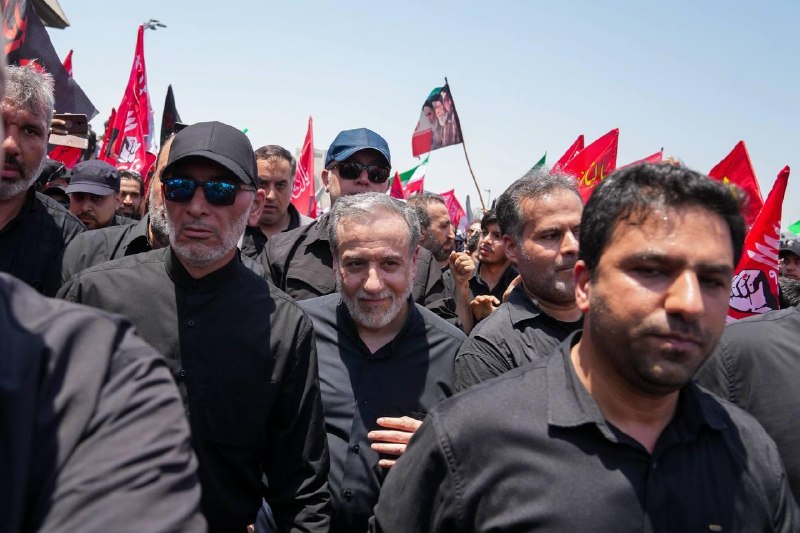
At roughly 10:09 UTC on 6 July 2026, Iran's foreign minister, Seyyed Abbas Araghchi, walked into a funeral procession in Tehran. The Iranian state outlets that documented the appearance — Mehr News and Tasnim — each carried the same single-line caption, naming him in his ministerial capacity and tagging the event with the shorthand that Iranian outlets use to mark a senior security figure: shahid, or martyr. The Cradle, a Beirut-based outlet that frequently translates Iranian state framing for an English-language regional audience, also confirmed Araghchi's presence, in two near-identical posts dispatched within minutes of one another. The image is small. The choreography is not.
The point of the moment is not the funeral itself. It is that the country's chief diplomat is being photographed, in uniform respect, alongside the security establishment, in the immediate aftermath of a high-casualty event. Foreign ministers are usually elsewhere — in foreign capitals, in negotiating rooms, in front of cameras talking to reporters. When the foreign minister shows up at a shahid funeral instead, that is a signal about which faction of the state currently owns the public stage.
Reading the procession
Iranian state media does not send a foreign minister to a martyr's funeral by accident. The official news agencies framed the appearance as a duty: Araghchi, as a member of the cabinet, was paying respects to a slain member of the security services. Both Mehr News and Tasnim used the same clipped language — "the presence of" the minister "at the funeral ceremony" — that Iranian outlets deploy when they want to record solidarity without elaborating on the politics of the deceased.
The Cradle, writing for an external audience, added a degree of editorial gloss. The Beirut-based outlet's two English-language posts on the procession, both timestamped at 10:27 UTC, described Araghchi simply as "mourners at the funeral procession." The flatness of the framing is itself a tell: the regional press that usually supplies colour and context offered none, signalling either that the identity of the deceased was politically sensitive or that the news value was the optics rather than the person being mourned. The Cradle's coverage, like Mehr's, named the foreign minister in his official role and otherwise left the scene uninterpreted.
The result is a tight cluster of state-aligned confirmations and a near-total absence of independent reporting on the substance of the event. The sources we have agree on one thing: Araghchi was there. They disagree, by silence, on almost everything else.
Why the foreign minister, why now
Iran's foreign-policy portfolio and its security services are not separate hierarchies. They are braided. Araghchi is a career diplomat — he served as deputy foreign minister during the nuclear-deal era and is one of the most recognisable faces of Tehran's external bargaining — but the foreign ministry in Tehran operates under the supreme National Security Council, which is dominated by the Islamic Revolutionary Guard Corps and the intelligence apparatus. When the foreign minister appears at a security funeral in the formal company of mourners, he is performing a specific act of institutional alignment.
The pattern is familiar from earlier rounds of the Iran–US confrontation. After the January 2020 killing of Qasem Soleimani, the foreign ministry's diplomatic channels went quiet and the security apparatus's messaging dominated. After the April 2024 exchange with Israel, the same pattern repeated: the foreign ministry reduced its public footprint, and commentary came from military spokespeople and state media rather than from the diplomatic corps. The 6 July appearance fits that pattern. The diplomatic class is not in the lead. It is in attendance.
That is not a small distinction. Iran's external posture depends on the foreign ministry being visibly in charge of negotiations. When the foreign minister is filmed at martyr funerals rather than at the UN or in Gulf capitals, the implicit message to outside observers is that the file is owned elsewhere — and that whatever deal-making happens next will be done on terms set by the security services, not by the diplomats.
The Western wire silence
It is worth noting what is not in the public record from 6 July. No major Western wire service — Reuters, the Associated Press, the BBC, Bloomberg, the Financial Times, Axios — appears to have published a standalone story on the funeral or on Araghchi's appearance there, according to the inputs available to this publication. There is no independent confirmation of the deceased's name, rank, or operational background. There is no footage, only still photographs carried by Iranian state-aligned channels.
The asymmetry of sourcing is itself the story. An event at which Iran's most senior diplomat publicly appears is being reported almost entirely through outlets that answer to the Iranian state or to a regional readership that consumes that framing at one remove. The Western press, with its correspondents in Tehran and its usual appetite for moments of regime choreography, is silent. That silence could mean the event was small, or it could mean the event was too sensitive to confirm independently. The sources do not let us choose between the two reads. They let us say only that the framing of the day is being supplied, almost in full, by the Iranian state itself.
What the optics buy
State ritual in Iran is not just expression. It is a tool of political economy inside the regime. The security services compete with the clerics, the technocrats, and the bazaar for resources, prestige, and the ear of the supreme leader. Funerals for shahids are a recognised arena in that competition: a foreign minister standing among the mourners publicly subordinates the diplomatic track to the security track, and in exchange signals the security services' claim to define Iran's posture in the next round of confrontation.
For outside governments reading the signal, the practical translation is straightforward. Any negotiating channel that runs through the foreign ministry is currently weaker than the imagery suggests. Anyone betting on a near-term diplomatic reset with Tehran should price in the possibility that the security services — whose martyrs the foreign minister is publicly honouring — will set the floor on concessions, not the diplomats who will sit across the table from the Americans, the Europeans, or the Gulf states.
What we still do not know is substantial. The sources do not name the deceased, do not specify the circumstances of death, do not say when the funeral took place relative to the killing, and do not record any statement by Araghchi on the substance of the event. The Western wire silence leaves an open question of whether the event was a high-casualty strike on Iranian personnel — which the choreography would suggest — or something more contained, dressed in the formal language of martyrdom. The honest answer, on the evidence in hand, is that we cannot tell. The visual record shows a senior official in mourning. The verbal record leaves the rest to the Iranian state.
This publication framed the funeral as a question of regime choreography rather than as a news item about a specific casualty, because the sources available on 6 July 2026 — Iranian state media and The Cradle — confirm only the foreign minister's presence. Independent confirmation of the deceased's identity and circumstances of death did not appear in the inputs reviewed for this article.
Wire provenance
This editorial synthesis draws on the following public wire/social posts:
- https://t.me/thecradlemedia
- https://t.me/mehrnews
- https://t.me/tasnimnews_en