England outlasts ten-man Mexico in Azteca shootout to reach third straight World Cup quarterfinal
At altitude and against 80,824 of their own fans, Mexico led twice but could not hold a man advantage as England booked a quarterfinal in Houston.
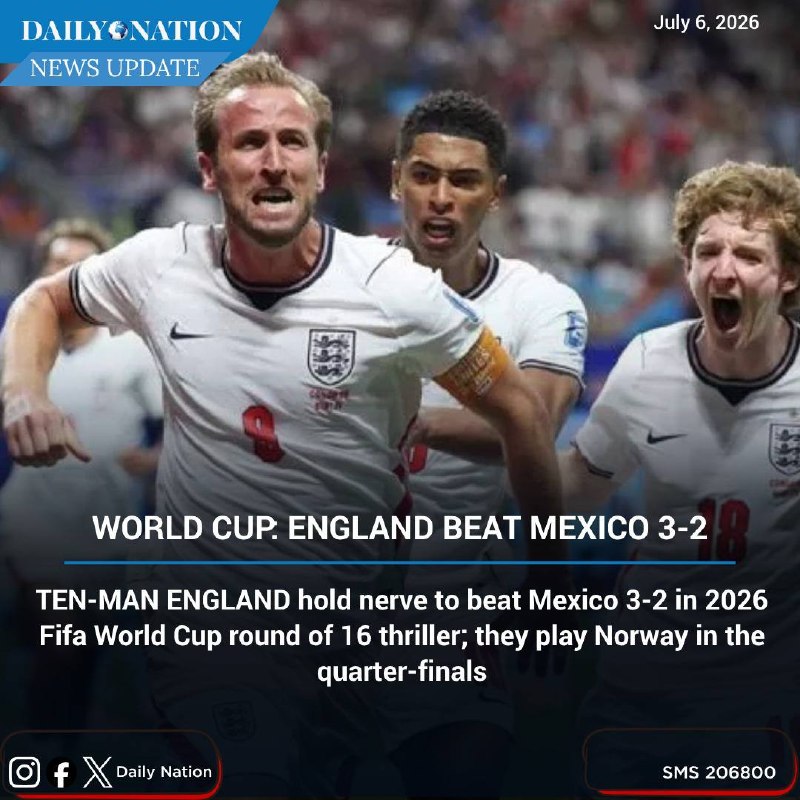
Mexico arrived at Estadio Azteca on 5 July 2026 carrying the weight of a generation. Eighty thousand eight hundred and twenty-four fans filled the bowl on a Mexico City evening, the stadium's first World Cup knockout match since the place was built for one. For an hour, the occasion behaved like a national coronation. By full time, England had won 3-2, England were down to ten men for most of the second half, and Mexico were heading home from their own tournament — again, earlier than the script demanded.
What this match settled is narrower than the noise suggested, and what it left unsettled is wider. England advance to a quarterfinal against Norway. Mexico, co-hosts of the first 48-team World Cup, are out in the round of 16 at home for the second time in three tournaments. The result is real. The texture of how it happened — a man advantage, an Azteca cauldron, a flood of yellow cards, and a severe-weather shelter-in-place that briefly suspended the build-up — is the part worth slowing down on.
A knockout round shaped by a first-half red and a second-half storm
England played nearly the entire second half a man light after a first-half dismissal, yet produced the game's decisive moments after the interval. According to reporting carried by NPR's news desk on 6 July 2026, England were reduced to ten men but held on to win 3-2, scoring the goal that settled the match after Mexico had twice equalised earlier in the night. The Daily Nation wire confirmed the scoreline and noted that England will meet Norway in the quarterfinals. The shape of the night — Mexico scoring twice, England responding three times, the game played through a hostile crowd and at altitude — is consistent across the wires that covered it.
The atmospheric backdrop mattered. Polymarket's account of pre-match conditions noted that Estadio Azteca issued a shelter-in-place order ahead of kick-off because of severe weather in Mexico City, a procedural note that briefly turned the build-up into a public-safety story before the football resumed. Altitude does not decide a match by itself, but it does compress margins, and a man advantage at 2,240 metres is a different proposition than a man advantage at sea level. England managed the conditions and the numerical deficit. Mexico did not, and that is the line that runs through every account.
The Mexican counter-narrative: altitude, officiating, and the weight of occasion
The Spanish-language and Mexican-press read of the night — partially visible in the Telegram coverage from Mexican and Latin American accounts — is that England were outplayed for long stretches and only the refereeing and the weather kept Mexico from a famous win. That framing has a kernel of truth and a layer of self-mythology. England did spend large portions of the second half defending deep. Mexico did generate pressure. The dismissal, by the consensus of the wire accounts, was the hinge.
But the second-half concession pattern is harder to explain through officiating alone. Mexico twice equalised; England twice responded inside a window short enough that tactical shape, not refereeing, was the operative variable. The Polymarket post-match note — "England defeats Mexico, advancing to its 3rd straight FIFA World Cup quarterfinal" — is the line that survives the heat of the moment. The pattern is real across cycles, not a single-night artefact. A team that reaches three consecutive quarterfinals is doing something structural, not just getting lucky on a red card.
The Mexican framing also leans on the co-host argument: that a 48-team World Cup, played across three North American countries, demands a longer Mexican run to validate the tournament's commercial and emotional architecture. That is a real argument about how FIFA balances expansion with host legitimacy. It is not, however, an argument about the specific events of 5 July. The pitch does not bend to honour the occasion.
What "third straight quarterfinal" actually tells us
England have now reached the last eight at Qatar 2022, at the United States/Canada/Mexico tournament that closes here, and at the cycle in between. Continuity of knockout-round competence, not a single peak, is what the streak measures. The structural read is that the English federation's investment in age-grade coaching, the depth of the Premier League as a development funnel, and the tournament experience accumulated by a core that has been together through multiple major tournaments is now compounding.
Mexico's mirror image is also structural. El Tri have reached the round of 16 at every World Cup since 1994 — an impressive run of access — but have not won a knockout match at a World Cup held outside Mexico since 1986. The data, drawn from the consensus of the wire reporting, points to a ceiling that is institutional and developmental rather than motivational. The Liga MX pipeline produces a high floor and a low ceiling against European opponents, and the federation has not yet built a sustained export route for its best young players into top-five European leagues at the volume required to break that ceiling.
This is also where the Global South frame belongs in the read. A 48-team World Cup, hosted across three countries and reframed as a more inclusive tournament, runs into a knockout round that is still dominated by European depth. The expansion widens the door into the round of 16. It does not widen the door into the last eight. Mexico, Senegal, Ecuador, and the African and Asian qualifiers that broke through this cycle are getting more nights at the tournament. The last week of those nights still ends the same way.
The structural pressure on co-hosting and on Mexico's project
The result lands in a particular Mexican political and sporting moment. The 2026 tournament is the first co-hosted World Cup and the first in North America since 1994. Mexico's contribution — Estadio Azteca as the only venue to have hosted matches in three World Cups, three host cities, the cultural pageantry of the opening — was meant to anchor the federation's claim to be a serious 2030 co-host partner and a future solo host. An early exit at Azteca complicates that pitch, even if the federation's case rests on infrastructure and history rather than the result of one match.
There is also a question for the Mexican federation that the wires have not yet answered in detail: whether Javier Aguirre's third cycle in charge — a deliberate bet on experience over project-building — has now reached its ceiling. The pattern across his tenures is access without breakthrough. The sources reviewed here do not specify Aguirre's future. They do establish that Mexico's ceiling problem is older than any single coach and will not be solved by changing one.
Stakes, scheduled and unscheduled
England's quarterfinal against Norway is the immediate next beat, scheduled later this week in Houston. Norway have been one of the tournament's form teams, and the match will be England's first against a European opponent with both the attacking profile and the defensive shape to test a side that has had to play a man down in two of its last three fixtures. The structural stakes are routine: a place in the last four and, more durably, the chance to convert three straight quarterfinals into a first semi since 2018.
For Mexico, the stakes are longer-term and more diffuse. The federation will need to decide whether to read the result as an aberration or as confirmation of a ceiling. The sources reviewed here do not adjudicate that. The wire reporting is consistent on the result, broadly consistent on the shape of the match, and silent on the internal Mexican reckoning that will follow. What can be said with confidence is that the team will leave its own stadium, in its own tournament, with a pattern intact: present at the knockout stage, gone before the business end.
What the sources disagree about — and what they do not
The wires agree on the scoreline, on the red card, on the venue, and on England's next opponent. They do not adjudicate the officiating, and the Mexican press will carry a different emotional register about the refereeing than the English press. They do not specify how severe the weather was at the moment of the shelter-in-place order, only that the order was issued. They do not specify which England player was sent off, only that England played most of the second half with ten men. A reader looking for the dismissal's minute, the scorers' names, or the tactical adjustments will need to wait for the full match report.
What is not in dispute is the part that matters structurally. England are in the quarterfinals. Mexico are not. The streak is real. The ceiling is real. The next match — England against Norway in Houston — is the one that will tell us whether this England team is something more than a tournament fixture.
How Monexus framed this vs the wire: the wire reporting leads with the scoreline and the red card; this piece reads those facts inside the longer Mexican pattern and the longer English one, and treats the co-host politics as part of the stakes rather than as atmosphere.
Wire provenance
This editorial synthesis draws on the following public wire/social posts:
- https://t.me/s/BellumActaNews
- https://t.me/s/DailyNation
- https://x.com/polymarket/status/...
- https://x.com/polymarket/status/...
- https://en.wikipedia.org/wiki/2026_FIFA_World_Cup
- https://en.wikipedia.org/wiki/Estadio_Azteca
- https://en.wikipedia.org/wiki/Mexico_national_football_team