Hamas dissolves Gaza government, opening door to US-backed technocrats Israel has refused to admit
Hamas has formally stood down its governing apparatus in Gaza after nearly two decades, but Israel is blocking the US-backed civilian committee from entering the strip, freezing the transition before it begins.
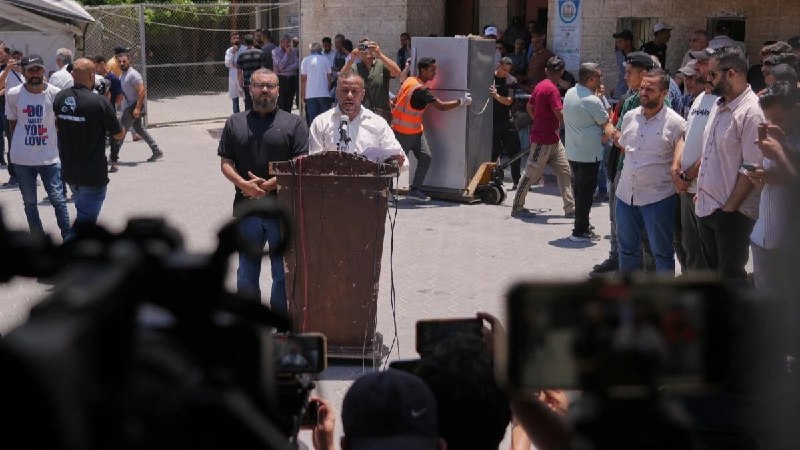
Hamas announced on 6 July 2026 that it had formally dissolved the administrative body that has run the Gaza Strip since 2007, clearing the legal and political ground for a US-backed technocratic committee to assume civilian governance of the territory. According to Middle East Eye, the move ends nearly two decades of Hamas-led administration in Gaza and is intended to facilitate the entry of an outside committee tasked with running day-to-day affairs during the post-war transition. The Cradle Media reported on the same day that the technocratic committee is composed of figures associated with the Palestinian Authority, and that Israel has so far refused to allow those figures to enter the strip.
The dissolution is the most consequential institutional concession Hamas has made since 7 October 2023. It does not, on its own, transfer power: the technocratic body still needs physical access to Gaza, Israeli clearance to operate, and a donor pipeline to fund salaries and reconstruction. None of those conditions are met. What has changed is that Hamas has removed the principal legal obstacle it controlled — its own governing committee — and has publicly called on the international community to press Israel to admit the new arrangement.
What Hamas actually dissolved
Middle East Eye's 6 July 2026 report describes the step as the dissolution of the body "that has governed the Gaza Strip for nearly two decades," a reference to the Hamas administrative committee established after the 2007 takeover of the territory. The announcement came on a Monday, was framed by Hamas as a goodwill measure, and was paired with an explicit request that the technocratic committee be allowed to enter "swiftly," according to The Cradle Media. The Cradle's reporting frames the move as part of a wider ceasefire and post-war governance track in which Hamas is ceding administrative authority in exchange for a cessation of hostilities and a humanitarian opening of the strip.
The substance of the announcement is narrower than the headline suggests. Hamas has not disarmed, has not relinquished its security formations, and has not altered its political posture toward the Palestinian Authority. What it has done is vacate the civil-administrative slot — ministries, payroll, municipal services, public-sector employment — for a third-party body to occupy. That distinction matters because it determines who runs hospitals, schools, and tax collection in Gaza from this point forward, and who is held accountable when those services fail.
The committee Israel refuses to admit
The Cradle Media reported that Israel has blocked the technocratic committee from entering Gaza over its ties to the Palestinian Authority. The framing inside Israel, as relayed by The Cradle, is that any body staffed by PA-linked figures is unacceptable because the PA remains, in the Israeli assessment, compromised by its security cooperation record and by the legacy of its post-Oslo governance of the West Bank. Jerusalem's reported position is that allowing PA-affiliated administrators back into Gaza would amount to a strategic reversal without the disarmament, deradicalisation, and security-control guarantees that Israel insists must precede any such step.
The result is a procedural standoff with operational consequences. A civilian committee with no physical presence in Gaza cannot run a civilian administration. Reconstruction funding, donor pledges, and the lifting of access restrictions all flow through the committee in the technocratic arrangement as currently designed. By blocking entry, Israel effectively freezes the transition at the moment Hamas has unlocked its side of it. The political cost of that freeze accrues to the Palestinian civilian population in Gaza, which continues to live under wartime conditions without a functioning administrative interlocutor.
A wider ceasefire track?
The Cradle Media report situates the dissolution inside a broader sequence that includes a reported Israeli plan to fully resume hostilities. The implication is that the technocratic handover is one element of a wider package — a sequence that would normally include a ceasefire, prisoner exchanges, humanitarian access, and a reconstruction funding mechanism — and that the Israeli decision to block the committee's entry is being read in Cairo and Doha as a signal that Israel is not yet prepared to lock in the civilian-governance component even as it leaves the door open to other elements of the package. The sources do not specify the precise state of those negotiations on 6 July 2026; what is documented is that Hamas has done its part procedurally and that the technocratic committee is, in the language of The Cradle, waiting.
What this confirms structurally is that the post-war order in Gaza is not being designed as a single negotiated settlement but as a series of sequenced, reversible moves. Each party commits to one component while reserving judgment on the rest. The risk is that the sequence stalls in the middle — that Hamas is seen to have conceded without the concessions it was promised in return, and that the population of Gaza is left in a legal and administrative limbo that no single authority owns.
Stakes and the road ahead
If the technocratic committee eventually enters and operates, the short-term winners are Gaza's civilian population, which gains a functioning administrative interlocutor, and the donor governments, which gain a legal entity to channel reconstruction funds through. The medium-term winner is the Palestinian Authority, which is restored to a governance role in Gaza for the first time since 2007 without having to negotiate that role with Hamas directly. The loser, in any version of this scenario, is Hamas, which exits the administrative space it has occupied for nineteen years without a guarantee that its security and political standing will be preserved in whatever governing arrangement follows.
If the committee is not admitted, the reverse holds: Hamas retains de facto administrative responsibility without the legal authority to discharge it, Israel is accused of sabotaging the civilian track while pressing the security track, and the reconstruction and humanitarian pipeline remains blocked. The Cradle Media's reporting on 6 July suggests this second outcome is, at least for now, the operative one. The sources do not specify when — or whether — the Israeli position will change.
The most honest reading of the moment is that 6 July 2026 is not a turning point but an opening bid. Hamas has conceded the procedural piece it controlled. The harder concessions — security arrangements in Gaza, the future of armed factions, the political relationship between Gaza and the West Bank, the legal status of the territory itself — remain unresolved, and the technocratic committee is, at this point, less a government in waiting than a marker of how much further the parties still have to travel.
Desk note: Monexus framed this as a procedural milestone inside a stalled negotiation, not as a definitive transfer of power. Wire coverage on the day emphasised the symbolic weight of the Hamas announcement; the operational reality is that the committee Israel has refused to admit cannot govern a strip it cannot enter.
Wire provenance
This editorial synthesis draws on the following public wire/social posts:
- https://t.me/thecradlemedia
- https://t.me/TheCradleMedia