Hamas dissolves its Gaza administration, and the technocrat fix gets stuck at the border
Hamas has stepped aside in Gaza. The US-backed committee meant to replace it is sitting at the gate, blocked by Israel, while a wider Israeli military operation is reportedly being readied.
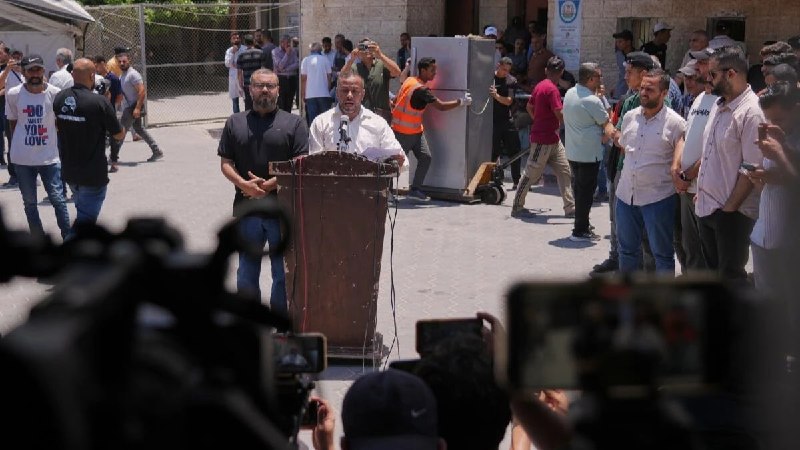
On 6 July 2026, Hamas announced it was dissolving the administrative government it has run inside Gaza since 2017 and called for the "swift entry" of a US-backed technocratic committee to take its place. The committee, designed in talks mediated by Qatar, Egypt and the United States, has been ready to deploy for weeks. It is not yet inside the strip. Israel has refused to allow it across, citing the committee's ties to the Palestinian Authority in Ramallah, and is reportedly preparing a full resumption of major military operations in Gaza, according to regional outlets tracking the talks.
This publication reads the move as a forced concession, not a voluntary one: the strip's wartime economy is hollowed out, the leadership in Doha lacks the leverage to govern remotely, and the United States has made clear that no arrangement entrenching Hamas in office will be tolerated. The technocrat committee was meant to be the frictionless replacement. Instead it has become the most revealing argument in the war — about who is permitted to administer a population of more than two million people after the fighting stops.
The mechanics of the announcement
Hamas's statement, carried by The Cradle Media, frames the dissolution as an opening to the committee and to further negotiations under the existing ceasefire framework. The Indian Express summarised the same sequence on the same day and asked the operative question: what happens next. The committee is staffed by technocrats nominally independent of both Hamas and Fatah, with names brokered in Doha and Cairo. The United States has publicly backed the arrangement as a way to keep the Palestinian Authority from re-entering Gaza under its own flag while still putting a non-Hamas administration on the ground.
Israel's objection is narrow but absolute. Senior officials have framed the committee as a Palestinian Authority front, arguing that accepting it is functionally equivalent to allowing Ramallah back into Gaza. That objection is structural rather than personal: it cuts across the current coalition in Jerusalem, where the governing majority remains unwilling to be seen empowering the same Palestinian leadership that pays stipends to the families of attackers.
The counter-narrative from the ground
Reporting from regional outlets presents a less tidy picture. Local Palestinian voices tracked by The Cradle describe a humanitarian emergency that no committee, however composed, can paper over: housing destroyed at scale, medical infrastructure operating as a fraction of pre-war capacity, and a population that has run out of patience with declarations issued from hotel rooms in Doha or press rooms in Ramallah. The technocratic committee, in this telling, is the international community's preferred fig leaf, not a Palestinian demand.
A second reading, harder to confirm but consistent with the reporting, is that Israel is using the committee as a low-cost veto. Blocking entry costs nothing diplomatically, because Washington has already signalled it will not push the issue to a breaking point with the current Israeli government. The cost is borne inside Gaza. If a major military operation is readied in parallel, as the same reporting suggests, the technocrat fix is being held in reserve as a future brand rather than deployed as a present instrument.
The structural frame, in plain language
What we are watching is the gap between two doctrines of post-war order. One, pushed by the United States and the Arab mediators, treats governance as separable from political resolution: a competent administration can be parachuted in, deliver services, and defer questions of statehood, elections and sovereignty. The other, embedded in Israeli coalition politics, treats governance as inseparable from political recognition: any administration that includes even indirect PA involvement is read as a first step toward a Palestinian state, and is therefore blocked.
That gap is not new. It has shaped every ceasefire framework since 2008. What is new is that the actors most affected — the population of Gaza — have less voice in the design of each arrangement than at any point in the past two decades. The committee's entry is being negotiated between four capitals that are not Gaza, Doha, Cairo, Washington and Jerusalem, and a fifth in Ramallah whose writ the committee would carry without its flag.
The stakes, plainly named
If the committee enters and operates at scale, the strip gets a functioning administration, the mediators get a deliverable for the ceasefire track, and Hamas is reduced to a militia without a government. If the committee is kept out and a wider operation is resumed, the civilian toll compounds, the hostage file reopens, and the post-war architecture collapses back to a humanitarian patch held together by aid convoys and Egyptian mediation.
The narrower political stakes are equally stark. A successful technocratic deployment would be the first credible demonstration that the Palestinian Authority can govern outside its own territory without triggering an Israeli veto. A blocked committee, by contrast, hardens the position of those inside the Israeli coalition who argue that no Palestinian partner exists, and strengthens the case against any wider political track in the coming negotiating window.
What remains uncertain
Two points are contested in the reporting and should be flagged. First, the precise scope of the Israeli military planning: regional outlets speak of a "full resumption" of operations, but the framing, language and operational specifics have not been independently confirmed by Israeli official sources in the inputs available to this article. Second, the durability of Hamas's announced dissolution: a leadership decision issued under wartime pressure is not the same as an organisational one, and past cycles of ceasefire and collapse suggest that the movement retains capacity to reconstitute administrative functions in parts of the strip if the political ground shifts.
For now, the line that matters most is at the crossing. The committee is ready. The crossing is closed. The strip waits.
Desk note: The wire cycle on 6 July 2026 has been dominated by the Hamas announcement and the stillborn committee. Monexus has foregrounded the gap between the announcement and the operational reality on the ground, and avoided both the framework of unconditional celebration and the framework of moral equivalence between a besieged civilian population and the governments negotiating over its head.
Wire provenance
This editorial synthesis draws on the following public wire/social posts:
- https://t.me/thecradlemedia
- https://t.me/TheCradleMedia