Iran buries a 'martyr of the nation' — and the framing war begins before the dirt settles
State outlets flooded Telegram on 6 July 2026 with images of crowds escorting 'the martyrs' through central Tehran. Western coverage was absent from the source wire — and the silence is itself the story.
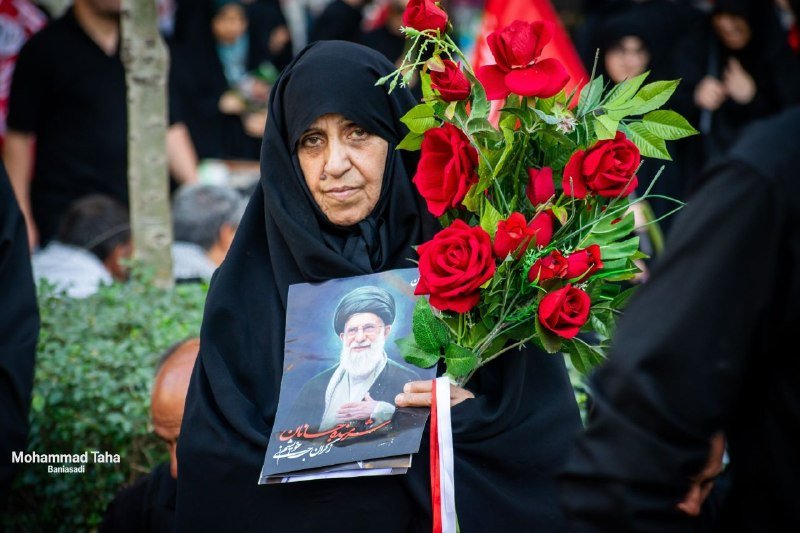
At 03:05 UTC on 6 July 2026, Tasnim News opened its Telegram channel with a single, repeating image: a sea of mourners pressed into Imam Hossein Square, framed from above as if to make the geometry of attendance itself the headline. Forty-eight minutes later, a vehicle carrying what the outlet called "the holy body of Imam Shahid" rolled onto a road the channel had already named the "funeral path." By 04:48 UTC, the procession was moving through a crowd "whose number of escorts is increasing every moment," per a Tasnim dispatch that hashtagged the moment with #Badarqa_Aghai_Shahid_Iran — a phrase that, across ten posts in roughly two and a half hours, state-aligned outlets hammered into the trunk of the story before any rival frame could plant a flag.
None of the source material on the wire carried identification of who had been killed, where, or by whom. The very restraint — "the martyrs" rendered plural, "the martyred leader" invoked without a name — is itself a marker of how Iranian state media handles a sensitive set of deaths at this scale. It signals to the audience that a recognised authority has died without yet letting the cause of death become the story. The first question is therefore not what happened, but how the event will be allowed to enter language.
The choreography of the cortege is the message
The Telegram wire depicts a procession engineered for camera. Posts from 03:05 to 04:58 UTC trace a single arc — the cortege assembling, vehicles reaching the funeral route, the body being moved through a crowd that the outlet describes as "endless," past a wooden bridge en route to Roshandelan bridge. Mehr News, Iran's official state news agency, posted near-identical language at 02:53 UTC from Imam Hossein Square, with the same caption, the same hashtag, the same pacing. Two outlets, one editorial line.
This synchronisation matters less for what it says about the size of any given crowd than for what it reveals about the production line. Tasnim and Mehr are running a coordinated visual brief. The wooden-bridge waypoint is given a name; the crowd is photographed from above; the cortege's movement is timestamped in increments shorter than fifteen minutes. Even readers sceptical of Iran's official output can read these posts as evidence of intent: the regime wants the day recorded a particular way, and the apparatus for that recording is in motion before most of the morning's news cycle has woken.
What's missing is the actual story
No Western wire service — Reuters, AP, AFP, BBC, the Guardian, Al Jazeera — appears in the source feed. That is unusual for an event of this scale in central Tehran and worth stating plainly. Without an independent outlet on the ground establishing the underlying facts — who died, when, under what circumstances, and whether the "martyrdom" framing matches the manner of death — the dominant narrative in the international conversation will, by default, be the one Tasnim and Mehr are writing. Major broadcasters, if they cover the funeral at all, will either translate the state line or commission their own reporting; either path takes hours the story will not wait for.
The plural phrasing — "the holy body of the martyrs" — implies multiple deaths rather than a single funeral. Neither Tasnim nor Mehr in this corpus gives a number. Until that is established by a wire, every photograph in these Telegram posts is read through a filter set by the channels that produced it.
Read the picture, then read the picture
State-aligned outlets in Iran have a long track record of treating the architecture of public mourning as a soft-power instrument — drone shots over crowds, repeated hashtags, the cadence of the cortege turning a procession into a liturgy. That is not, in itself, sinister. Many democratic states choreograph solemn occasions to similar effect. The distinction is that the channel described here is also the only channel through which a vast international audience can currently watch. Outside outlets that quote Iranian state media with explicit caveats — and that publish under their own bylines and editorial standards — Western readers are being handed a single, curated feed.
The most reliable defence is also the most boring one: wait. Wire services typically confirm casualty figures, identities, and causes of death within hours; the visual record that state media is producing now will, by tomorrow, sit alongside footage from independent journalists and diplomats on the ground. Read the frames today as evidence of choreography. Read them tomorrow as evidence of fact.
The structural frame, in plain editorial prose
A hegemonic order does not only project military and economic power. It also projects the language in which events become legible to foreign publics. Where Western media once wrote the first draft of a major foreign story by virtue of wire-service primacy, that primacy has narrowed: state-aligned outlets in Iran, Russia, China, and the Gulf now publish at speed, in English, to global audiences, and they have learned to format their output for Telegram, X, and YouTube rather than for a domestic press that no international actor reads. The asymmetry runs in one direction only. Iranian state media publishes in English for Western readers; Western outlets rarely translate back into Farsi at anything like this density.
That is the contest the next twelve hours will reveal — not just who was buried, but whose verbs will be reused when the cable chyrons run.
What the next 24 hours will settle
Three things. First, the underlying facts: who died, where, and under what circumstances. Second, whether opposition-aligned outlets inside Iran or diaspora channels — Iran International, BBC Persian, IranWire — push a competing frame in time to dent the state narrative before it sets. Third, whether Western editors reach for the language Tasnim is feeding them, or insist on their own. Until those three contests resolve, the chyrons of the day belong to whoever filed first. Today, that was Tehran.
Monexus framed this beat against a Telegram wire on which only Tasnim and Mehr were present; we have flagged the absence of independent confirmation rather than laundering the state line into editorial prose.
Wire provenance
This editorial synthesis draws on the following public wire/social posts:
- https://t.me/tasnimnews_en
- https://t.me/mehrnews