Iran buries Khamenei in Tehran as Tabriz holds parallel ceremony
Ayatollah Ali Khamenei's funeral procession and burial took place in Tehran on 6 July 2026, with a parallel commemoration in Tabriz. The unanswered question is what the transition makes possible — and who decides.
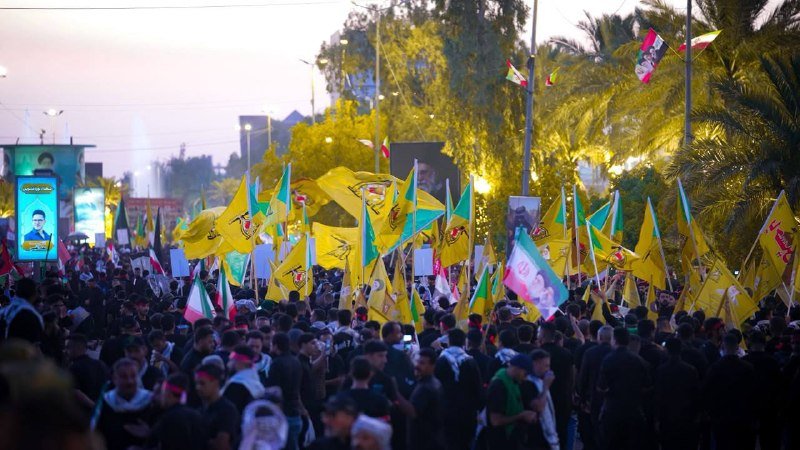
The body of Ayatollah Ali Khamenei, Iran's Supreme Leader since 1989, was laid to rest in Tehran on Monday 6 July 2026, after a funeral procession that Iranian state-linked channels broadcast live and from the air. A parallel commemoration ceremony convened simultaneously in Tabriz, the Azeri-speaking metropolis in the north-west that Khamenei himself was born near. The dual staging — capital burial, provincial mirror — tells you what the Islamic Republic wants the world to see: national unity at the moment of transfer, with provincial weight visibly attached to the central rite.
What neither the procession nor the parallel ceremony can answer, on the evidence available today, is who now holds the levers. That is the question that will define the next news cycle, the next sanctions round and the next set of regional calculations, and it is not answered by any of the footage released so far.
The ceremony as choreography
The Tehran procession, captured from the air by state-aligned outlets, moved through the capital under the standard registers of a senior Islamic Republic funeral: banners, religious elegies, crowd footage, controlled access to the bier. Iranian state-aligned Telegram channels — including the official Khamenei.ir channel and the English-language Khamenei_in account — used identical language of "martyr" ("شهید" / "Martyr Rahbar") to frame the deceased, a designation that ties him into the same symbolic register used for Iranian military dead from the Iran-Iraq war and the wider regional axis. The Mehr News channel, an outlet affiliated with state broadcasting, carried matching video from Tabriz.
The choreography matters because the "martyr" framing is not adjectival colour in the Islamic Republic; it carries institutional weight. It locates Khamenei within a continuity of sacred loss shared by the Islamic Revolution Guard Corps, the basij volunteer force, and the wider network of regional allies that Iran has built since 1979. Read literally, it says: the succession is not a routine administrative handover, it is a wound that the system absorbs.
The Tabriz mirror
Holding a parallel commemoration in Tabriz at the same hour as the Tehran burial is the more revealing of the two decisions. Khamenei was born in 1939 in the city of Mashhad, but he spent formative years in Tabriz and rose through the Azeri-speaking clerical networks of the north-west — the same networks that produced many of the Islamic Republic's early state-builders. Putting a Tabriz ceremony on screen at the burial hour is a signal to those networks that they are visible inside the rite of passage.
It is also a signal to everyone who watches Iranian politics from the outside. A leadership transition in the Islamic Republic is decided, in the first instance, by the Assembly of Experts — a body of senior clerics whose meetings are not public, whose deliberations are not televised, and whose final vote is announced only as a fait accompli. The Tabriz ceremony is one of the few visible levers the outgoing system can pull to indicate which factional balance it would prefer the Assembly to ratify. The choice to give Azeri clerics a parallel stage is a reading of that balance; readers should treat it as soft evidence, not as a forecast.
What the sources do not say
The state-aligned Telegram channels that surfaced the imagery on 6 July 2026 are operating inside the Iranian information system; they are reliable witnesses to what was shown and where, but they are not neutral witnesses to what it means. The thread of coverage available at time of writing does not name a successor, does not disclose the Assembly of Experts' sitting calendar, and does not specify how Iran's regional partners — the axis from Beirut through Baghdad to Sanaa — were formally notified. The most consequential questions of the day are, in other words, exactly the ones the visible footage was engineered to step around.
There is also a Western wire-frame question worth flagging plainly. Mainstream international coverage of Iranian leadership transitions has historically run on three beats: who inherits the security portfolio, who controls the bargaining posture in any renewed nuclear-file diplomacy, and whether the succession opens or closes space for domestic protest movements. None of these beats can be answered from the ceremony footage alone. They require sourcing from inside the Assembly of Experts, from the intelligence services of Iran's Gulf neighbours, and from the network of Iranian diplomats who — historically — begin to signal through back-channels before anything is said publicly. That sourcing does not exist in the thread of state-aligned imagery on which this article is built.
Stakes over the next 30 days
Three pressure points will be tested quickly. First, the question of formal succession inside the Assembly of Experts — a body whose deliberations are opaque and whose outcome will determine whether the system produces a Khamenei-shaped continuity figure, a more overtly security-state candidate, or a compromise candidate acceptable to the clerical networks symbolically honoured in Tabriz on Monday. Second, the question of nuclear-file diplomacy: any administration in Washington, Brussels or the Gulf states dealing with Tehran after 6 July 2026 will need to know whether the bargaining posture inherited by the new Supreme Leader is identical to the one Khamenei carried, and that answer will not arrive in a single announcement. Third, the question of regional escalation risk — through the Lebanese Hezbollah front, through Iraqi Shia militias, and through the Houthi axis in Yemen — where local commanders have historically been given latitude at moments of Iranian internal transition. None of these questions is resolved by the funeral. All of them are now in play.
For readers, the discipline is to resist the temptation to read the pageantry as a forecast. The Islamic Republic has spent four decades perfecting the visual grammar of institutional continuity; what that grammar hides is precisely the matter that will decide the next phase of Iranian politics, and the next phase of Middle Eastern geopolitics along with it.
The Telegram thread under analysis here carried only Iranian state-aligned footage and captions. Monexus sourced the descriptive facts — date, location, the Tabriz parallel ceremony, the "martyr" framing — directly from those channels; the article deliberately avoids naming or forecasting a successor, since the source material does not support such a claim.
Wire provenance
This editorial synthesis draws on the following public wire/social posts:
- https://t.me/khamenei_es
- https://t.me/khamenei_in
- https://t.me/mehrnews