Iran buries a martyred leader, and the language tells you who wrote the script
The state-aligned wires choreograph a Tehran farewell with identical hashtag scripts. The choreography is the story: when the messaging is this uniform, the question is not what happened but who benefits from the framing.
Lead
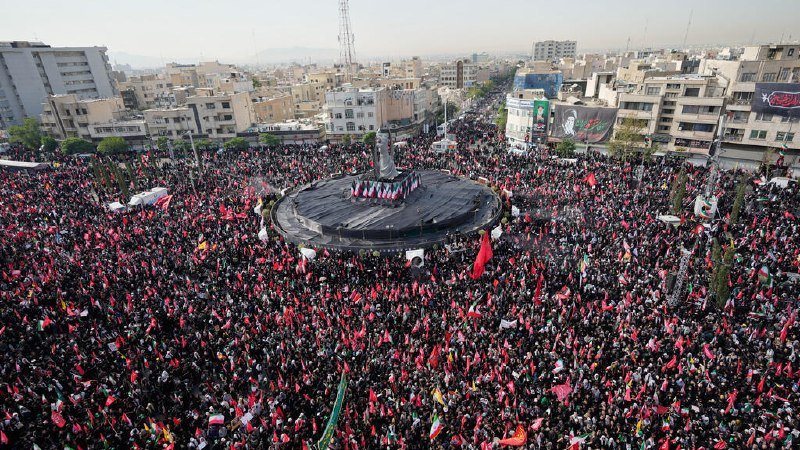
In the pre-dawn hours of 6 July 2026, the lawns around Imam Hossein Square in central Tehran filled with mourners for the state funeral of Ayatollah Ali Khamenei, the Supreme Leader of the Islamic Republic since 1989. State-aligned outlets Tasnim and Mehr, working off identical scripts, broadcast aerial footage of the crowd, video of Iran's national anthem ringing out over the square, and rolling stills of the convoy carrying the coffin. The hashtags were uniform across both feeds: #Badarqa_Aghai_Shahid_Iran, #must_rise. The choreography — the order of broadcast, the framing, the rallying call — points to a tightly centralised messaging operation, not a spontaneous outpouring of grief.
Nut graf
Tehran's foreign critics will read these images and dismiss them as performance. Tehran's domestic audience will read them and not need to be told what they symbolise. Somewhere between those two readings sits the actual news: in a country where the state wires, the opposition diaspora, and the Western press each carry their own version of events, the funeral footage is best understood as a propaganda artifact in the literal sense — material produced by a regime to confirm a story to itself and to its adversaries at the same time.
What the footage actually shows
The earliest items in the feed, time-stamped 02:53 and 03:05 UTC on 6 July 2026, depict the opening moments of the burial ceremony at Imam Hossein Square, with both Mehr and Tasnim emphasising the size of the gathering through identical descriptive phrasing. By 03:29 UTC, Iran's national anthem was being broadcast; the square was full. By 03:32 UTC, a sustained crowd was waiting for the arrival of the coffins, Tasnim reported, with Mehr carrying the same line in telegram thumbnail form. By 04:00 UTC, aerial imagery was being filed. By 04:10 and 04:11 UTC, both outlets were publishing images of the convoy vehicle being prepared, with Mehr linking back to its own website and Tasnim carrying stills on its channel. By 05:04 UTC, the convoy was moving through the streets of Tehran, flanked by chants of "Labik ya Hossein" — the Shia devotional cry that doubles, in Iranian political liturgy, as a loyalty oath to the supreme leader. By 05:12 UTC, the framing was complete: mourners offering a "historic farewell to a leader whose name will remain in the memory of this land forever."
The machinery behind the picture
What is striking is not the funeral itself — Iran has buried heads of state before, and large turnouts at state funerals are a feature of most political systems with serious public ritual. What is striking is the discipline. Two outlets, working through different Telegram channels and different owners, filed near-identical captions, in English, in the same sequence, with the same hashtags. The shared linguistic register — "the holy body of the Martyr of the Revolution," "the martyred leader of the Islamic Revolution," "Imam Martyr" — is not the vocabulary of reporters watching from a hotel rooftop. It is the vocabulary of a newsroom operating under instruction, producing material whose purpose is to be quotable internationally, not just domestically. The English-language packaging in particular is engineered for foreign wire readers, diaspora audiences, and adversaries who consume the feed for intelligence purposes.
The structural pattern here is familiar: the same actors who run the political succession run the language describing the political succession. There is no independent wire in Tehran producing competing copy; there is the state-aligned ecosystem and, outside it, the diaspora opposition and the Western press. Each lives in its own information economy.
What the framing is doing
The script fulfils three functions at once. Internationally, it positions Khamenei as a martyred figure rather than a politician who died in office, which grants his successor immediate sacred capital and pre-emptively criminalises dissent against the order he leaves behind. Regionally, it sends a signal to Tehran's allies and proxies — and to its rivals — that the regime's command of legitimacy in the Shia political vocabulary remains intact at a moment of maximum pressure. Domestically, the inclusive language of "the memory of this land" attempts to paper over the fractures of the last decade — the 2017 and 2019 protests, the 2022 Mahsa Amini uprising, the crackdown that followed, the succession anxieties that consumed the political class for years before this moment.
Stakes — and what we don't yet know
The immediate question is succession. Under Iran's constitution, Khamenei is succeeded by the Assembly of Experts; in practice, the procedure has been opaque for years, and the funeral coverage is the regime's first opportunity to demonstrate continuity rather than contestation. The medium-term question is whether the new leadership can hold the same authority that produced the choreography above — authority that depends less on the size of any single crowd than on the apparatus that assembled them, broadcast them, and narrated them to the world in unison. Western coverage will treat the funeral as backdrop. Iranian state media will treat it as proof. The honest read sits between them: a state performing its own legitimacy with a rigour that should not be confused with evidence of legitimacy, and that should not be dismissed as theatre either. The sources available here do not specify the precise circumstances of the leader's death, the membership of any new leadership council, or the identity of senior officials present at the square — those facts will need to be confirmed against independent reporting as it emerges. Until then, the safest conclusion is also the most uncomfortable: the footage is real, the language is coordinated, and the gap between those two facts is where Iranian politics now lives.
Wire provenance
This editorial synthesis draws on the following public wire/social posts:
- https://t.me/tasnimnews_en/26231
- https://t.me/tasnimnews_en/26229
- https://t.me/tasnimnews_en/26232
- https://t.me/tasnimnews_en/26233
- https://t.me/tasnimnews_en/26234
- https://t.me/mehrnews/29470
- https://t.me/tasnimnews_en/26235
- https://t.me/tasnimnews_en/26236
- https://t.me/tasnimnews_en/26237