Tehran stages a martyr's funeral and asks the world to watch
Crowds are converging on Qom for the funeral of a cleric the Islamic Republic calls Imam Shahid. The choreography is political as much as devotional — and the cameras are angled at the audience the regime most wants to reach.
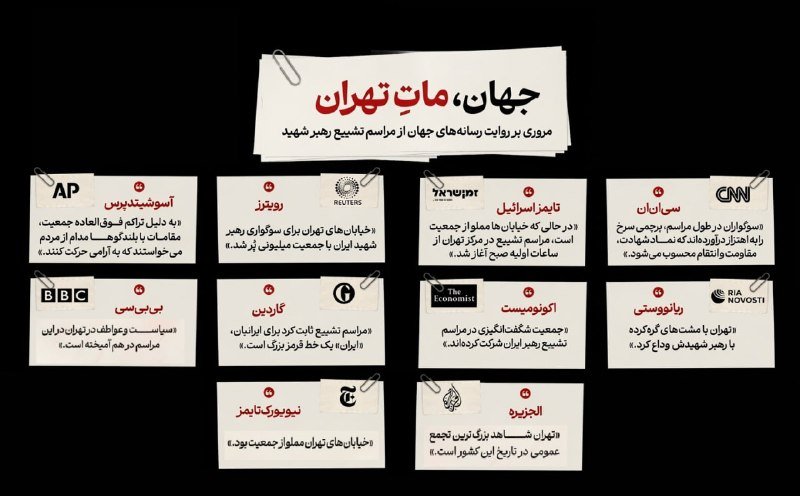
At 18:55 UTC on 6 July 2026, the English-language feed of Iran's Tasnim News Agency reported that mourners had begun a seven-kilometre walk from central Qom to the Jamkaran Holy Mosque, on the eve of what the agency described as the funeral prayer for "Imam Shahid" and the martyrs of his family. By 19:42 UTC, Tasnim had circulated video of the gathering inside the mosque itself. Mehr News, the state-affiliated outlet that functions as something closer to an official wire than a news channel, ran the same footage a few minutes earlier in its own stream. The choreography is devotional on the surface, and political underneath, and the difference matters.
This publication is not in a position to verify the identity, lineage, or family circumstances of the cleric the agency has labelled "Imam Shahid." The English-language state feed has not, in the items reviewed, published a single clarifying line on who he was, where he died, or how. What the feed has done with discipline is frame him as a "Martyr of the Revolution" — a phrase that slots him into a category the Islamic Republic reserves for figures whose deaths are treated as state-bearing sacrifices rather than private bereavements. The funeral, in other words, is being staged as a national act.
The visual grammar of a martyr's farewell
Iranian state media have spent the past 36 hours converting Qom into a set. Mehr's and Tasnim's Telegram channels are running parallel feeds: mourners on the road, mourners inside the shrine complex, mourners in tight close-up with the face softened by grief and the green and black of clerical mourning behind them. The composition is deliberate. The walk is long enough to be visible from the air and short enough that ordinary pilgrims — not professional marchers — can complete it. The setting, the Jamkaran Holy Mosque, is a major Shia devotional site on the edge of Qom, traditionally associated with the Twelfth Imam and with political-messianic expectation. Both outlets are careful to keep the camera on the size of the crowd and on individual emotion, in roughly equal measure. Western wire services, by contrast, are not visibly present in the feeds being aggregated here; the sourcing pipeline that brought this story to Monexus is, for the moment, Iranian state media.
This is the part of the story where the framing lives or dies. Iranian state outlets are primary documents, not neutral ones — they are how the Islamic Republic tells its own story to its own public, and the angle is always intentional. But treating their feeds as unusable would also be a choice, and a worse one: it would mean discarding the most detailed visual evidence of what is happening inside the country at a moment when the country is the story.
The unstated counter-narrative
The headline phrase being repeated across feeds — "Imam Shahid," "Martyr of the Revolution," "lovers of the Martyr Imam Mujahid" — does three things at once. It removes the cleric from ordinary clerical status and lifts him into the martyrology that the Islamic Republic uses to legitimise power at moments of internal strain. It binds the mourning public to the state by giving them a category of grief the state alone can officially recognise. And it leaves open the question of who killed him, how, and why — a question the state is choosing not to answer in these feeds, which is itself an editorial choice worth naming.
The counter-narrative is the silence. Independent reporting on Iranian domestic politics inside Iran is constrained in ways that do not need to be belaboured here. Telegram channels operating in Farsi have, in past cycles, become the venue where gaps in the state version surface — claims that an incident was an assassination rather than an accident, claims about factions inside the security services, claims about succession. None of that is visible in the items reviewed for this piece. Monexus is reporting what is being shown, with the caveat that what is being shown is one state's curated version of events that almost certainly have an unstated remainder.
What the staging buys the regime
A funeral of this kind performs three political functions simultaneously. Internally, it gives the clerical establishment a martyr without obliging it to specify the cause of death in a way that would be falsifiable — a useful posture in a year when the Islamic Republic has been absorbing drone-and-proxy pressure across the region and absorbing, in some quarters, public questioning at home. Regionally, it puts the messianic-symbolic vocabulary the regime has spent forty years building back on screen at a moment of soft power competition in the Shia crescent, where Iran, Iraq, and Lebanon all run competing dramaturgies of mourning. Internationally, it generates English-language copy of the kind Western wire desks have to decide whether to relay — and the act of relaying is, in itself, an asset to a state that wants its categories on the global page.
The structural shift under way is straightforward. Public diplomacy conducted through state-controlled Telegram feeds is now doing the load-bearing work that embassies, IRNA, and PressTV used to do jointly. The English-language Tasnim channel is being treated by Iran's information apparatus as primary, not secondary — a sign that the regime's communications infrastructure has consolidated around a smaller number of higher-volume outlets, with multimedia distributed across Telegram, X, and YouTube as one integrated product rather than three separate channels.
What to watch over the next 72 hours
The next moves are predictable in shape, if not in content. A speech by senior establishment figures at the funeral itself, almost certainly carried live by Mehr and Tasnim. A round of commemorative coverage across state TV that will keep the face of the cleric on screen for days. And — this is the meaningful variable — either the release of official details about the circumstances of his death, or a sustained refusal to release them, which itself becomes the story. Monexus will track the Farsi-language and Telegram feeds as well as the English-language ones; the asymmetry between them is where this story will either clarify or harden into something the state prefers to leave vague.
The remaining uncertainty is real. The sources being read here are a closed set: two Iranian state outlets operating in a tightly managed mode. They are not lying about the size of the crowd in Qom — the visuals are credible on their face. But they are also not volunteering the information that a reader in London, Washington, or Riyadh most needs to make sense of who is being mourned and at whose order. Until that gap closes, this story is half-reported by design, not by accident.
Desk note: Monexus is running this story on Iranian state feeds because the Western wires reviewed have not, as of the timestamps above, picked up the Qom gathering. Where state outlets are the only source, we say so explicitly. The next edition either corroborates the cleric's identity and cause of death from independent reporting, or marks this as continuing to be a state-only frame.
Wire provenance
This editorial synthesis draws on the following public wire/social posts:
- https://t.me/mehrnews/179562
- https://t.me/tasnimnews_en/264118
- https://t.me/tasnimnews_en/264112