Iran buries Khamenei: a regime on display
Hundreds of thousands filled central Tehran on 6 July 2026 for the funeral of Ayatollah Ali Khamenei, the longest-serving leader of the Islamic Republic, in a choreographed display that doubles as a test of the post-Khamenei order.
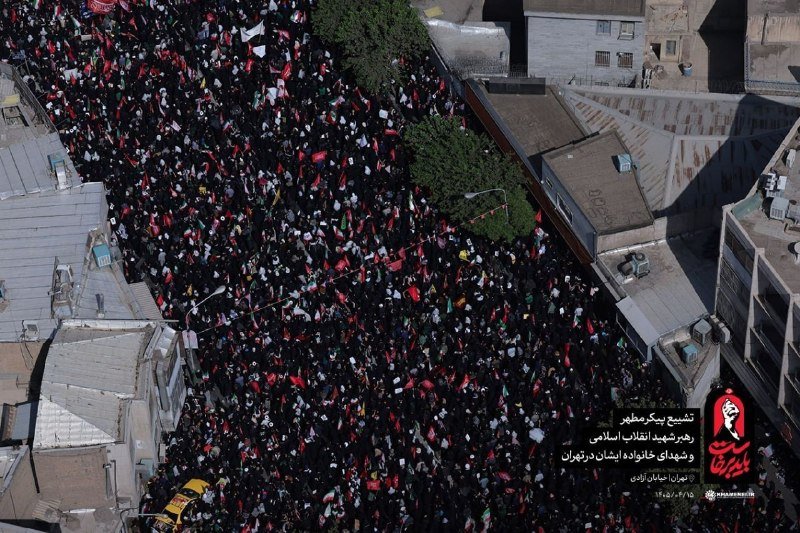
Huge crowds poured into central Tehran in the early hours of 6 July 2026 for the funeral procession of Ayatollah Ali Khamenei, who died at the age of 86 after 37 years as Supreme Leader of the Islamic Republic. State-aligned outlets broadcast images of mourners massing around the cortege carrying the coffins of the leader and members of his family, with the procession getting under way before 03:30 UTC. By 04:00 UTC, Iranian state media described attendance in the capital as reaching historic levels, framing the day as a test of national cohesion at the precise moment the post-Khamenei order begins to take shape.
The funeral is not merely a ritual. It is the first act of a transition that will decide whether the Islamic Republic survives its founder-leader's death as a unitary actor or fragments under the weight of its own contradictions. For 37 years, every major decision in Tehran — nuclear posture, regional alliances, the suppression of dissent, the management of oil revenue — passed through a single office. The next Supreme Leader will inherit that office without the personal authority that made it work.
The choreography of succession
Iranian state outlets have spent months laying the groundwork. The funeral itself is being run on a script: military escort, religious recitations, prepared communiqués, and tightly managed imagery intended to project unity across the system's rival factions. Tasnim News and Press TV carried coordinated photographs of the cortege being prepared, with the bodies of Khamenei and his family members laid out for transport to the procession site. Al-Alam Arabic broadcast footage of crowds filling the streets in the early hours, with the broadcaster describing participation as 'widespread' across multiple districts of the capital.
Behind the choreography sits a more brittle reality. The 1989 constitution places succession in the hands of the Assembly of Experts, a body of 88 clerics whose deliberations are secret and whose deliberations the public never sees. In practice, succession in Iran is a negotiated outcome among the Supreme Council of the Cultural Revolution, the Guardian Council, the IRGC command, and the office of the president — each with its own candidate, its own faction, and its own regional constituency. Khamenei himself was chosen by the Assembly of Experts in June 1989, in a vote that took less than a day.
The counter-narrative: a nation on edge
The official framing — a grieving nation united behind its leadership — sits awkwardly alongside the street reality that has shaped Iran since 2022. The September 2022 protests following the death in custody of Mahsa Amini were the largest sustained challenge to the Islamic Republic since 1979. They were suppressed by force, but the social fact of dissent was not extinguished. State-aligned coverage of the funeral does not address the gap between the official narrative of national unity and the public mood that produced those protests — a silence that itself is part of the story.
Independent verification of crowd size is not yet possible. Iranian state media has a structural incentive to overstate attendance, and satellite imagery has not, as of publication, been used by any independent outlet to produce an alternative count. The English-language Telegram channel tied to Khamenei's office (@Khamenei_en) broadcast the start of the procession at 03:06 UTC, the Arabic-language channel (@Khamenei_arabi) posted images of the cortege vehicle being prepared by 04:13 UTC, and Press TV reported at 02:54 UTC that 'millions' had begun to gather. All three outlets are state-aligned; none claims neutrality.
A structural hinge
Khamenei's death lands at a moment of acute external pressure. Iran remains under sweeping US sanctions, with periodic episodes of direct kinetic confrontation between Iranian proxies and Israeli and US forces across the region. The regime's regional axis — Hezbollah in Lebanon, the Houthi movement in Yemen, a network of Iraqi militias — has been degraded since late 2023 but not dismantled. The next Supreme Leader will be judged, both inside and outside Iran, on whether that axis is rebuilt, frozen, or quietly wound down.
Domestically, the structural problem is older. The Islamic Republic was built around a single clerical authority that fused religious legitimacy, military command, and economic patronage. That fusion is difficult to replicate. The most plausible successors — including the president's office, the judiciary, and senior IRGC commanders — each hold only a fragment of the apparatus. A collective leadership, run through a reconstituted Supreme Council or a strengthened presidency, is one option. A return to a single Supreme Leader, drawn from the hardline seminary network, is another. The funeral is the visible surface of a deeper argument that has been running inside the system for at least a decade and that will now become the operative fact of Iranian politics.
What remains uncertain
The sources do not yet specify the date of the burial, the identity of any interim leader, or the timetable for the Assembly of Experts vote. They do not provide independent confirmation of the cause of death, the names of family members reported killed alongside Khamenei, or the security posture in Iranian cities outside Tehran. State-aligned coverage in the immediate hours after a leader's death is, by design, a managed environment; the more revealing reporting will come in the days that follow, as the political economy of succession begins to surface.
For now, the funeral is doing what it was designed to do: producing an image of continuity at a moment when the underlying question — who, exactly, runs Iran next — has not yet been answered in public.
Desk note: The wire so far is dominated by Iranian state-aligned channels (Tasnim, Press TV, Al-Alam, Khamenei office feeds). Monexus will move to independent verification of crowd size, succession procedure, and regional reaction in subsequent filings; the editorial line treats the official framing as one input rather than as the lead.
Wire provenance
This editorial synthesis draws on the following public wire/social posts:
- https://t.me/presstv/101
- https://t.me/alalamarabic/100
- https://t.me/alalamarabic/101
- https://t.me/tasnimnews_en/100
- https://t.me/Khamenei_en/100
- https://t.me/Khamenei_arabi/100
- https://t.me/Khamenei_arabi/101