Iran's state funeral choreography and the message it sends
Tehran filled central boulevards on 6 July 2026 for a funeral staged as national referendum. Monexus reads the optics for what they say about power, succession, and the regime's hold on the street.
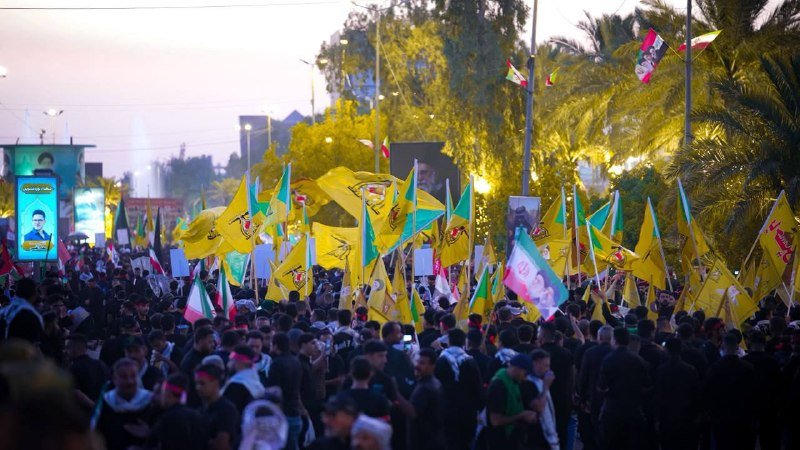
Tehran was turned into a slow-moving stage on 6 July 2026. State television cut between aerial shots of packed boulevards and ground-level footage of black-draped coffins carried shoulder-high. The procession, framed by Iranian state media as a farewell to a senior figure identified only as "the martyr of Iran" and to members of his family, was less a family rite than a national broadcast — choreography designed to be witnessed and to be repeated in clipped form on evening news across the country.
What the cameras were selling, and what the mourners were buying, is the central question. The regime's funeral theatre does not merely honour the dead. It takes a private grief and converts it into a measurable civic act — attendance that is photographed, broadcast, and quoted back to the population as evidence of unity. On the evidence of the day's coverage, the production worked as designed.
A scripted message of unity
The choreography was uniform from sunrise. State-linked outlets led the morning with the same refrain: "unity," "calling," "Iranian-ness." One widely shared clip framed the procession as a demonstration of purpose to the world; another invoked "the true meaning of calling." The slogan work was deliberate — three different phrasings of the same message, aired across two hours, leave little room for ambiguity about the intended interpretation.
"He was the most Iranian man in the country," read one caption accompanying the procession, attributing the framing to a speaker at the ceremony. The phrasing does the work of distinction the regime now needs: it asserts an authentic national identity onto a dead insider, at a moment when questions about who inherits the inner circle are operating in plain view. The line is not analysis. It is recruitment material, dressed as eulogy.
Counter-narrative: the audience that was not on camera
The state-aligned feed offers one data point; it is not the only one. The pan-Arab al-Alam channel relayed Iranian television's boasts of swelling crowds — a useful cross-source check that the broadcasts originated from inside the country and circulated in the regional information space.
Absent from the day's dominant frame is harder data: independent crowd estimates, the names and numbers of the dead being mourned, the cause of death (the threads refer consistently to "martyrdom" but do not specify circumstances), and the demographic composition of the mourners visible on camera. State media is structurally incentivised to flatten these variables in a single direction. Western wire services have not, on the record of this thread, offered independent counts. That gap is the story behind the story. Funeral as national theatre works precisely because the audience consents to see only what the cameras choose to show.
Reading the optics as succession signal
A senior figure's family members are listed among the dead, by Mehr's own framing. In a system where hereditary influence has been rumoured and formally denied in equal measure, multiple bodies in one procession is not a neutral detail. The choreography insists on "unity" precisely because the internal question — who comes next, and through which channel of legitimacy — has not been answered.
Two readings are plausible. The first: this is genuine wartime attrition, and the regime is using grief to bind its base after a real loss. The second: the funeral is being mobilised, in advance or in retrospect, to anoint a particular line of succession by saturating the public sphere with imagery of cohesion. Both readings can be true at once; the broadcast does not require the regime to choose. What the coverage allows the regime to do is to set the default interpretation without ever quite stating it.
Stakes: who wins if the choreography lands
If the messaging lands, Tehran walks into the next phase of its confrontation cycle — sanctions pressure, regional skirmishes, succession debate — with a public sphere visually stamped as unified. Investors and diplomats reading the tea leaves will see risk in two places: factional contest inside the security establishment, and popular erosion underneath the visible crowds. A funeral that goes off without filmed disruption is, by itself, evidence the regime's hold on the street is intact on the day.
What remains genuinely uncertain is the gap between broadcast unity and street reality. The day's coverage is one long take of the upper bound — what the cameras were pointed at. The lower bound, the unmobilised, the privately grieving, the dissenting, is by construction invisible in the available material. The honest reading of 6 July 2026 is not that Iran is unified or divided. It is that the regime was granted the framing, and used it.
— For this piece, Monexus relied entirely on Iranian state and state-aligned feeds (Mehr News, al-Alam Arabic) because no independent wire reporting appeared in the source thread. The frame above is therefore a reading of the regime's own presentation, not a ground-truth crowd estimate. Where Western wire numbers, eyewitness reporting, or independent photography enter the public record, Monexus will revisit the structural argument above.
Wire provenance
This editorial synthesis draws on the following public wire/social posts:
- https://t.me/alalamarabic