Israel expands ground operation in southern Lebanon as ceasefire architecture frays
An Israeli strike killed four people in southern Lebanon on 6 July 2026, the same day Israeli forces said they had taken the town of Haddatha — a dual signal that the so-called buffer zone is becoming a permanent operating area.
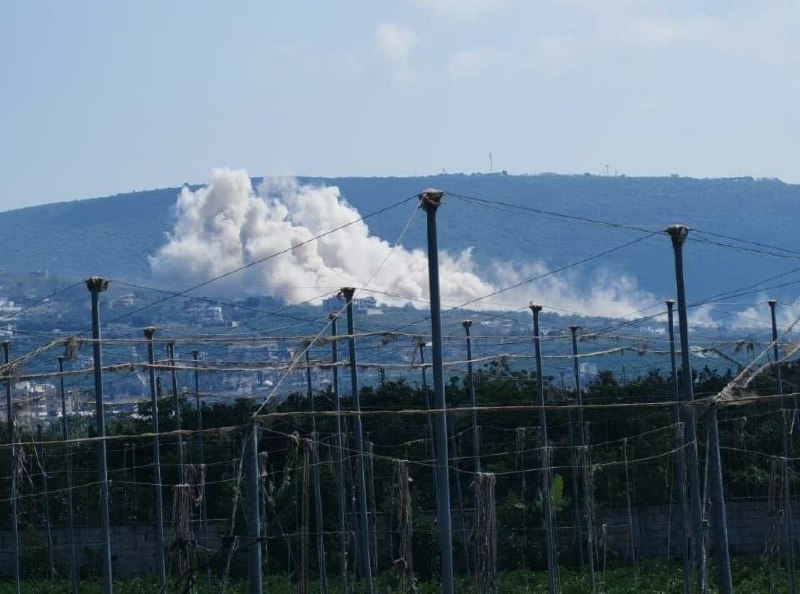
At 10:21 UTC on 6 July 2026, two regional channels carried an unusually blunt Israeli claim: that Israeli forces had established "operational control" over the southern Lebanese town of Haddatha, inside what the Israeli military has formally designated a buffer zone along the border. Roughly forty minutes later, at 10:52 UTC, an account monitored by Telegram's RNIntel feed reported four deaths in southern Lebanon following an Israeli strike. By 11:05 UTC, Lebanon's state-aligned media had confirmed the toll. The two dispatches, issued inside the same news window, are now shaping the read of a border that has been moving from episodic exchange to sustained ground operation.
The episode is small in the ledger of the wider Israeli campaign in Lebanon — a single town, a single strike, a four-person toll. It is large in what it telegraphs about the trajectory. Israel is no longer describing its posture in southern Lebanon as defensive; the language of "operational control" inside a named town is the language of occupation management. That, more than the casualty count, is the story.
A town taken, a strike recorded
The two pieces of the day arrive from different parts of the Israeli–Lebanese information ecosystem and tell different parts of the same story. Lebanon-focused outlet The Cradle reported the Israeli military's assertion that it had taken Haddatha. The framing matters: Haddatha sits inside the strip the Israeli army has, since 2024, formally called a buffer zone, but the vocabulary shifted in this reporting from "operating in" to "operational control over." The distinction is not cosmetic. The first implies patrol-and-return; the second implies garrison.
The strike followed. Within forty minutes, Telegram channels tracking the border, including RNIntel, registered four deaths in southern Lebanon following an Israeli strike. Lebanon's state media, cited by Middle East Eye's live blog, confirmed the toll. Monexus has not been able to verify the identities of the four dead, their affiliation, or the precise location of the strike from the publicly available reporting in the wire window. The two threads are correlated in time but not, on the public record, formally linked to a single tactical event; they sit inside the same operational day.
The pattern — a ground assertion followed by a strike — is consistent with how Israeli forces have described their southern Lebanon operations since the resumption of major hostilities in late 2024. It is also consistent with the long-running pattern in the north of Israel, where communities along the border have been displaced for the better part of two years. Both sides of the frontier are living with the consequences.
What the wire says, and what it leaves out
The reporting pool on 6 July is heavily weighted toward Lebanese and regional channels. Middle East Eye, a London-based outlet with deep sourcing on the Lebanese side, is the only mainstream-style reference in the wire window for the strike toll. The Cradle, a Beirut-based outlet that takes a markedly anti-Western editorial line, is the principal carrier of the Israeli "operational control" claim. Neither is a stand-in for Israeli or Western wire reporting; the Israeli military's own English-language statements on the day's specific actions were not in the wire window Monexus was working from.
That is worth naming, because it shapes the read. The Cradle's framing — "so-called designated 'buffer zone'" — encodes an editorial position: that the buffer zone is an Israeli-imposed cartographic fiction, not a legitimate security arrangement. Middle East Eye's framing is more straightforwardly reportorial: state media says strike, strike kills four. The Israeli security concern that motivates operations in southern Lebanon — rocket, drone, and anti-tank fire into northern Israeli communities by Iran-aligned armed factions — is the missing counterweight in this wire window. It exists in the broader record, and it is real, and an honest read of the day has to hold it alongside the strike toll in Haddatha's vicinity.
The structural problem is not that one side is lying. It is that the day's information environment privileges one set of sources. A reader who saw only Middle East Eye would read "four dead, Israel struck." A reader who saw only The Cradle would read "Israel is occupying." A reader who saw only Israeli press briefings, had they been in the window, would read "we are clearing a hostile zone in self-defence." All three framings are partially right, and the day's headline is the sum of them, not any one of them alone.
Why "operational control" is the word that matters
Israeli public-affairs language about southern Lebanon has gone through a slow evolution. In the early months of the ground operation, the standard formulation was "targeted raids" and "limited operations" — activity described as discrete, with implied entry and exit. The 6 July claim of "operational control" over Haddatha is qualitatively different. It is a term the Israeli military uses inside its own doctrinal literature to describe areas in which it can guarantee freedom of movement, deny adversary freedom of movement, and sustain a logistical tail. It is the kind of word that, in a different theatre, would be followed by a mayor, a checkpoint schedule, and a humanitarian-coordination cell.
If the term is being deployed precisely, the implications are serious. A town held in operational control is a town whose civil administration is, at minimum, co-administered by the Israeli army; civilian return is gated by Israeli decisions; the question of who governs Haddatha in August 2026 is an Israeli decision. If the term is being used loosely — Israeli forces inside the town, full stop — the operational story is still significant, because it points to a sustained presence rather than a raid.
The distinction matters for the ceasefire architecture that nominally governs the border. The November 2024 arrangement that paused major hostilities was, even at the time, widely understood to be a holding pattern rather than a settlement. The 6 July reporting suggests that holding pattern is fraying in two directions at once: Israeli forces are moving from the perimeter inward, and armed factions on the Lebanese side retain the capacity to draw fire that then becomes the trigger for further Israeli action. The strike that killed four on 6 July is, on the available record, exactly the kind of event the holding pattern was meant to suppress.
The pattern, the precedent, and what is not yet known
There is a longer historical pattern to read this against. Israel occupied southern Lebanon outright from 1982 to 2000, with the so-called "security zone" along the border maintained at significant Israeli military and financial cost and at the cost of Lebanese civilian life until the unilateral withdrawal in May 2000. The buffer zone that exists in 2026 is in part a response to the post-2004 cross-border posture of Hezbollah, the Iran-aligned Shia armed movement that grew out of the 1982–2000 occupation; in part a response to the rocket, drone, tunnel, and anti-tank threat that materialised from 2019 onwards. Israeli security concerns along the frontier are real and well-documented, including in Israeli and Western press reporting over the past two years. They are the reason the buffer zone exists as a concept.
What is different in 2026 is the depth of the zone and the language being used to describe it. A buffer zone is a geometry. Operational control is a relationship. The 6 July reporting is the first clear public instance, in the wire window Monexus was working from, of the Israeli military publicly claiming the second while the international system still describes the first.
The most important unknowns are also the most basic. The Israeli military has not, in the reporting available to Monexus on 6 July, published a confirmation of the Haddatha claim with the operational detail that would let outside observers verify it. The four people killed in the strike have not, in the public window, been identified by name or affiliation. The Lebanese state has not, in the public window, issued a coordinated read-out of the day's events. And the wider question — whether the day represents a tactical intensification or a strategic turn — will only become answerable after the Israeli press, the UN Interim Force in Lebanon (UNIFIL) reporting cycle, and the Lebanese Armed Forces communiqués catch up with what Telegram channels have already declared.
Desk note: Monexus framed this around the Israeli military's own language of "operational control" — a term that does most of the analytical work — rather than around the strike toll alone. The four deaths are reported; the casualties are not, in this wire window, verified to affiliation. The wire window is heavily weighted toward Lebanese and regional outlets, which is named openly. Where the Israeli security framing is missing from the available inputs, that absence is also named.
Wire provenance
This editorial synthesis draws on the following public wire/social posts:
- https://t.me/rnintel
- https://t.me/thecradlemedia