The funeral the cameras couldn't fit: Iran buries Khamenei and the question no wire wants to answer
A multi-million-strong Tehran procession on 6 July 2026 is being framed as liturgy. The harder question is what comes after a founder-generation leader dies — and whose interest it serves to keep the frame on the pavement.
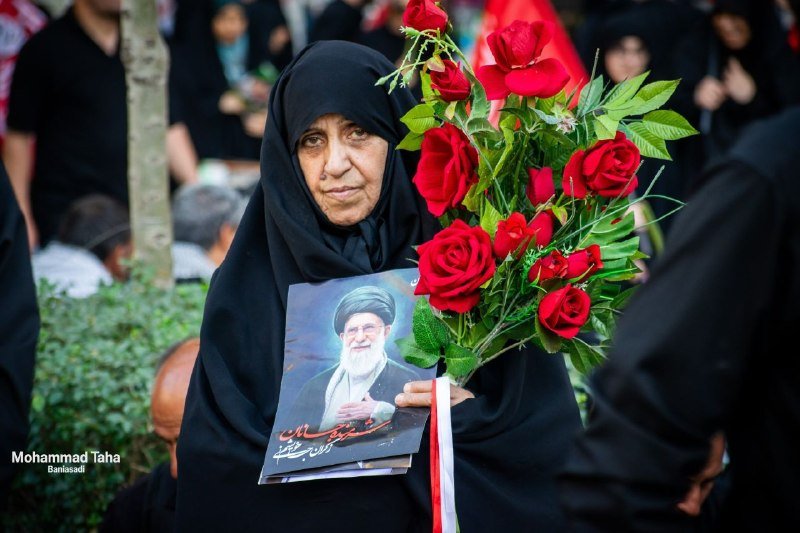
An endless sea of mourners, by every available account, swallowed the streets of central Tehran on 6 July 2026. PressTV footage carried in the late-morning European window — published at 08:45 UTC and again at 09:03 UTC, with aerial shots at 08:50 UTC — shows coffins showered with flowers and crowds dense enough that individual bodies became texture, not features. A parallel dispatch at 09:15 UTC reported Muslim communities in Sri Lanka holding prayers for the same martyred Leader, Ayatollah Seyyed Ali Khamenei, and his family members. The procession is real. The grief is real. The cameras are not lying, and the scale is not invented.
The question worth asking is why every wire serving Western newsrooms is treating a multi-million-strong, multi-continent mourning event as a story about optics, while the harder, more consequential story — what kind of power transition follows a founder-generation leader, and who inside the Islamic Republic controls its script — gets a paragraph at the bottom.
What the wire sees
The default framing inside Western editorial meetings is already telegraphed: huge crowds, religious symbolism, a moment of choreography. It is a safe frame because it keeps the camera on the cobblestones rather than on the levers being pulled behind them. PressTV, the Iranian state broadcaster that supplied the funeral feeds, has every reason to maximise the visual story; it does not need to exaggerate what is plainly visible, only to keep the lens off the negotiating rooms where Khamenei's successor will be chosen. That instinct is shared by outfits in London, Washington and Tel Aviv who would rather Tehran be read as a mass of indistinguishable believers than as a state with a narrowing set of decisions to make, fast.
What the wire is less eager to print
The structural fact under the procession is a power transition in a theocracy. Supreme Leaders do not retire; they die in office, are killed in office, or are incapacitated in office. The transitions of 1989 — Khomeini to Khamenei — and the four decades that followed offer a fairly clean template: confirmation by the Assembly of Experts, ratification by the Guardian Council, a quiet consolidation period, and a calibrated rollout. None of that is democratic in the procedural sense the word carries in Brussels or Washington; it is, however, a real institution in a real state with real regional depth, and it will produce a specific named individual with specific foreign-policy consequences. The Western press knows this. The Western press would rather you read about flowers.
The counter-frame worth steelmanning
There is a serious counter-frame, and it deserves more space than it is getting. From Iran's own vantage point, the procession is not theatre staged for foreigners — it is a sovereign nation in genuine grief, attended by Muslim communities from Sri Lanka to the Levant and beyond. A regime's grip on its own streets is not a story that requires external validation; the images, taken at face value, suggest an order with deep civic purchase. The Western instinct to flatten that into propaganda, and the structural Western interest in a pliable or weakened successor, are easy enough to spot that they should be named openly. They are also not the whole story.
The structural frame, in plain prose
What we are watching is a hegemonic transition inside one of the most consequential states in the Middle East, dressed up as liturgy. Coverage that refuses to look past the optics serves a particular interest: it lets the audience assume that Iranian politics is unreadable, opaque, or mystical, and therefore not worth a careful read. That assumption has a long Western pedigree, and it is useful to a particular kind of reader. The alternative read is plainer, slower, and ultimately more dangerous for the regimes that currently calculate on continuity: a specific succession process is underway, with a specific set of internal candidates, contested by specific institutions, and the answers will be visible inside weeks, not months.
Stakes
If the next Supreme Leader is read as a tightening of the existing line — a cleric from the establishment circle, confirmed by a Guardian Council that has spent four decades centralising its own power — the regional cost is immediate: continued material support for Hezbollah and the wider axis, a slower nuclear file, and a more cautious posture in any negotiation with Washington. If the succession cracks along the establishment-revolutionary fault line that Iranian analysts have been writing about for a decade, the file is destabilised in ways that are bullish for some Gulf capitals and bearish for others, and bearish for Israeli planners who have built short-term doctrine around the assumption of a single, predictable voice in Tehran. Either outcome is a story. The wire, today, is reporting one mood-board instead.
What remains uncertain
The sources available to this publication on 6 July 2026 do not yet specify the cause of Ayatollah Khamenei's death, the date he died, or the composition of the Assembly of Experts that will confirm his successor. They do not name a frontrunner. They do not record a statement from the Guardian Council, nor a reaction from the IRGC command. They do record, repeatedly and from a contested but not implausible broadcaster, that the funeral drew a vast, multi-continent crowd. The honest ledger is that the pageantry is documented; the politics are, for the next several days, not. Reporters outside Iran will do their readers a service by holding that line honestly rather than filling the silence with speculation.
This publication framed the procession as a power-transition event with a liturgy overlay; the wires are running the same procession as a liturgy with a power-transition footnote. The next forty-eight hours will tell which frame was right.
Wire provenance
This editorial synthesis draws on the following public wire/social posts:
- https://t.me/s/presstv
- https://t.me/s/presstv
- https://t.me/s/presstv
- https://t.me/s/presstv
- https://t.me/s/presstv